您想继续阅读英文文章还
是切换到中文?
是切换到中文?

THINK ALUMINIUM THINK AL CIRCLE

India’s exports have shrunk considerably in FY 2017 alongside a slow growth in the domestic manufacturing sector. As compared to an export target of US$900 billion by 2020, exports were less than a third at US$275 billion in the last financial year. The figure is strikingly lower than FY 2014’s US$314 billion worth exports. A prominent producer of primary aluminium in the global map, India’s non-alloyed aluminium ingot export was valued at US$ 1.89 billion (1092.5 tonnes) in FY2016-17 accounting for 0.68 per cent of the total export.
During April to July 2017, India exported 376.02 tonnes of non-alloyed aluminium ingots worth US$737.21 (0.79 per cent of the total export value of US$93.3 billion), revealed data shared by the Export Import Data Bank of India Department of Commerce, Ministry of Commerce & Industry. While the volume has increased from 226.2 tonnes, the value of export has come down from nearly US$420 billion in the corresponding period previous year.
{alcircleadd}The year-on-year non-alloyed aluminium ingot export trend of India is as follows:
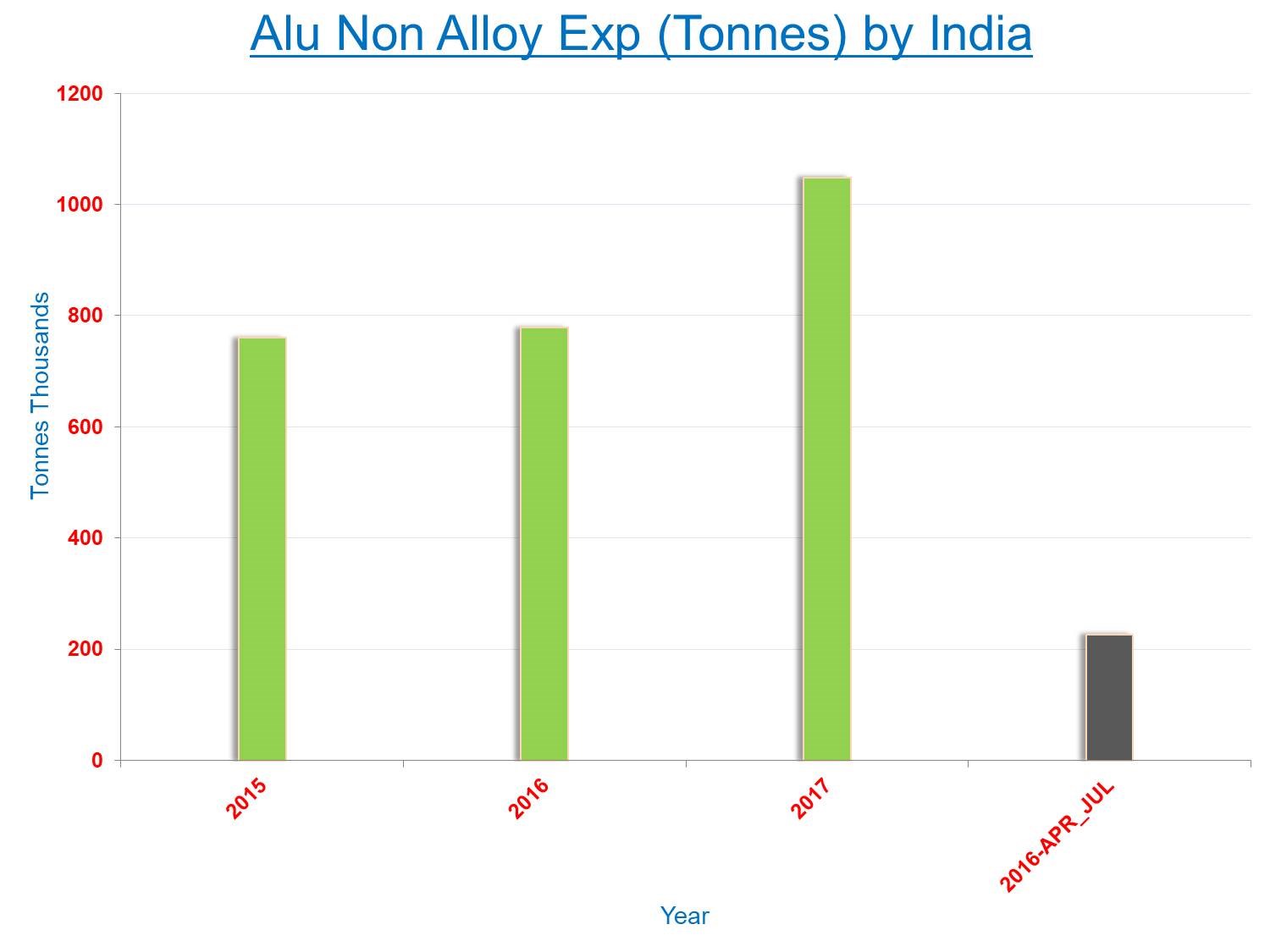
According to recent reports, overall exports from India have faltered in recent years partly due to a drop in commodity prices globally. Outbound shipments in volume terms, however, have risen steadily. Aluminium, for instance, was among the 21 commodity segments that registered growth in export volumes in 2016-17, compared to 15 in the previous fiscal.

Amid talks of stimulus for certain sectors, including trade, the government is considering adopting a two-pronged strategy to achieve higher exports growth — to promote more value-addition in goods, and to diversify the country’s services product basket to reduce traditional reliance on a few sectors, reported Financial Express.
Responses


A proud
ASI member
AL Circle Private Limited | CIN: U72200WB2017PTC221175
Registered Office: Ecospace Business Park, Block 3A, Unit 401A, New Town, Rajarhat, Kolkata, WB 700160
Corporate Office: Ecospace Business Park, Block 3A, Unit 401A, New Town, Rajarhat, Kolkata, WB 700160
© 2026 AL Circle. All rights reserved. AL Circle is not responsible for content from external sources.