Mexico’s Alumina import remains "even" during 2017-19: Projected 9.69% growth in 2020
A lack of domestic bauxite mines means Mexico can't make enough aluminium domestically to meet demand. Aluminium is the world’s second-most-used industrial metal, second only to steel. Mexico’s long-running mining tradition dates back to colonial times, and despite the historically large (and continuing) importance of the mining industry and the fact that Mexico leads in the production of several metals and minerals.
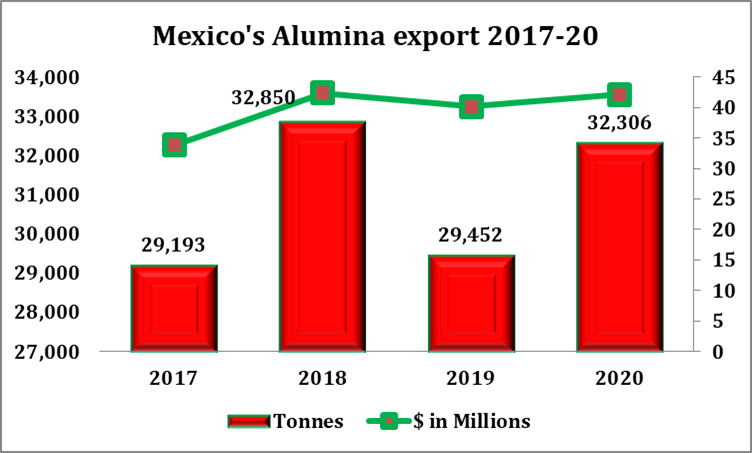
The alumina import of Mexico has remained even during 2017-19, as the total volume recorded was 91,495 tonnes and the revenue expenditure reflected was $116.42 million. The analyzed import volume for 2020 has been noted at 32,306 tonnes, while the expenditure might rise to $42.18 million. When the 2020 import volumes and revenue gets summed up with the last three years it stands at 123,801 tonnes and $158.60 million.
In 2017, Mexico’s alumina import was recorded at 29,193 tonnes, and revenue expenditure remained at $33.85 million, whereas in 2018 the import raised to 32,850 tonnes and revenue stood at $42.38 million.
The alumina importation of Mexico in 2019 saw a dip, as the volume remained at 29,452 tonnes and while the revenue expenditure also dropped to $40.19 million.

Mexico’s alumina import has been projected with a growth of 9.69% Y-o-Y, as the import volume is expected to reach at 32,306 tonnes.
The major exporting countries for Mexico’s alumina import are Belgium, Brazil, France, Germany, Hungary, Japan, Netherlands, Spain, Turkey, USA, etc.
Rusal’s Mykolaiv alumina refinery settles dispute with Ukrainian customs over bauxite supplies
Next articleAlumina price marginally higher at RMB2211/t; A00 aluminium ingot prices edge higher after two days of decline
Grow with
AL Circle