After prolonged consultations and bilateral discussions with the United States regarding the 25 per cent tariffs on aluminium and steel exports, India has officially proposed the imposition of retaliatory duties under World Trade Organization (WTO) guidelines. These countermeasures, scheduled after 30 days from the notice, could take the form of suspending concessions previously extended to the US or adjusting tariff rates on select American imports. Through these measures, India aims to recover an estimated USD 1.9 billion, an amount it would require to pay to the US government for exporting USD 7.6 billion worth of aluminium and steel products.
According to a WTO communication cited by a PTI report, "The safeguard measures would affect $7.6 billion worth of imports into the U.S. of relevant products originating in India, on which the duty collection would be $1.91 billion."
India still considers the US tariffs on aluminium and steel imports as safeguard measures, even though President Donald Trump defended them as a necessary step for protecting the weakenening domestic manufacturing base due to persistent trade deficits driven by a surge in cheap imports sold at unfairly low prices, in addition to currency manipulation and exorbitant value-added taxes imposed on US exports by other countries.
In its formal submission to the WTO, India argued that, "the measures taken by the US are not consistent with the GATT (General Agreement on Trade and Tariff) 1994 and AoS (Agreement on safeguards), adding that as consultations provided for under a provision of the AoS have not taken place, India reserves the right to suspend concessions or other obligations that are substantially equivalent to the adverse effects of the measure to India's trade.”
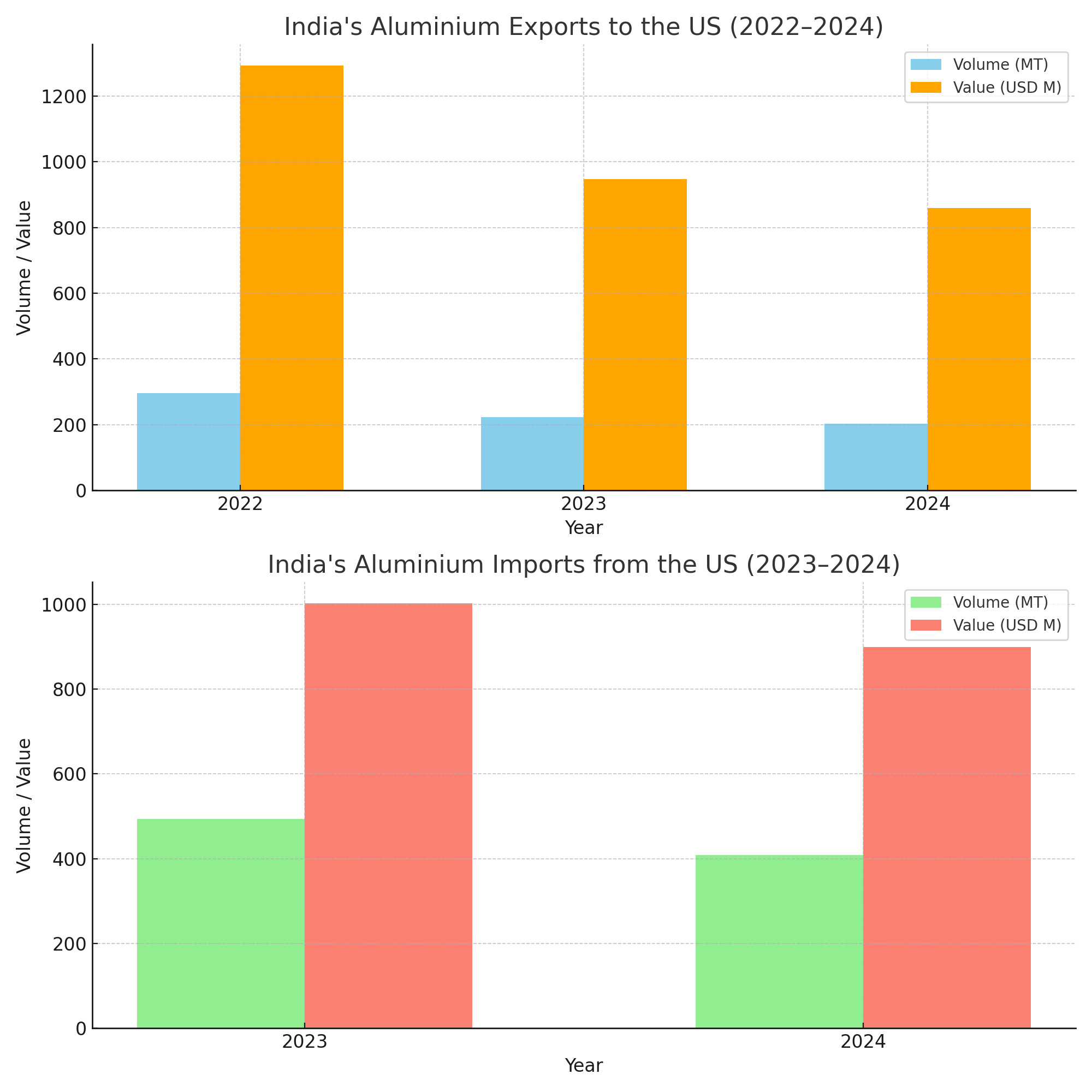
India approached the World Trade Organization in mid-April 2025, requesting consultations with the United States over tariffs, following the implementation of flat 25 per cent duties on India’s aluminium and steel exports for an indefinite timeline. India is a valuable trade partner of the United States, exporting more than 200 million tonnes of aluminium and aluminium products (including scrap) annually. According to the Ministry of Commerce, India’s aluminium exports to the US from January to December 2024 was around 203 million tonnes in 2024 valued at USD 860 million.
The historical data of the past three years indicates a steady decline in both volume and value of India’s aluminium exports to the United States. In the calendar year of 2023, India’s export volume stood at 223.6 million tonnes valued at USD 947 million, down from 296 million tonnes worth USD 1.294 billion.
On the import side, India's steel imports from the US are minimal, and aluminium imports in 2024 totaled 408 million tonnes valued at USD 899 million, down from 494 million tonnes worth USD 1.003 billion in the previous year. Although India has not yet announced the specific US-origin products or tariff rates for retaliation, but assuming mirrored 25 percent tariff on aluminium and steel may not be sufficient to meet the targeted recovery of USD 1.91 billion.
However, the data on India’s aluminium export trends to the US indicates a deliberate move to reduce dependence on the American market. Consequently, if the financial burden from the 25 percent US import tariffs continues to escalate, India may further scale back its exports to the US and intensify efforts to explore and expand into alternative markets.












_md.webp)
_md.webp)
_md.webp)