Hormuz crude flows recover, but aluminium, LNG and fertiliser face a slower return to normal
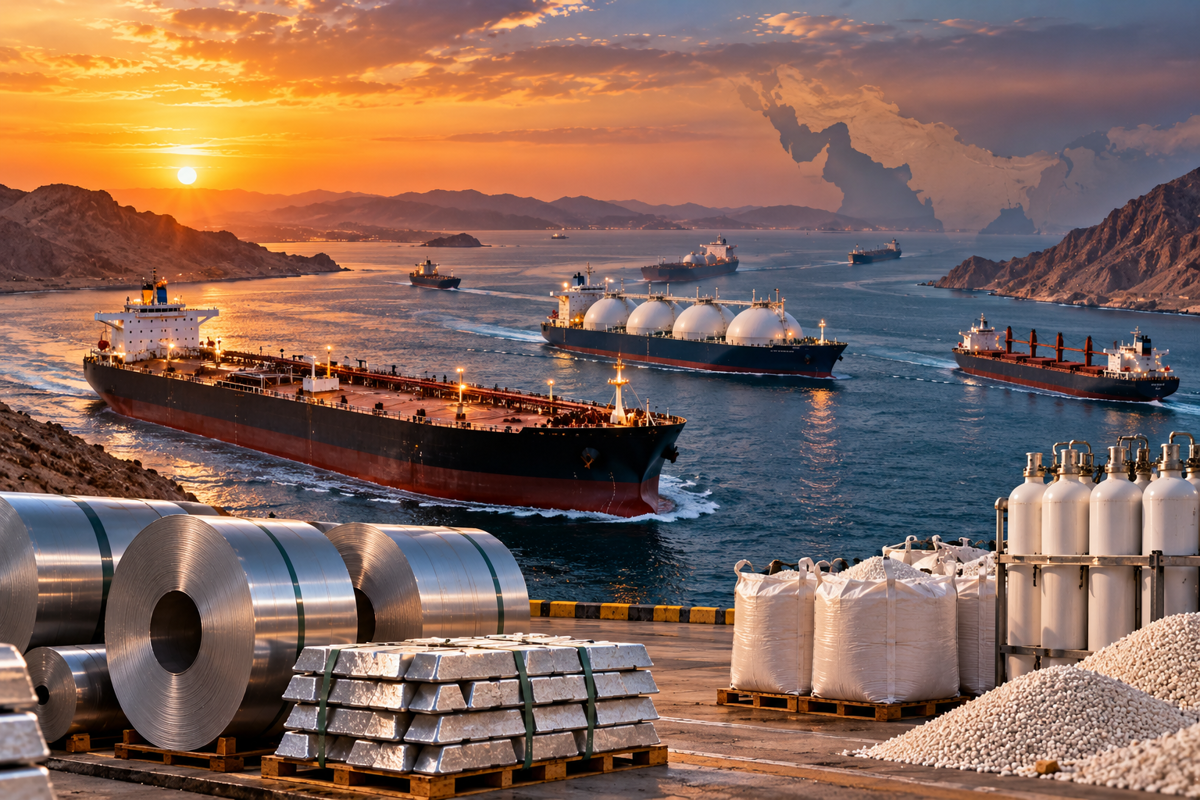
The image used in this article is generated with an AI tool and does not depict any real-time moment.
Middle East crude exports ended September at roughly their pre-conflict levels and exceeded them on several days, according to Reuters. However, the recovery is far less complete for other Gulf commodities. Diesel and gasoline shipments were running at 58 per cent of pre-conflict volumes, while LNG, fertiliser, aluminium and helium were recovering more slowly.
The uneven rebound highlights why crude flows alone do not provide a complete picture of trade through the Strait of Hormuz. For commodities with lower margins, limited routing options or specialised infrastructure requirements, the cost of moving cargoes and repairing damaged facilities continues to weigh on supply.
Crude can absorb the cost of moving through Hormuz
Supertanker rates for voyages from the Middle East to China reached a record USD 656,000 per day in late August, more than 10 times their level a year earlier. TotalEnergies' CEO also put the cost of moving a single cargo through the Strait of Hormuz at around USD 20 million.
Those costs can be absorbed when Gulf crude is purchased at around USD 50–60 per barrel while Brent trades above USD 90 per barrel, creating enough margin to support the expensive logistics.
The same economics do not apply to LNG, fertiliser and other bulk commodities, where elevated freight and conflict-risk costs can quickly erode margins.
LNG recovery remains constrained by routing and damaged capacity
Four carriers loaded at Ras Laffan resurfaced outside Hormuz over the weekend after making largely untracked crossings. At least five loaded vessels had also been spotted outside the Gulf since mid-September, compared with none in August.
QatarEnergy continues to extend force majeure, leaving buyers in Pakistan, Bangladesh and at least one Indian customer shut out until November, while Italy's Edison remains affected until early December.
Qatar entered the crisis exporting around 77–80 million tonnes of LNG a year, equivalent to roughly one-fifth of global supply. There is no meaningful pipeline bypass around Hormuz, while ship-to-ship transfers cannot handle anything close to Qatar's normal export volumes.
The disruption has also affected helium flows. Qatar's share of Taiwan's helium imports fell from nearly 88 per cent to around 30 per cent in the first half of 2026, while US supply increased to nearly 60 per cent from below 4 per cent. Qatar's share of South Korea's helium imports declined to around 34 per cent from 55 per cent, according to Taiwan News.
Explore the production, demand and consumption forecasts of bauxite and alumina in our report: "Global Bauxite & Alumina Market Forecast to 2036: Supply–Demand, Trade Flows & Price Outlook"
Fertiliser faces a costly land-route workaround
Fertiliser has fewer options for bypassing Hormuz than crude and generally has less capacity to absorb higher freight and conflict-risk costs.
Wolfgang Lehmacher, former head of supply chain and transport industries at the World Economic Forum, said vessel shortages create the initial shock, but storage constraints and continuous-process chemistry can quickly become the main operational bottlenecks.
“Synthesis loops (ammonia, urea and phosphates) require constant off-take,” Lehmacher said. He added that operating at minimum load without sufficient off-take can rapidly exhaust buffer capacity.
Gulf producers have turned to land routes where possible. Saudi Arabia has been trucking urea west since May, while UAE producers have redirected cargo towards Fujairah for loading alongside Omani material.
Sabic required around 1,300 trucks to move a single 25,000-tonne urea cargo from Jubail to Yanbu. Ma'aden deployed around 3,500 trucks to move phosphate fertilizer from Ras Al Khair towards Yanbu.
Scaling such workarounds to millions of tonnes would overwhelm road capacity and undermine the economics of low-margin bulk cargoes, Lehmacher said. Red Sea terminals also cannot necessarily replicate the specialised loading infrastructure available at Gulf ports.
The seaborne trade remains particularly weak. Roughly one-third of global seaborne fertiliser trade crossed Hormuz before the middle east conflict, but only eight urea vessels left Gulf waters in September, compared with two in August. Ammonia shipments had almost stopped, according to Asharq Business, citing Argus Media.
Sulfur adds another constraint for phosphate fertiliser.
Gulf countries account for around 44 per cent of global seaborne sulphur exports, making the region an important source of feedstock for phosphate fertiliser production. Morocco's OCP imports around 3.7 million tonnes of sulphur a year from the region.
Sulphur is particularly difficult to replace because its supply is concentrated around oil and gas processing hubs and has fewer substitutes than some other fertiliser inputs, according to Lehmacher.
That means a prolonged Gulf sulphur shortage could impose a more rigid constraint on phosphate fertiliser production. Urea production, by comparison, can shift towards other gas-rich producers when Gulf supply is disrupted.
Unlock key insights from leading companies and experts across the aluminium ecosystem with our e-Magazine - Mine to Market: Aluminium Producers & Manufacturers 2026
Aluminium recovery depends on Hormuz reopening
The impact also extends to aluminium, with Gulf smelters accounting for roughly 9 per cent of global primary aluminium production.
Emirates Global Aluminium (EGA) had restored 25 per cent of its reduction cells at the Al Taweelah smelter by late August. The company expects hot-metal production to return to pre-incident levels in the first quarter of 2027.
However, the recovery in production does not mean aluminium shipments have fully normalised. EGA has said shipments will not return to pre-incident levels until the Strait of Hormuz reopens.
This leaves the aluminium market exposed to the same logistical constraints affecting other Gulf commodities, even as smelter operations gradually recover. The distinction is important: production recovery and export recovery are not necessarily happening at the same pace.
Some supply losses could last years
Two Ras Laffan LNG trains damaged in earlier strikes remain offline, removing 12.8 million tonnes per year of Qatar's LNG capacity, or around 17 per cent of its total capacity. Repairs are expected to take three to five years.
For aluminium, the physical production recovery is expected to be faster, with EGA targeting pre-incident hot-metal production in the first quarter of 2027. However, the company continues to link a full recovery in shipments to the reopening of Hormuz.
The result is a recovery that cannot be measured simply by counting vessels moving through the strait. Different commodities face different combinations of freight economics, infrastructure damage, alternative routes and production constraints.
What would a return to normal look like?
A genuine normalisation of Gulf commodity trade would require more than crude exports returning to pre-conflict levels. Lehmacher points to several indicators: risk insurance surcharges returning to pre-crisis levels, major regional producers securing spot and contract charters over multiple weeks, idled ammonia loops and gas-sweetening facilities being fully recommissioned, and sulphur-price spreads between China, India and Brazil narrowing.
Another signal would be the resolution of the 30–40-day dry-bulk vessel ballasting lag as vessels return to Gulf berths.
Until those indicators emerge, the recovery in crude exports risks giving an overly optimistic impression of the wider Gulf trade picture. LNG, fertilizer, helium and aluminium remain tied to a supply chain in which reopening the route is only one part of the return to normal.
Looking for unwrought aluminium business opportunities? Explore potential leads of primary aluminium on AL Biz.
Ma’aden aluminium surge puts growth back in focus as stock trades at $17
Next articleLME aluminium cash offer price falls around 1% to $3,102/t, while stocks drop to 238,875t
Grow with
AL Circle