Green Science Alliance more than doubles aqueous aluminium battery capacity
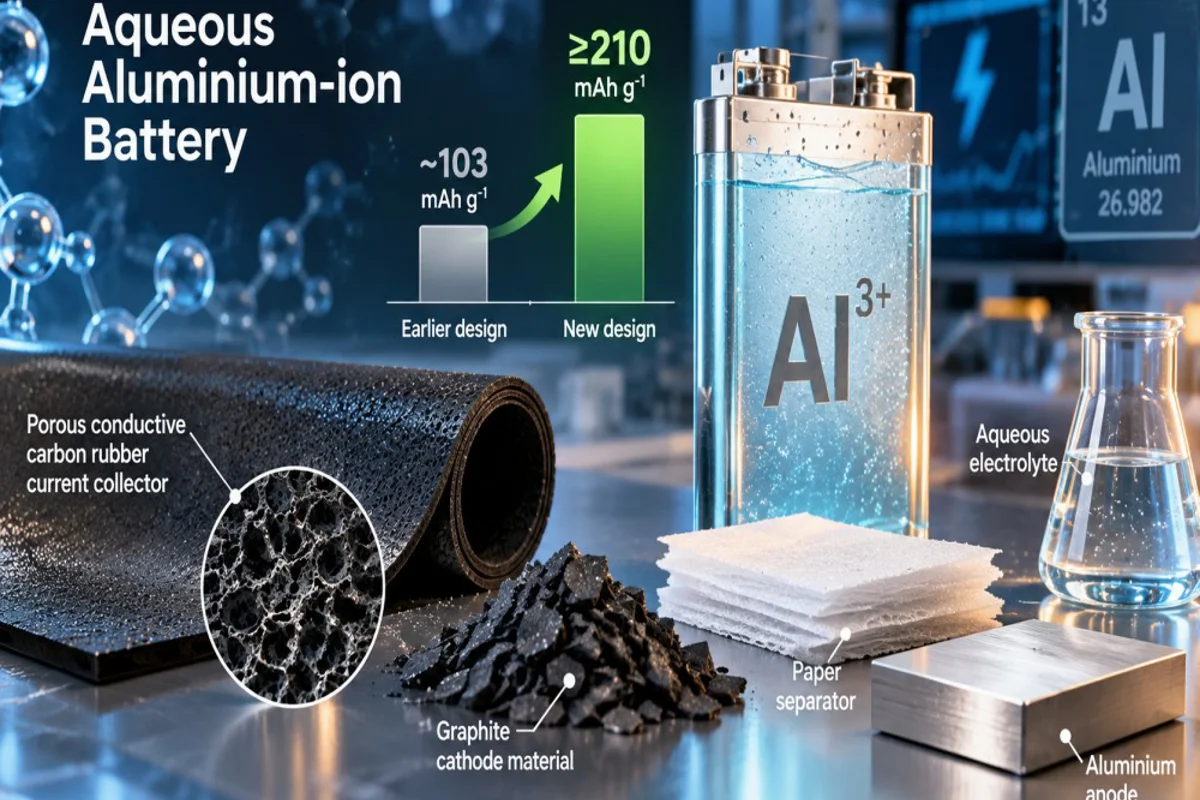
The image used in this article is generated with an AI tool and does not depict any real-time moment
Green Science Alliance has more than doubled the initial capacity of its aqueous rechargeable aluminium-ion battery, reporting a rise from approximately 103 mAh g⁻¹ to at least 210 mAh g⁻¹ after introducing a low-cost conductive carbon rubber sheet as the cathode current collector.
The development, led by Dr Ryohei Mori, could help address cost and manufacturing challenges associated with aluminium-based batteries. The company said the improved cell maintained its reported capacity for at least 25 cycles, with testing still under way.
The result marks progress for aqueous rechargeable aluminium-ion batteries (AAIBs), which have attracted research interest because aluminium is abundant, comparatively inexpensive and recyclable. However, their commercial development continues to face challenges, including limited cycle stability.
Porous carbon rubber supports battery performance
The latest design uses a commercially inexpensive conductive carbon rubber sheet as the cathode current collector. According to Green Science Alliance, its porous structure allows graphite cathode material to penetrate the sheet, forming a three-dimensional conductive composite.
The structure also allows greater electrolyte penetration and increases the effective surface area available for electrochemical reactions. The company reported that a dense carbon board did not produce comparable performance.
The battery uses graphite as its cathode active material, commercial paper as the separator, a concentrated aqueous aluminium-perchlorate-based electrolyte and a specially composed aluminium anode.
The reported improvement follows earlier research by Mori, published in Energy Advances in 2025, which examined the potential of aqueous rechargeable aluminium batteries and identified poor cycle stability as a significant barrier to commercial deployment.
Explore AL Circle’s report ALuminium Wires & Cables - Insights & Forecast to 2030 for insights into aluminium applications, industry developments and opportunities across the electrical sector.
Water-based electrolyte offers a different manufacturing route
A key feature of the battery is its aqueous electrolyte. Conventional aluminium-ion battery designs often use moisture-sensitive and corrosive ionic-liquid electrolytes, which can require controlled manufacturing environments and corrosion-resistant components.
Water-based systems may offer a simpler route to manufacturing because they can potentially be assembled under normal atmospheric conditions. Their use of readily available raw materials could also help reduce component and processing costs.
The battery reportedly operates at approximately 0.9–1.0 V, below the voltage of conventional lithium-ion cells. Multiple cells can be connected in series to increase the overall voltage.
Green Science Alliance also reported redox peaks in cyclic-voltammetry measurements, including after 100 cycles, indicating continued charge-discharge activity. However, the company’s reported capacity was maintained for at least 25 cycles, and the available results do not establish the battery’s longer-term cycle life.
Further testing needed before commercial adoption
Despite the capacity increase, the technology remains at the development stage. Longer-term cycle life, energy density, voltage performance, electrode stability and scalability will need to be demonstrated before commercial adoption can be assessed.
Aqueous aluminium batteries also face wider technical challenges, including aluminium-anode corrosion and passivation, dendrite formation and electrolyte stability.
If further testing confirms the performance and the design can be scaled, the technology could have potential in stationary energy storage and other cost-sensitive applications. However, any effect on demand for aluminium, graphite, carbon materials or aluminium salts would depend on successful development and commercial deployment.
For now, the reported improvement represents a research-stage performance gain rather than evidence of an imminent shift in battery markets.
Explore AL Circle’s B2B Marketplace to discover aluminium electrical and power products, including conductors, busbars, cables and wires, and connect with suppliers across the industry.
US-Mexico trade review faces delay, with automotive rules and metal tariffs in focus
Next articleNautor Swan’s 43.5-metre aluminium supermaxi takes shape ahead of 2028 delivery
Grow with
AL Circle