After the pandemic in 2020 and early 2021, global aluminium demand has made a strong comeback and is now on a steady growth trajectory. According to industry data, total global consumption hit 97.6 million tonnes in 2023 and is projected to rise to 100.8 million tonnes in 2024, primarily driven by the release of pent-up demand. Out of this total, recycled aluminium made up 27.7 million tonnes in 2023, with a slight increase to 28.4 million tonnes in 2024.
As per AL Circle's report, the global aluminium recycling market is set to experience notable growth from 2023 to 2032. By 2024, the industry had already shown consistent progress, due to strategic moves and investments from key players in the field.
In 2024, global aluminium consumption, which includes both primary and recycled metal, saw a rise of 3.28 per cent, hitting a total of 100.8 million tonnes. This total breaks down to 72.4 million tonnes of primary aluminium and 28.4 million tonnes of secondary aluminium.
Low-carbon aluminium production trend
In 2024, the world saw a remarkable production of low-carbon aluminium, reaching a total of 55.2 million tonnes. This impressive figure was primarily fueled by 41.7 million tonnes sourced from secondary aluminium, along with 13.5 million tonnes coming from primary aluminium that was produced using renewable energy.
Primary aluminium: Low-carbon production & projects
Global primary aluminium producers are reducing carbon emissions by shifting to energy-intensive smelting operations due to increasing pressure from policy mandates, ESG commitments and a rising demand for low-carbon materials.
Arctial has kicked off a feasibility study for a low-carbon aluminium smelter in Finland, which is a big leap towards achieving Europe's Vision 2050 goals. This proposed facility will produce 550,000 tonnes of aluminium each year, utilising Rio Tinto's AP60 technology, known for its impressive energy efficiency. Nestled between Kokkola and Kronoby, the site is perfectly positioned to tap into CO₂-free electricity and boasts strong logistics. ABB, a vital partner in this venture, will spearhead the electrification and automation processes, ensuring a sustainable and resilient supply chain. This initiative highlights Europe's dedication to decarbonisation and strengthening the supply chain in the aluminium industry.
EGA has made a significant move by delivering its first batch of CelestiAL-R low-carbon aluminium billets to the Japanese manufacturer Sankyo Tateyama. These billets are crafted using solar-powered aluminium and recycled scrap metal, making them a perfect fit for Japan's net-zero goals by considerably cutting down greenhouse gas emissions. EGA's state-of-the-art casthouse capabilities and careful scrap selection process guarantee top-notch, low-carbon products. This partnership highlights EGA's dedication to growing its sustainable aluminium offerings and playing a key role in global decarbonisation efforts.
Secondary aluminium: Low-carbon production & projects
Secondary aluminium, which comes from recycled scrap, is leading the charge for a low-carbon future in the aluminium industry. It uses only 5 per cent of the energy needed for primary production, making it a wise, cost-effective choice for producers looking to cut emissions. Countries with strong recycling systems, like the USA, the EU and China, are increasingly tapping into this method to meet their domestic needs sustainably. With a 45 million-tonne limit on primary aluminium, China is ramping up its investments in recycling to enhance its secondary output.
Capral Aluminium rolled out a new line of lower-carbon aluminium sheets as part of its LocAl® range, which cuts CO₂ emissions down to about six tonnes for every tonne produced. By harnessing renewable energy and utilising recycled aluminium, this initiative is a big step forward for Australia's journey towards sustainable manufacturing and low-carbon supply chains.
RUSAL and AB InBev Efes have made a groundbreaking move by launching Russia's very first beverage can crafted from low-carbon aluminium, marking a significant step forward in sustainable packaging. This initiative utilises RUSAL's innovative ALLOW INERTA technology and boasts over 50 per cent recycled content, slashing the carbon footprint by more than half. The collaboration covers the entire production journey, from extracting raw materials to delivering the final product to stores, all while aligning with national environmental goals and the partners' commitment to sustainability.
Recycled aluminium: Market share by region & product type
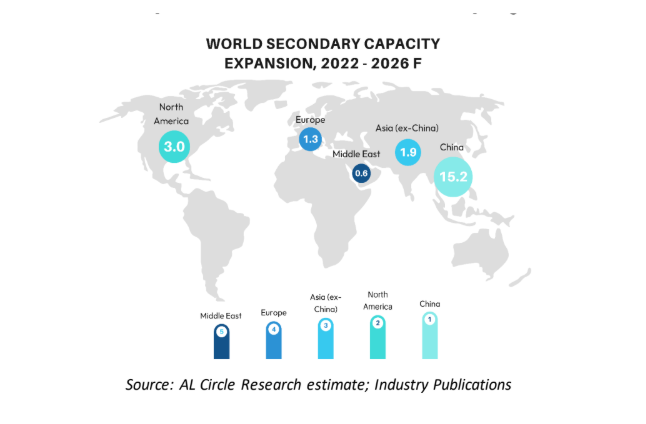
As per AL Circle research estimates and Industry Publications, the global secondary aluminium industry is set for impressive growth from 2022 to 2026, with China taking the lead at a whopping 15.2 million tonnes. This surge reflects the country's strategic pivot towards recycled aluminium and low-carbon production methods.
North America is projected to contribute 3.0 million tonnes, while Asia (excluding China) and Europe are expected to add 1.9 million and 1.3 million tonnes, respectively. Even though the Middle East is smaller in scale, it's anticipated to see a significant rise of 0.6 million tonnes, showcasing a growing regional interest in sustainable aluminium solutions.
According to AL Circle research estimates and Industry Publications, the global aluminium industry is on a steady path of expansion, with secondary aluminium leading the charge in growth from 2022 to 2026. It is expected that annual capacity additions will hit a high of 8.1 million tonnes per year (MTPY) in 2025, primarily fueled by a significant increase in secondary aluminium production, which is projected to jump from 1.9 MTPY in 2022 to an impressive 6.4 MTPY by 2025.
Primary aluminium production: Factors that can affect & matters
Tariffs that have shaken the industry
The US aluminium market is currently facing a challenging situation, primarily due to the recent hike in import tariffs from 25 per cent to 50 per cent from June 4, 2025. This change has resulted in a significant 12.24 per cent drop in aluminium imports month-on-month for February 2025, with a striking 17.3 per cent decrease in aluminium scrap imports. This downturn is widespread, striking major suppliers, including Canada, which makes up 57 per cent of the US aluminium imports and the UAE, which could have been a viable source for low-carbon aluminium. The fall in scrap imports is particularly alarming, as it jeopardises the US recycling industry, which heavily depends on imported scrap to satisfy domestic needs.
The EU's Carbon Border Adjustment Mechanism (CBAM), which will be effective from January 1, 2026, is already shaking up the global aluminium trade. According to the Global Trade Research Initiative (GTRI), India's aluminium exports to the EU took a hit, dropping by 9.8 per cent in FY25, which is part of a larger 24.4 per cent decline in steel and aluminium exports to the region.
This decline happened even before the CBAM officially came in, suggesting that the EU's carbon reporting rules, rolled out in October 2023, have already made exporters think twice. The gap between India's expected carbon credit prices and the EU Emissions Trading System benchmark is growing, potentially creating a cost difference of around USD 61 per tonne of CO₂. This situation, along with existing anti-dumping and safeguard tariffs, is creating serious hurdles for exporters.
By mid-2025, China's aluminium production is expected to hit around 44.5 million tonnes per year, getting close to the cap. This restriction is prompting a change in trade patterns, as China shifts its focus toward higher-value aluminium products and cuts back on primary aluminium exports. As a result, the global supply of primary aluminium is tightening, likely driving up the demand for aluminium scrap as an alternative source. This change could push scrap prices higher and spark more competition among importing countries, particularly those in the EU, for the limited scrap available.
According to the Bureau of International Recycling (BIR), producing primary aluminium is quite the energy hog, needing about 15 MJ of hydroelectric energy for every kilogram and at an efficiency of 89 per cent. Moreover, alternative energy sources like black coal and natural gas aren't as efficient, using up 211 MJ/kg at 35 per cent efficiency and 150 MJ/kg at 54 per cent efficiency, respectively. In stark contrast, secondary aluminium production is a lot more efficient, with energy consumption ranging from 6 to 10 MJ/kg and efficiencies between 60 per cent and 80 per cent. This indicates a saving of 90 to 95 per cent of energy compared to primary production, making recycled aluminium a really appealing and strategic choice for the future.
What makes decarbonisation important in this situation?
Decarbonisation is becoming a top priority for the global aluminium industry, with its hefty environmental impact and the increasing pressure from regulations and market demands, the need for change is urgent. Aluminium production is responsible for about 2 per cent of the world's greenhouse gas emissions. This translates to roughly 1.1 billion tonnes of CO₂e each year! This significant carbon footprint puts the industry in the spotlight for sustainability efforts, pushing producers to embrace cleaner technologies, enhance energy efficiency and transition to low-carbon production methods.
Moreover, it goes beyond just meeting environmental regulations; it's a key strategy because aluminium is crucial for the global shift towards a low-carbon economy. Lightweight aluminium parts are vital for electric vehicles, renewable energy systems and energy-efficient buildings, all of which are essential for achieving international climate goals. By focusing on decarbonisation, aluminium producers can cut down on emissions while also boosting their competitiveness, enhancing their ESG credentials, and tapping into markets that are increasingly focused on sustainability.













_md.webp)








