Germany’s bauxite imports from Guinea increase 15% Y-o-Y in 2018
The German association of the aluminium industry (GDA) had pointed out in August 2018 that the development of business activity in the German aluminium sector until then remained positive. The production reportedly increased in the first half of the year – up 0.9 per cent by aluminium producers and 0.4 per cent by semis-producers. So, the overall expectations for 2018 were hopeful.
GDA’s executive director Christian Wellner particularly explained: “Despite political uncertainties, the German economy has developed well so far this year. On top of these favourable general conditions, there are the positive economic forecasts for aluminium, which are pointing upwards for nearly all product sectors in Germany and the rest of Europe.”
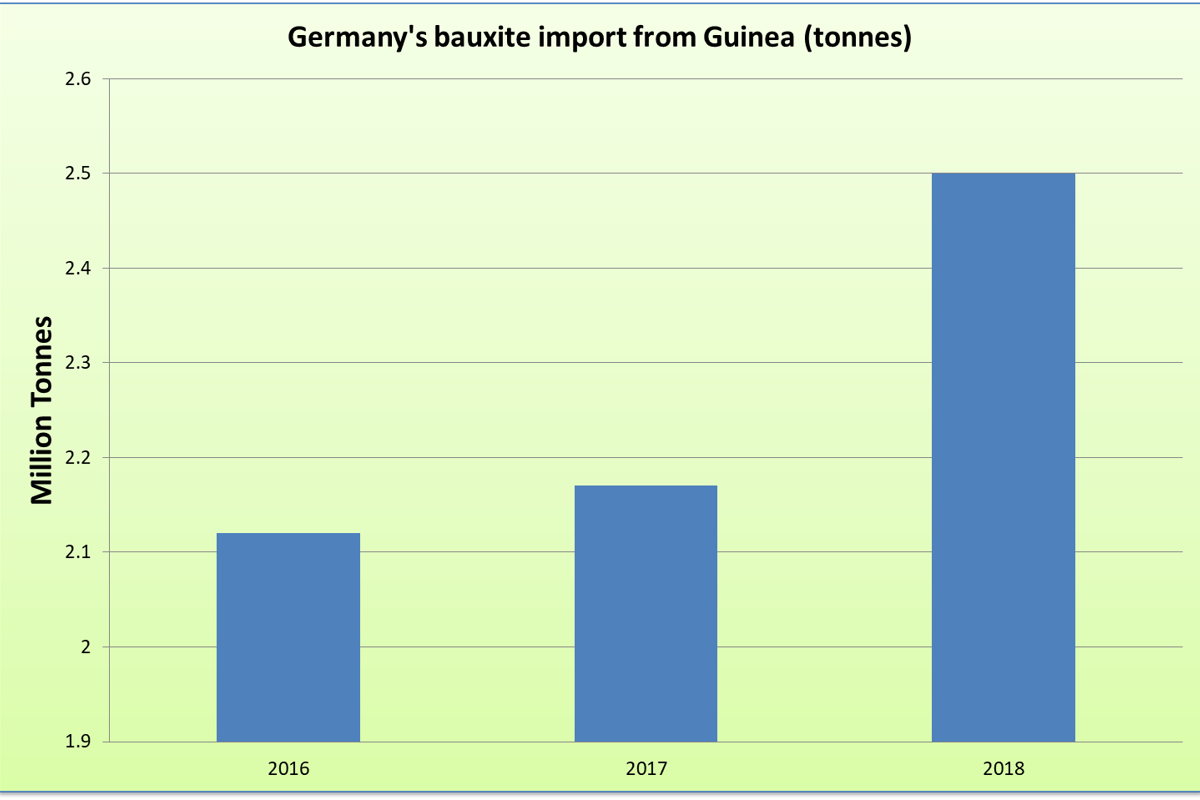
This indicates that the country imports a significant amount of bauxite to feed its domestic smelters. While Germany imports bauxite from various parts of the world, Guinea exports the highest amount. According to our own third party data, Germany’s estimated bauxite import from Guinea increases year-on-year since the last couple of years. In 2016, the country’s import had pegged at 2.12 million tonnes, which in the next year grew marginally to 2.17 million tonnes. The data of 2018 shows no exception as the amount is estimated to grow 18 per cent from 2016 and 15 per cent from 2017 to 2.5 million tonnes.
Germany’s estimated total bauxite imports have also recorded a growth year over year. While 2016, the amount was at 2.23 million tonnes, in 2017 and 2018 it grew to 2.31 million tonnes and 2.8 million tonnes respectively.
But the year 2019 is forecast to see a plunge in Germany’s bauxite imports to 2.25 million tonnes, down 20 per cent from 2018.

Trimet and Hydro are the two notable smelters in Germany that have an annual aluminium production capacity of approximately 305,000 tonnes and 230,000 tonnes, respectively.
Konecranes to deliver floating cranes to COSCO for transporting bauxite from Guinea to China
Next articleAlcoa Corporation sees bauxite, alumina surplus for 2019
Grow with
AL Circle