EU launches CLEANMAT project to advance low-emission aluminium recycling through digital sorting and melt refining
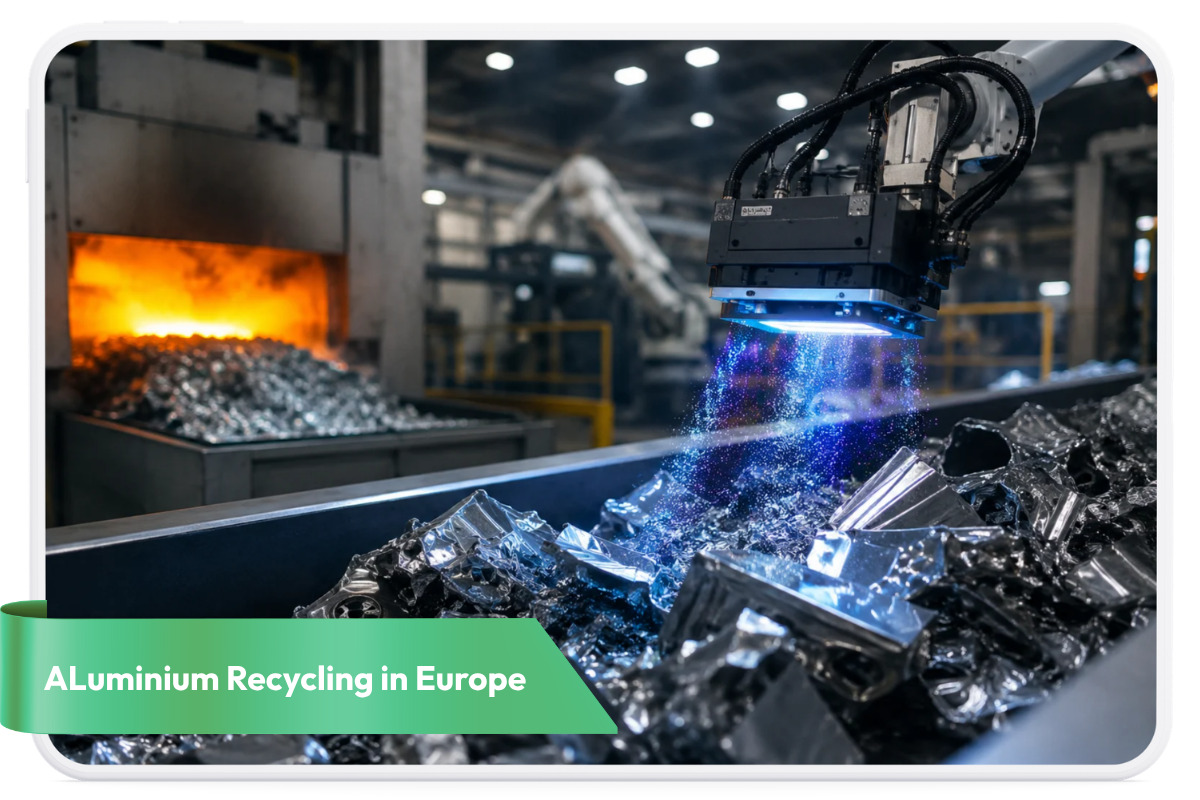
The image used in this article is generated with an AI tool and does not depict any real-time moment
The European Union has launched CLEANMAT (Smart Clean Aluminium Material Processing), a Horizon Europe-funded project aimed at reducing emissions and flux consumption in aluminium recycling by integrating digital sorting, intelligent pre-treatment and advanced melt refining technologies.
With funding of EUR 7.33 million, the project seeks to establish an end-to-end, low-emission pathway for processing difficult aluminium scrap streams into high-performance aluminium alloys.
Book your seat for the free-to-attend webinar, "Autonomous furnace tending in aluminium cast houses: Improving safety, productivity and yield". Limited slots available
While aluminium recycling consumes only a fraction of the energy required for primary production, conventional recycling continues to depend on hazardous fluxing agents and chemical cleaning processes. It also generates emissions, including particulates, volatile organic compounds (VOCs), dioxins and salt slag waste, while facing challenges in converting mixed and contaminated scrap into high-quality alloys.
To address these issues, CLEANMAT will combine scrap sorting, pre-treatment, melt refining and alloy qualification through a Digital Thread. The project will deploy AI-driven multi-sensor characterisation to identify residual contaminants that conventional sorting methods may fail to detect, improving feedstock purity.
Delve deeper into the recycled aluminium and secondary aluminium market with our World Recycled ALuminium Market Analysis Industry forecast to 2032
The project will also use closed-loop heat pre-treatment to remove organic coatings and residues safely. In addition, two refining approaches—near-zero flux processing for induction furnaces and ultra-low flux retrofits for rotary, reverberatory and crucible furnaces—will incorporate magnetohydrodynamic flow, vacuum distillation and high-shear melt conditioning. These technologies are expected to reduce flux use by up to 97 per cent without compromising alloy quality or production yield.
The technologies will be validated at industrial scale in collaboration with automotive and recycling partners. The validation will include life-cycle, techno-economic and occupational safety assessments and will be aligned with EN standards to support a replicable pathway for safe, low-emission and circular aluminium recycling.
The CLEANMAT consortium officially launched the project during a meeting held on June 22-23, 2026, at Brunel University of London, home to the Brunel Centre for Advanced Solidification Technology (BCAST). During the two-day meeting, project partners presented individual work packages, discussed technical implementation across the aluminium value chain and toured BCAST's casting and processing facilities.
The project commenced on June 1, 2026, and will run for 36 months. It is coordinated by Brunel University of London (UK) in partnership with RWTH Aachen (Germany), Otto Junker (Germany), Zyomax (UK), NTNU (Norway), CRF – Centro Ricerche Fiat (Italy), TU Delft (Netherlands), Ford Otosan (Türkiye), Fraunhofer (Germany), IRES (Belgium), Doktaş (Türkiye), GBP Metal Group (Spain), Teknopar (Türkiye), Alumisel (Spain), Gemmate Technologies (Italy), European Aluminium (Belgium) and Recycling Europe (Belgium).
By demonstrating cleaner and digitally enabled recycling technologies, CLEANMAT aims to strengthen Europe's position in safe, low-emission and circular aluminium recycling.
Explore the position of aluminium at the intersection of sustainability and strategy in Sustainability & Recycling: Aluminium's Dual Commitment
Why scrap is becoming central to the aluminium industry: the past fortnight’s updates
Next articleAluminium scrap supply surge could cool LME rally to $2,400–2,700/t, says InCred
Grow with
AL Circle