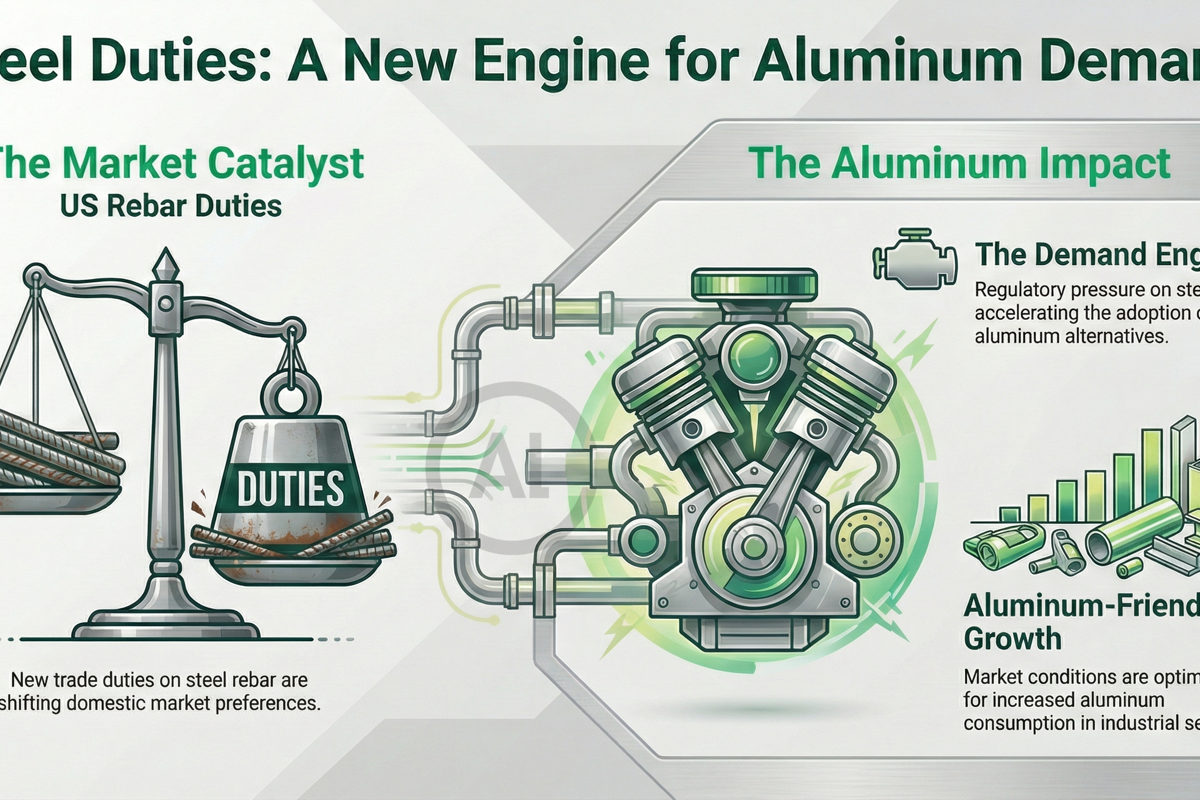
The US’s latest countervailing duty action against rebar imports from Algeria, Egypt and Vietnam is definitely a steel story. But in the layer under, it is shaping up to be a structural aluminium demand event for the North American construction ecosystem.
In January 2026, the US Department of Commerce imposed preliminary countervailing duties of 72.94 per cent on Algerian rebar, 29.51 per cent on Egyptian material and 1.08 per cent on Vietnamese shipments, on top of the blanket 50 per cent steel and aluminium tariff regime. The move followed investigations launched in mid-2025 after domestic producers alleged heavy subsidisation and dumping.
There has been the sudden removal of a large volume of low-cost rebar from the US market. According to US import data, Algeria shipped about 91,543 tonnes of rebar to the US in 2024. Egyptian exports fell from around 243,000 tonnes in 2023 to about 205,800 tonnes in 2024, while Vietnam’s volumes, though smaller, doubled year-on-year to 56,400 tonnes. Overall, US rebar imports shrank from 1.41 million tonnes in 2023 to nearly 1.01 million tonnes in 2024.
In tonnage terms, nearly 400,000 tonnes of offshore rebar supply have disappeared in barely a year.
Domestic mills were quick to react. Within days of the duty announcement, US producers announced price hikes of around USD 30 per short tonne, citing reduced import competition and tighter supply. This is the first link in what is becoming a decisive chain reaction across construction metals.
Steel rebars are used everywhere concrete needs tensile strength, reinforcing everything from foundations, slabs, beams, and columns in houses, skyscrapers, and industrial buildings to massive infrastructure projects like bridges, dams, highways, tunnels, and airport runways, also appearing in retaining walls, marine structures, and even decorative items, ensuring durability and resistance to stress and cracking.
Explore- Most accurate data to drive business decisions with our Outlook 2026 insights across the value chain
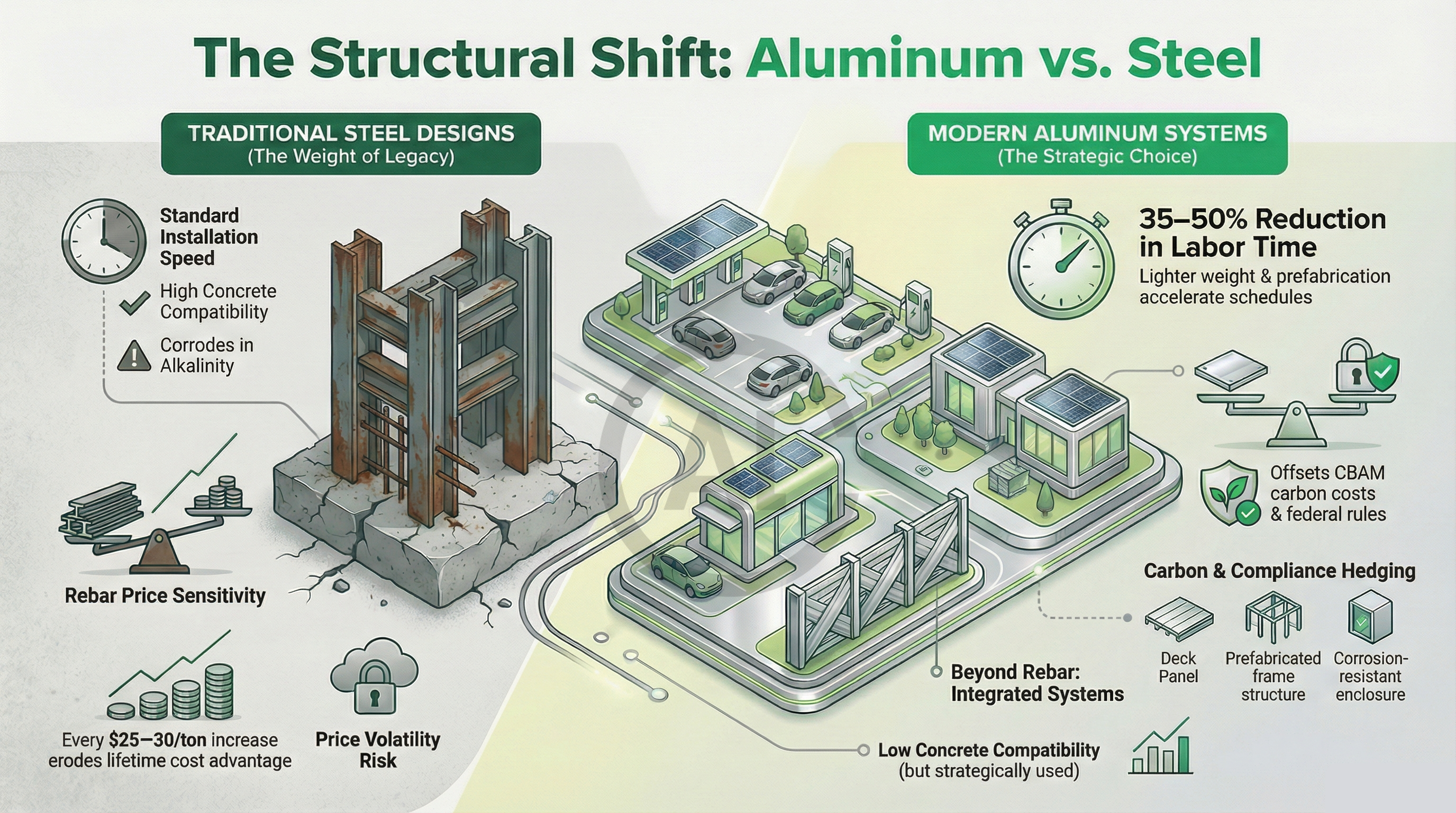
Steel rebars cannot be replaced with aluminium in standard concrete due to aluminium’s poor chemical compatibility (it corrodes in concrete's high alkalinity), lower strength, poor ductility, and different thermal expansion, which cause expansion and cracking.
However, in modern infrastructures like EV charging parks, modular buildings, coastal defence structures, bridges and logistics hubs, traditional steel reinforcement increasingly competes with aluminium-intensive structural systems like aluminium deck panels, prefabricated framing modules, corrosion-resistant enclosures, cable raceways and lightweight composite reinforcement cages.
These systems were already gaining traction due to carbon compliance, corrosion performance and speed of installation. What the rebar duties have done is tilt the cost equation decisively.
Every sustained USD 25-30 per short tonne increase in rebar pricing erodes the lifetime cost advantage of steel-heavy designs. For contractors working under tight delivery schedules, aluminium’s lighter weight and prefabrication compatibility reduce on-site labour time by 35-50 per cent. When combined with rising carbon compliance costs under CBAM-style frameworks and stricter procurement rules for federally funded projects, aluminium suddenly stops being a premium material and becomes a risk-hedging choice.
Don't miss out- Buyers are looking for your products on our B2B platform
The displacement mathematics
Industry estimates indicate that for every 1 million tonnes of steel rebar substituted in high-performance infrastructure, between 180,000 and 220,000 tonnes of aluminium extrusions and rolled products are absorbed into framing, decking, cladding and load-distribution systems.
By that metric, the disappearance of roughly 400,000 tonnes of imported rebar from the US market creates a latent upside of nearly 75,000 tonnes of incremental aluminium demand, equivalent to the full annual output of a mid-sized North American extrusion cluster.
What makes this shift more structural is the supply profile of the countries now shut out of the US market.
Algeria’s Tosyali Oran complex alone has around 3 million tonnes per year of long-product capacity. Egypt’s rebar ecosystem — led by Ezz Steel and Egyptian Steel Group — exceeds 9 million tonnes annually. Vietnam’s export to the US crossed 12 million tonnes in 2024 and continues to expand. These producers were not exporting marginal surplus to the US; they were using the US as a price-clearing outlet for structurally excess steel capacity.
With that door closed, some volume redirection is on the way
Europe has already tightened its safeguard quota regime, triggering a 25 per cent duty on out-of-quota rebar in October 2025 and sharply limiting quarterly access for North African suppliers. Turkish mills have responded by capturing displaced EU market share, while Algerian and Egyptian exporters are pushing aggressively into Africa, the GCC and Southeast Asia.
This redirection of steel volumes has measurable downstream implications, including for aluminium, but through cost, procurement and design responses rather than direct substitution.
As Algerian and Egyptian rebar exports are diverted away from the US, surplus long steel is increasingly targeting Europe, Africa and the Middle East, regions already operating under safeguard quotas or price-sensitive construction cycles. In parallel, the US market is experiencing a tightening of rebar availability.
Rebar accounts for a significant share of structural steel input costs in transport, commercial and energy infrastructure projects. Sustained increases in reinforcement steel prices tend to trigger design optimisation rather than outright demand destruction, particularly in federally funded or time-bound projects where delays carry penalties.
But at the same time, the secondary impact is a gradual recalibration of material choices at the project design and procurement stage as especially in certain applications, aluminium systems reduce labour hours by 30-50 per cent and project timelines by weeks, not days.
Must read: Key industry individuals share their thoughts on the trending topics













_md.webp)
_md.webp)







