Bead blasting: The finishing process behind high-quality aluminium products
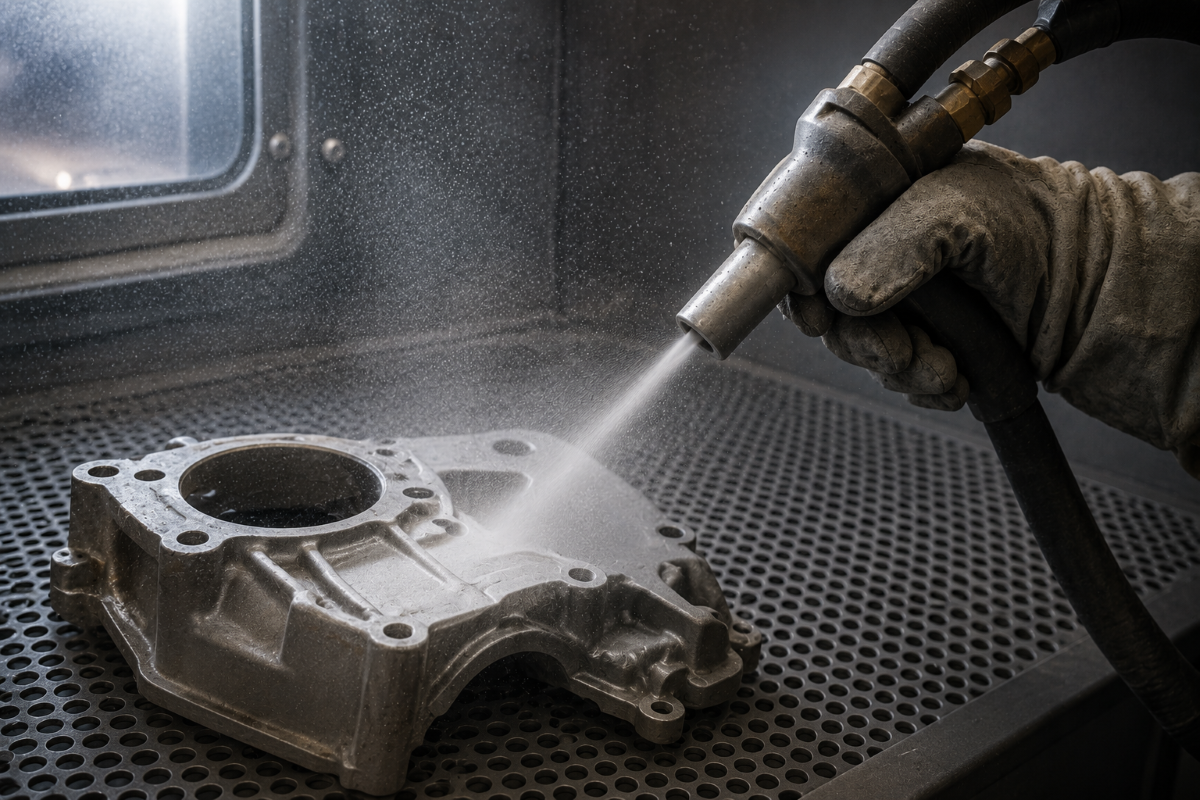
The image used in this article is generated with an AI tool and does not depict any real-time moment
As aluminium producers and fabricators increasingly focus on high-value applications, surface finishing is playing a bigger role in the manufacturing process. One technique used extensively across the industry is bead blasting, which is commonly carried out before anodising, painting, powder coating and other finishing operations.
By the time bead blasting takes place, the aluminium has already been cast, extruded, rolled or machined into its required shape. The process uses compressed air to direct fine spherical media - usually glass or ceramic beads - onto the surface of the component. The impact removes oxidation, traces of light corrosion, machining marks, residual oils and other surface contamination, while removing only a very small amount of the base material.
For aluminium manufacturers, the process offers a practical way of creating a clean and consistent surface before the product moves to the next stage of production. Because the blasting media is rounded rather than angular, it textures the surface without the more aggressive cutting action associated with other abrasive methods. This helps preserve the dimensional accuracy of the component while giving the surface a uniform appearance.
Preparing aluminium for anodising and coating
A large proportion of bead blasting in the aluminium industry is carried out before surface treatments are applied. Whether a component is destined for anodising, painting, powder coating or adhesive bonding, the quality of the finished product depends to a large extent on the condition of the metal beforehand.
For anodised aluminium, the surface preparation stage has a direct influence on the final appearance. Bead blasting creates a consistent surface profile that supports the matte or satin finishes commonly used on architectural systems, consumer electronics housings and a wide range of fabricated aluminium products. The process can also make minor machining lines and superficial casting marks less noticeable, producing a cleaner and more uniform finish.
The same preparation is valuable before painting and powder coating, where the removal of contamination and the creation of an even surface help achieve a more consistent result. Components intended for adhesive bonding also benefit from a surface that has been properly cleaned and conditioned before assembly.
To explore the market dynamics, emerging applications and future outlook for aluminium extrusions, download the TOC of The World of Aluminium Extrusions – Industry Forecast to 2032.
Widely used across aluminium manufacturing
The process is now a routine part of production for many aluminium castings, extruded profiles and machined components. It is widely used in the manufacture of automotive parts, aerospace components, architectural products, industrial equipment and consumer electronics, where both surface quality and dimensional consistency are important.
Bead blasting also performs a number of everyday workshop functions. It is commonly used to remove small burrs left after machining and to clean away oil, grease and other residues that may remain on the surface after fabrication. In many plants, it forms part of the normal preparation cycle before parts move to coating lines or final assembly.
Compared with more aggressive abrasive processes, bead blasting provides a controlled method of surface conditioning. The use of spherical media allows manufacturers to create a uniform texture while preserving the quality of the aluminium surface, making it well suited to components that require a consistent finish.
Process settings matter
The final result depends on how the process is controlled. Manufacturers select bead type, particle size, blasting pressure and processing time according to the aluminium alloy and the requirements of the finished component. Careful adjustment of these parameters helps achieve the required surface finish while maintaining dimensional consistency.
Cleaning after blasting is also an important part of the process. Components are typically washed and inspected to remove residual media and dust before moving to anodising, painting, powder coating, assembly or other downstream operations. Larger aluminium structures or components with complex shapes may require specialised blasting systems to ensure a uniform finish across the entire surface.
As the use of aluminium expands across transport, aerospace, construction and consumer products, the demand for consistent surface quality continues to grow. For many manufacturers, bead blasting has become a routine but essential finishing operation, providing the surface condition required for anodising, coating and other downstream manufacturing processes.
Participate in our upcoming e-Magazine - Mine to Market: ALuminium Producers & Manufacturers 2026

Here’s how Press Metal Aluminium Holdings Berhad shows strong fundamentals with EPS growth and more
Next articleSINOMACH secures $245m EPC contract for the Angola aluminium project
Grow with
AL Circle