The numbers are staggering. In 2024, a whopping 17 million electric cars found new homes worldwide — a 25 per cent surge that speaks volumes about our shifting automotive landscape. To put this in perspective: 2024’s additional EV sales alone (3.5 million vehicles) surpassed the total electric car sales of 2020.
At the heart of this electric revolution stands China, commanding the global stage with over 11 million sales. It’s a figure that would have seemed impossible just two years ago when it represented the entire world’s electric car sales. While Europe grappled with subsidy reductions and unchanged EU CO2 targets, causing market stagnation, the United States showed modest growth, albeit at a quarter of the previous year’s pace.
The impact of this five-year surge has been transformative. By the close of 2024, nearly 58 million electric cars roamed the world’s roads, reckoning for 4 per cent of all passenger cars and more than triple the fleet size of 2021. These vehicles aren’t just changing our streets. They are reshaping our energy consumption, displacing over 1 million barrels of oil daily in 2024. Yet the distribution remains uneven — while one in ten cars in China now runs on electricity, Europe lags with roughly one in twenty.
China’s electric dominance
China’s appetite for electric vehicles seems insatiable. With almost half of all car sales being electric in 2024, representing nearly two-thirds of global electric car sales, the country’s 40 per cent year-on-year growth has further cemented its position as the world’s EV powerhouse. Since July 2024, monthly electric car sales have consistently outpaced conventional vehicles, pushing the annual share to nearly 50 per cent.
This remarkable growth stems from several factors, most notably the increasing cost-competitiveness of battery electric cars. April 2024 saw the introduction of an innovative trade-in scheme, offering RMB 20,000 (USD 2,750) for those replacing old vehicles with new electric cars, compared to RMB 15,000 (USD 2,050) for conventional replacements. The scheme’s success is evident in its numbers: 6.6 million consumers participated, with 60 per cent choosing electric options.
The evolution of electric preferences
Interestingly, China’s market has seen a shift in consumer preferences. Plug-in hybrid electric vehicles (PHEVs) have gained significant ground, their share rising from 15 per cent in 2020 to nearly 30 per cent in 2024. Extended-range EVs (EREVs) have made an even more dramatic leap, quadrupling their market share to over 10 per cent. While battery electric vehicles’ share has declined from 80 per cent to below 60 per cent, their absolute sales have increased sevenfold—a testament to the market’s robust growth across all electric variants.
Emerging Asia’s electric awakening
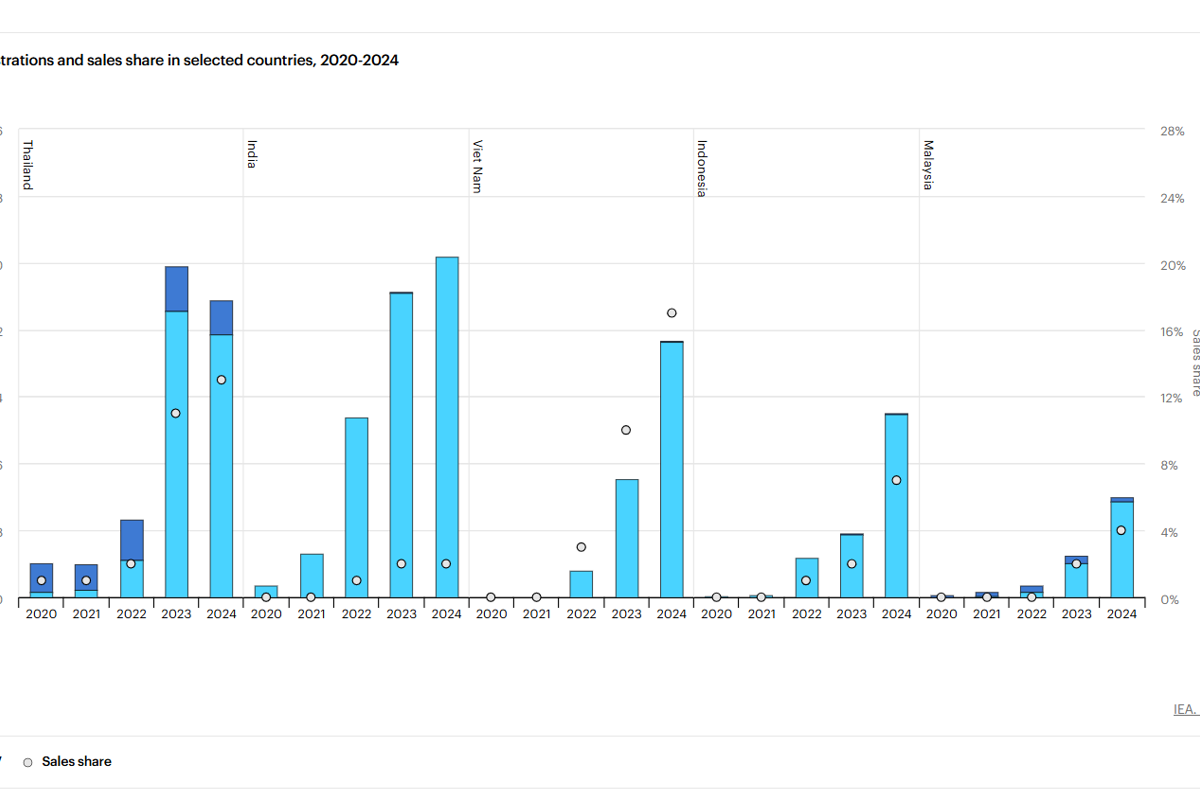
Beyond China’s borders, emerging Asian markets are writing their own electric success stories. Sales reached almost 400,000 units in 2024, marking a 40 per cent increase from 2023. India’s journey has been more measured, approaching 100,000 sales (2 per cent market share) in 2024. Thailand maintained its position as Southeast Asia’s largest EV market, achieving a 13 per cent sales share despite a 10 per cent drop in electric car sales. This figure looks more impressive against the backdrop of a 26 per cent decline in conventional car sales.
Indonesia and Vietnam emerged as surprising powerhouses, tripling and doubling their sales, respectively, matching the adoption rates of established markets like Spain and Canada. These markets show a strong preference for battery electric vehicles, which account for over 90 per cent of electric car sales.
The rise of Asian automotive brands
The region’s success isn’t just about sales — it’s also about innovation and manufacturing. New players like Vietnam’s VinFast and Türkiye’s Togg are making waves both domestically and internationally. VinFast has expanded to 11 countries, with significant exports to Indonesia (44 per cent) and Malaysia (22 per cent), while announcing ambitious plans for production expansion in India and Indonesia.
Türkiye’s commitment to electric mobility is equally impressive, with Togg increasing production by 50 per cent year-on-year. The government’s USD 5 billion investment package aims to boost annual production to 1 million electric cars.
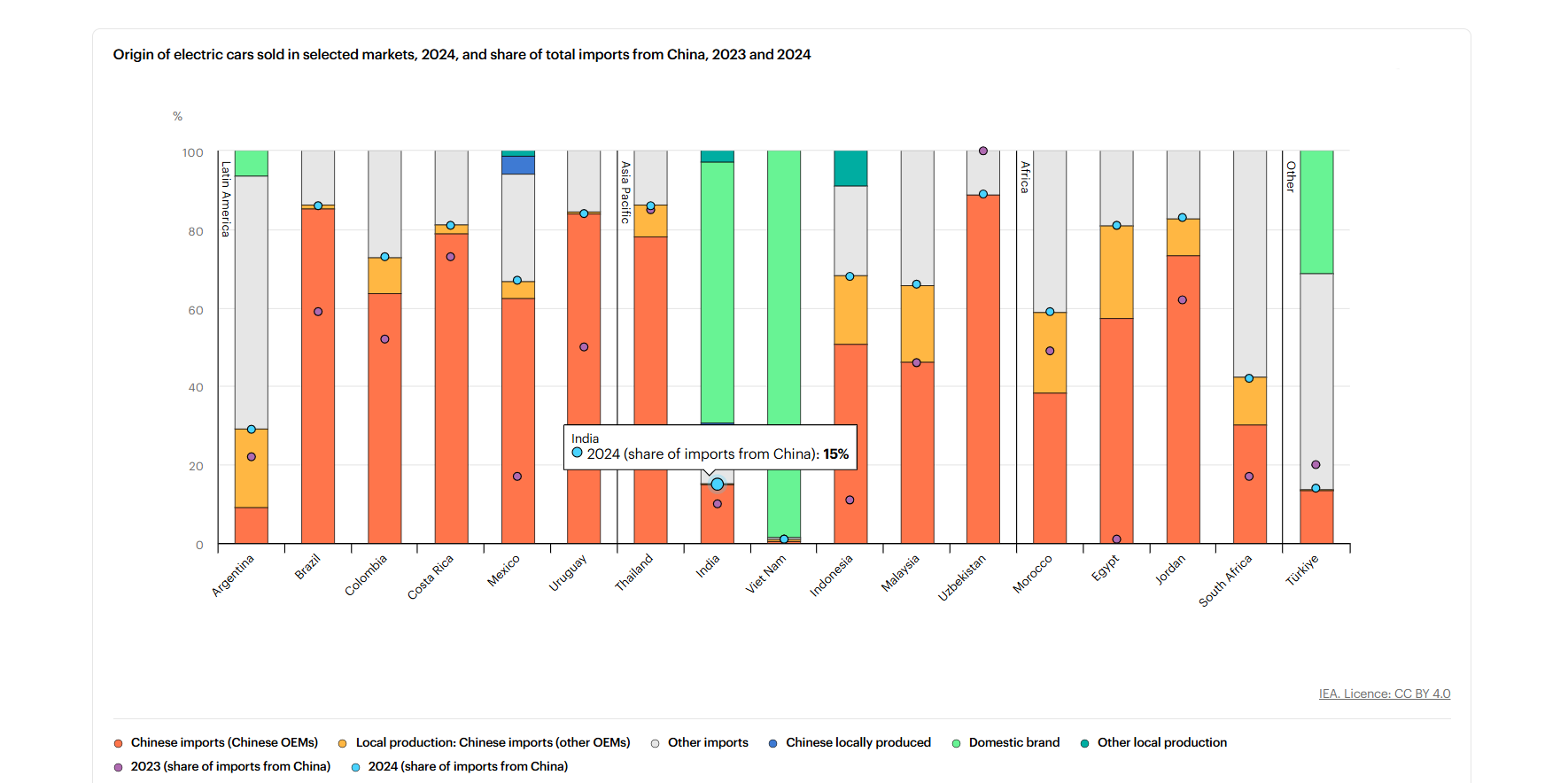
India’s market presents an interesting case study in collaboration. While Tata Motors leads domestic production, new partnerships are emerging. The joint venture between JSW and SAIC Motor (under the MG Motor brand) achieved a 50-50 split between domestic production and Chinese imports in 2024. JSW’s announcement of its own EV brand and potential collaborations with BYD and Geely signals growing ambitions in the sector.
The shifting landscape of manufacturing
2024 marked a pivotal year for manufacturing strategies, particularly as Chinese manufacturers responded to changing import tariffs across Asia. Thailand, where Chinese imports dominated 85 per cent of electric car sales, is transitioning towards domestic production through its EV 3.5 program. The program’s clever structure requires manufacturers to produce two domestic BEVs by 2026 for every imported BEV sold in 2024-2025 to maintain tax benefits.
Indonesia’s success story, revolving around a tripling of electric car sales against a 20 per cent contraction in conventional markets, stems from smart policy-making. The reduction of VAT from 11 per cent to 1 per cent, coupled with import tax waivers for manufacturers investing in local production, has attracted major players like BYD, GAC Aion, and Stellantis.
Malaysia’s doubling of electric car sales in 2024 has set the stage for domestic manufacturing initiatives. Geely’s partnership with Proton and Perodua’s planned entry into the electric market promise to reshape the local industry landscape.
The first quarter of 2025 has maintained this momentum, with sales growing 35 per cent compared to the same period in 2024, surpassing growth rates from previous years. With over 4 million electric cars sold in just three months, the electric revolution shows no signs of slowing.
The transformation of Asia’s automotive sector represents more than just a technological shift — it’s a fundamental reimagining of mobility. As manufacturers race to establish local production capabilities and governments fine-tune their incentive structures, the region is not just participating in the global electric vehicle revolution... It’s leading it.
Information and image credit: International Energy Agency












_md.webp)