Alumobility accelerates automotive innovation with six major aluminium projects

Alumobility, established in 2021, is a global collaborative network designed to promote the use of aluminium in the automotive industry. The ecosystem brings together leading aluminium producers—Constellium, Novelis, and Speira—with downstream technology partners and OEMs.
"What we are trying to do is create a team of people with wide industry knowledge, including our technical partners, like Magna, Atlas Copco, and Fisher," said Mark White, technical director of Alumobility.
Through joint project studies, Alumobility aims to develop innovative systems that enable the creation of lighter, safer, and more sustainable vehicles. In its first three years, Alumobility completed six major aluminium conversion projects, each demonstrating significant weight reduction while meeting or surpassing automakers' performance standards.
“We pool all of this knowledge and resources together into these projects to demonstrate to OEMs that there is a better way of building more sustainable bodies and vehicles for the future. We’re trying to create implementation-ready solutions, so that if an OEM decides to switch from steel to aluminum, we can provide them with all the key enablers to make that happen,” added Mark.
Alumobility’s six major projects
As per Light Metal Age, the first project focused on converting a mass-produced C-segment SUV passenger door from steel to aluminium, achieving an impressive 45 per cent weight savings. Following the passenger door project, Alumobility investigated the B-pillar, one of the most complex and traditionally heavy components in a vehicle's structure, due to its critical role in vehicle integrity and safety. The project successfully demonstrated that transitioning from a conventional steel solution to high-strength 6000 series aluminium alloys in the B-pillar could achieve a 35 per cent weight reduction while meeting structural and safety standards.
"B-pillars are quite challenging, because there's a bit of an urban myth that you can't have an aluminium B-pillar, that it can only be in high strength steel. We wanted to dispel that myth," noted White.
Building on the insights from the B-pillar project, Alumobility used the Audi e-tron electric SUV as a reference in a study that showcased the potential of an aluminium automotive top hat (the upper structure of the body-in-white) to significantly reduce weight compared to steel, achieving 42 per cent weight savings.
This was followed by a project focused on Last Mile Delivery Vehicles (LMDVs), small, lightweight trucks essential for the growing e-commerce sector. The study developed an aluminium-intensive LMDV, demonstrating an overall weight reduction of up to 22 per cent compared to its steel counterpart, with the aluminium body-in-white alone delivering a 47 per cent weight savings.
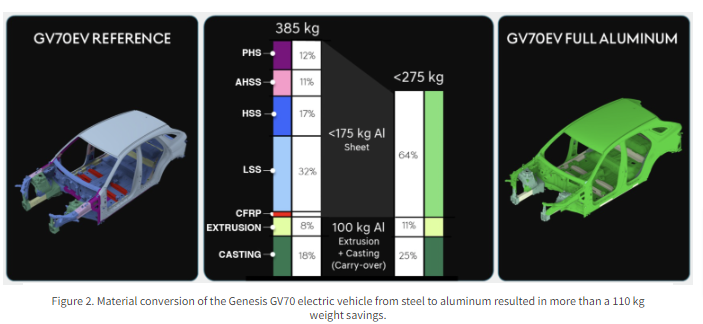
For its fifth project, Alumobility collaborated with Hyundai Motor Company to explore a theoretical conversion of the Genesis GV70 electric SUV's steel-intensive body to a fully aluminium structure. The original mixed-material body of the Genesis GV70 electric vehicle weighs 385 kg. The study replaced 285 kg of steel with 171 kg of aluminium, resulting in a 40 per cent weight savings for the converted components.
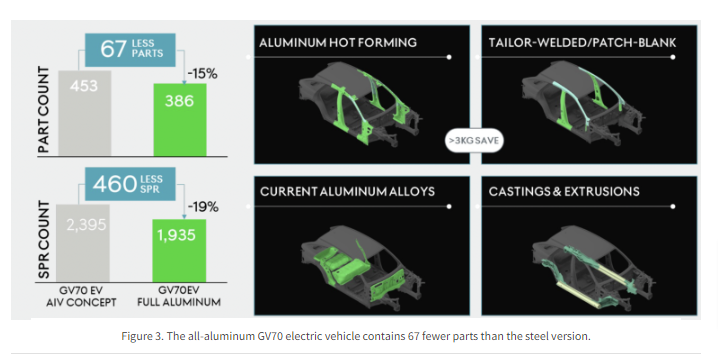
The project also emphasized optimizing the design to consolidate parts and reduce the variety and number of joints needed. This effort led to a 15 per cent reduction in the part count, decreasing the number of components from 453 in the steel-intensive version to just 386 in the aluminium version (Figure 3). Additionally, the number of spot-welded joints was minimized to 4,575, a 25 per cent reduction compared to the steel reference, and the number of SPR joints was reduced to only 1,935.
For the sixth project, Alumobility recently collaborated with Porsche on a theoretical case study to explore converting the existing steel-intensive, mixed-material body top hat structure of the Porsche Taycan all-electric sports car into an all-aluminium design. This conversion resulted in approximately 40 per cent weight savings compared to the steel reference parts while still maintaining essential attributes like safety, body stiffness, and performance.
The project highlighted the manufacturing efficiency benefits of aluminium-intensive vehicles, including a reduction in the number of parts, joint types, and total joint count. Furthermore, the study found that using recycled aluminium could significantly lower lifetime emissions compared to the steel reference.
Souce - Light Metal Age
Alumobility’s vehicle selection procedure
When selecting vehicles for their conversion studies, Alumobility focuses on projects that are most relevant to OEMs, particularly those where lightweighting can have the greatest impact on efficiency and driving range. This often includes SUVs and electric vehicles (EVs) but is not limited to these categories. SUVs, being the top-selling segment, offer significant opportunities for weight reduction due to their large size. EVs, on the other hand, are typically heavy because of their large battery packs, so reducing weight is crucial for enhancing driving range.
After selecting a vehicle model, Alumobility sets specific targets for the project. Typically, these targets include achieving at least a 40 per cent weight reduction across the body and major chassis components while maintaining the same performance as the steel version. This 40 per cent reduction is crucial as it facilitates further weight savings in other areas of the vehicle, such as enabling a smaller battery pack. Additional goals may include consolidating parts, simplifying gauge grades, and reducing the number of joints, as demonstrated in the Hyundai project, which aimed to cut the number of joints by 20 per cent.
Souce - Light Metal Age
Aluminium conversion stages
Alumobility begins with the initial straight conversion stage, where they take the steel reference parts and apply a set of value equations for a direct conversion. A conversion factor of 1.45 is used for basic structural parts, meaning that if a steel part is 1 mm thick, the corresponding aluminium part will be 1.45 mm thick. This approach typically results in an automatic weight savings of over 50 per cent. However, different components require varying conversion rates, particularly hard or strength-dominated ones, such as those using advanced high-strength or ultra-high-strength steel. In these cases, the conversion factor may range from 1.7 to 2.
“The big challenge for aluminium is to replace the ultra-high strength steel parts, such as B-pillars, A-pillars, and some of the structural members,” said White. “We relish those challenges, because we can take those parts and present aluminium solutions that meet or beat the performance of steel. For example, with components for roof crush protection, we believe that aluminium has an advantage, because aluminium absorbs more energy per kilogram than steel. Given the right grade and gauge, aluminium should be able to better absorb the impact during a crash, and these types of projects help to prove that. I don’t think it’s any coincidence that we’re seeing more and more crash structures in production cars, like the Ford Explorer or the BMW X5, where the whole front end of the car is being replaced in aluminium.”
Once the initial conversion is completed, Alumobility performs a hygiene check to verify that the weight and performance targets are met. Next, they move to the second stage, which focuses on combining and simplifying parts, reducing the number of joints, and optimizing the design for the aluminium concept. This stage also involves assessing the feasibility of the design in terms of joining and manufacturing processes, as well as evaluating the quality of the components.
In the final stage, the team re-evaluates the performance attributes of the aluminium design using the latest simulation techniques. They compare the aluminium conversion against the steel reference baseline to ensure that it meets or exceeds performance standards for attributes such as stiffness, strength, front crash, side crash, and other critical factors.
“To put this in context, with the GV70, we showed aluminium could increase torsional stiffness by 29 per cent and bending stiffness by 6 per cent, which is a considerable improvement over the steel baseline. So, we not only made the car as safe as the steel baseline, but have actually made it stiffer from a performance point of view,” added White.
The shift to aluminium
The automotive industry was predominantly steel-based until the 1990s when manufacturers like Jaguar and, later, Audi began introducing all-aluminium models. According to White, these vehicles indicated a future where aluminium could become the standard material for cars. In response, the steel industry evolved significantly, expanding from just four steel grades a few decades ago to over 65 advanced and ultra-high-strength grades today.
According to Light Metal Age, a significant trend from 2010 to the early 2020s has been adopting mixed- or multi-material construction, where automakers choose the most suitable material for each part. This approach often combines steel, aluminium, magnesium, composites, and other materials. According to White, this trend led to an unintended consequence.
The complexity of using multiple materials leads many automakers to revert to single-material designs. OEMs might use aluminium for closures like doors, hoods, and liftgates on a steel vehicle to achieve weight savings. In some cases, they may opt for a full aluminium top hat or even an all-aluminium body-in-white, as seen with models like the Ford F-150 or Lucid Air.
“You don’t hear many people saying the right material in the right place anymore,” explained White. “People better understand the penalties of mixed material now. Most people are of the view that it’s better to either make it steel or aluminium, and try to keep the interfaces between the two materials down to the absolute minimum, rather than mixing and matching.”
Conclusion
White believes addressing the issue of increasing vehicle weight is crucial despite advances in lightweight technologies. As vehicles become heavier due to larger batteries and additional technologies like entertainment systems and automated driving features, this weight increase compounds the problem. For instance, heavier cars require larger brakes for effective stopping and more robust crash structures to handle the greater energy involved in collisions.
“Our cars have been getting heavier and heavier. Imagine if we could reverse that weight cycle by mass decompounding. If we take enough mass out of the body and chassis using aluminium, we can actually reduce the size of the motors, battery pack, brakes, and other components. We could transform that negative weight spiral into what I call a virtuous spiral. That’s really where I’d like to get to with the next project and beyond—to show that we can make cars lighter, more sustainable, and more attractive to both the OEM and the customer,” concluded White.
Unlock full access – sign up for FREE.
Key benefits
Ball Corporation collaborates with global beverage brands to champion sustainable aluminium packaging
Next articleEskom rolls out 10 EV charging stations to support the growing electric vehicles market in South Africa
Grow with
AL Circle












_md.webp)
_md.webp)
_md.webp)







