As we reach the midpoint of the year, it's time to evaluate the performance of aluminium in the current market landscape. This analysis delves into the recent trends and factors impacting aluminium prices, offering insights into what we can expect in the year's second half.
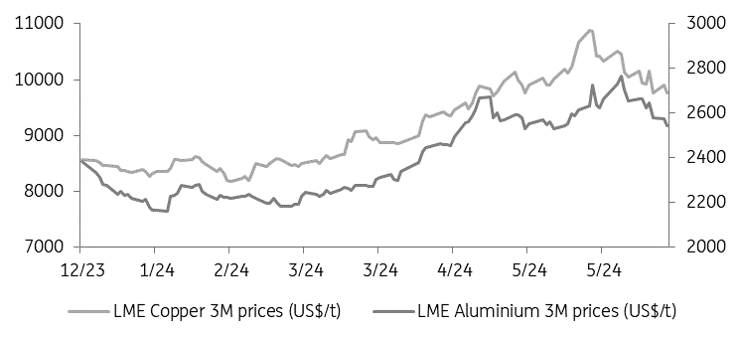
Aluminium prices on the London Metal Exchange soared to a two-year high by the end of May'24, spurred mainly by renewed investment in commodities following a significant rise in copper prices.
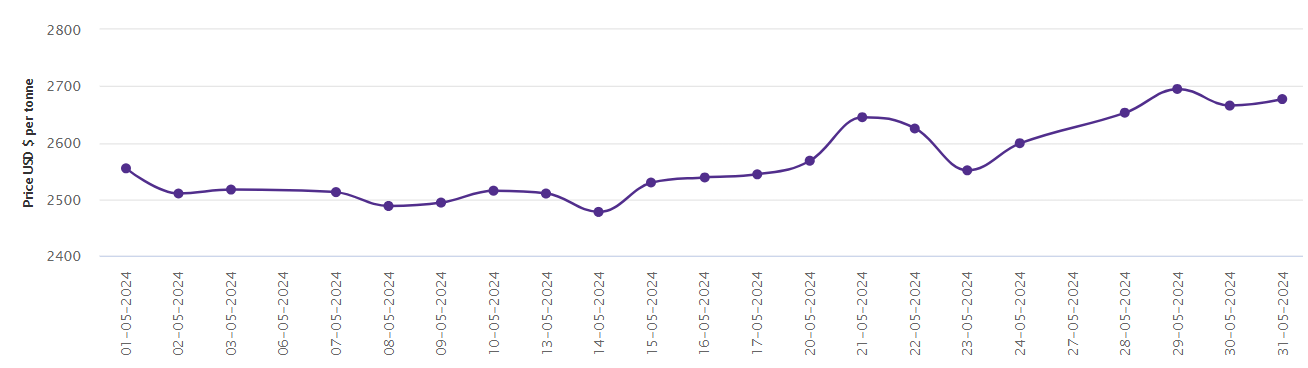 Source: LME, AL Circle News
Following Rio Tinto's declaration of force majeure on alumina shipments from its Queensland refineries due to gas shortages affecting their operations, supply risks temporarily drove aluminium prices higher. This force majeure impacts only third-party export supply, leaving Rio Tinto's own smelters unaffected. Despite initial concerns, these cuts are not expected to significantly impact the overall aluminium supply.
YTD industrial metals performance %
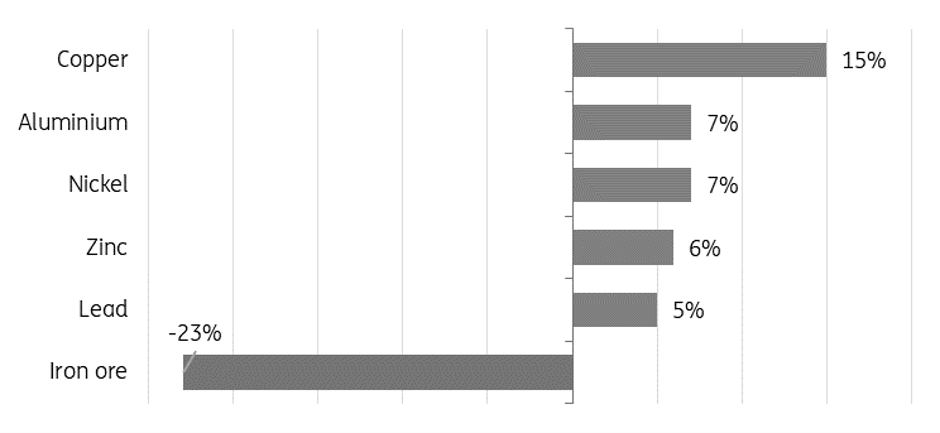 Source: ING
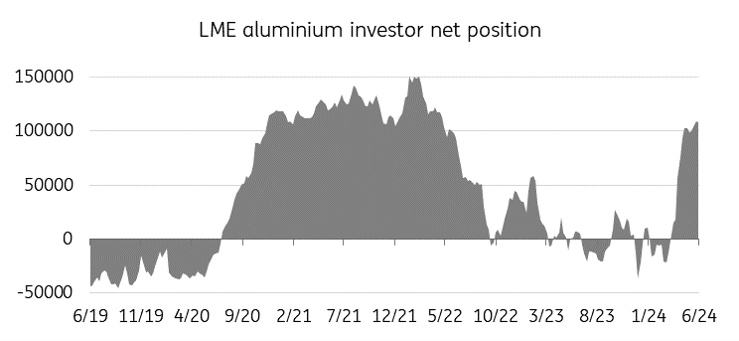
Since then, aluminium prices have declined by approximately 9 per cent, influenced by concerns over high global inventories, profit-taking by investment funds, and weak demand from China.
Despite the positive performance in May, the fundamentals of the aluminium market have not changed substantially, leaving prices vulnerable to further downward corrections. For 2024, the supply and demand outlook remains relatively balanced, with investor interest declining.
Aluminium and Copper soar to new highs in May 2024
AL Circle's industry-focused report, "Global Aluminium Outlook 2024", revealed that the global aluminium market in H1 2024 is anticipated to mirror 2023, but anticipated is a resurgence in both demand and prices for aluminium, expected to manifest in the latter half of 2024.
In early May, LME aluminium stocks experienced their largest daily inflow, primarily due to deliveries into Malaysian warehouses. By the end of May, total aluminium inventories had increased by 128 per cent compared to the previous month.
The surge in delivery wait times for aluminium on the LME, which escalated from zero to over five months, was reportedly triggered by substantial deliveries from the Trafigura group.
The latest exchange data reveals a 159-day wait time for aluminium delivery at Port Klang warehouses in Malaysia at the end of May. This marks the longest queue in the LME system since June 2021, when the wait time was 168 days.
According to the latest LME data, the Russian share of aluminium in London Metal Exchange (LME) warehouses experienced a significant decline last month, dropping to 42 per cent from nearly 90 per cent the previous month.
Despite an increase in the volume of Russian aluminium, which rose from 116,325 tonnes to 246,950 tonnes, its proportion of the total inventory decreased. This shift was due to a substantial influx of Indian-origin metal. Indian aluminium volumes surged to 293,325 tonnes from just 12,275 tonnes, raising its share on the LME from 9 per cent in April to 50 per cent in May. This increase followed large deliveries to Port Klang last month. In April, the LME banned the delivery of newly produced Russian aluminium in response to sanctions imposed by the US and UK.
China's aluminium production is rising
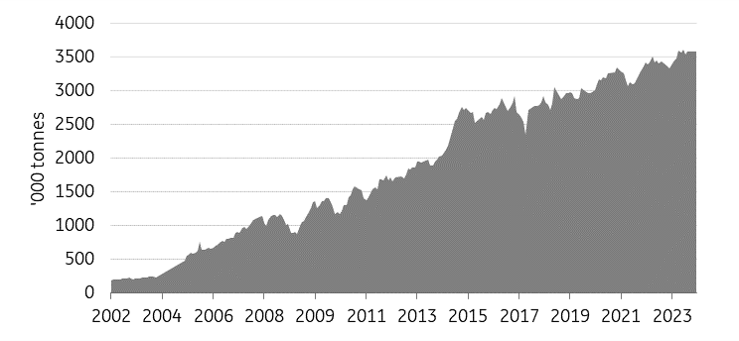
Source: NBS, ING Research
Chinese production is expected to rise in the coming months, driven primarily by Yunnan's steady recovery of power supply. As a result, the remaining idled capacity is gradually resuming operations. We anticipate that China's primary aluminium production will increase by approximately 2 per cent in 2024, reaching around 42 million tonnes.
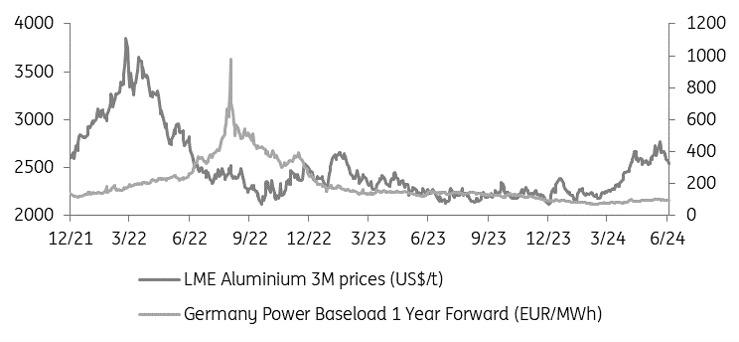
In Europe, smelter margins are stable due to high aluminium prices and lower energy costs, which might lead to more announcements of restarts, potentially driving aluminium prices down. The aluminium sector in Europe was severely impacted during the energy crisis, as producing the metal is highly energy-intensive. More than a million tonnes per annum of production was halted during the crisis. However, with power prices significantly retreating from their peak, the region is now witnessing some restart announcements. For instance, Trimet's St. Jean smelter in France restarted in the first quarter, and more such announcements are expected throughout the year.
High aluminium prices and low energy costs could lead to more European restarts
Source: LME, Refinitv, ING
Monetary policy in the US will significantly influence the trajectory of aluminium prices. Elevated interest rates and a robust dollar have recently suppressed industrial metals. Should US interest rates remain elevated for an extended period, this would bolster the US dollar and dampen investor confidence, thereby exerting downward pressure on aluminium prices.
AL Circle's "Global Aluminium Industry Outlook" report also unveiled the anticipated price increase in 2024 as demand slowly recovers. Global aluminium consumption is projected to grow by 100.6 million tonnes @ 2.33 per cent. The aluminium market is anticipated to experience a surplus in 2024, fuelled by the sustained growth driven by China. Geopolitical crises, inflation, economic deceleration in major economies, high bank interest, etc., will impact the industry. Despite all the above factors, the demand for aluminium consumption will still grow. However, the transition to renewable energy supply may increase the cost of aluminium production.
Note: All the data and information are sourced from ING, LME, NBS, Refinitv, Global Aluminium Industry Outlook 2024, AL Circle News













_md.webp)
_md.webp)
_md.webp)