您想继续阅读英文文章还
是切换到中文?
是切换到中文?

THINK ALUMINIUM THINK AL CIRCLE

In 2014 the Taiwanese Government had listed the metal related industry as one of Taiwan's pillar industries. It said going forward it would focus on assisting the sector to upgrade technology and develop high-end products. The country ranks second in per capita aluminium consumption with a rate of about 33.3 kg. The island country has reportedly seen a significant demand growth for aluminium alloy. One of Taiwan’s biggest flat-rolled aluminium products mill C.S. Aluminium has about 400,000 tonnes of aluminium product output capacity per year.
However, Taiwan imports both primary aluminium and aluminium alloys. Primary aluminium is used for making aluminium alloys and aluminium alloys for supplementing domestic production and make value-added products.
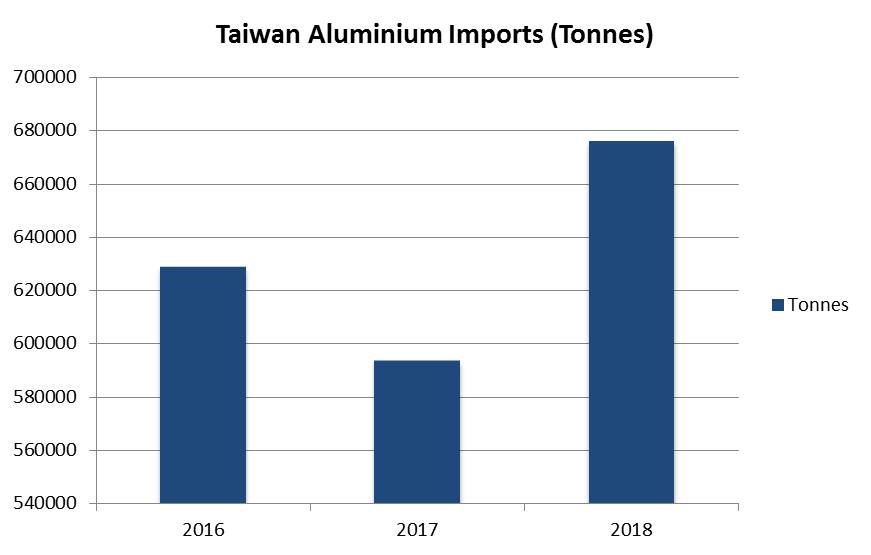
{alcircleadd}According to the global export-import data, Taiwan’s aluminium (both alloy and non-alloy) import is likely to increase this year by 14 per cent to 676,043 tonnes after a plunge last year. In 2017, Taiwan had imported 593,362 tonnes of aluminium in total, which was 6 per cent down from 628,659 tonnes in 2016.
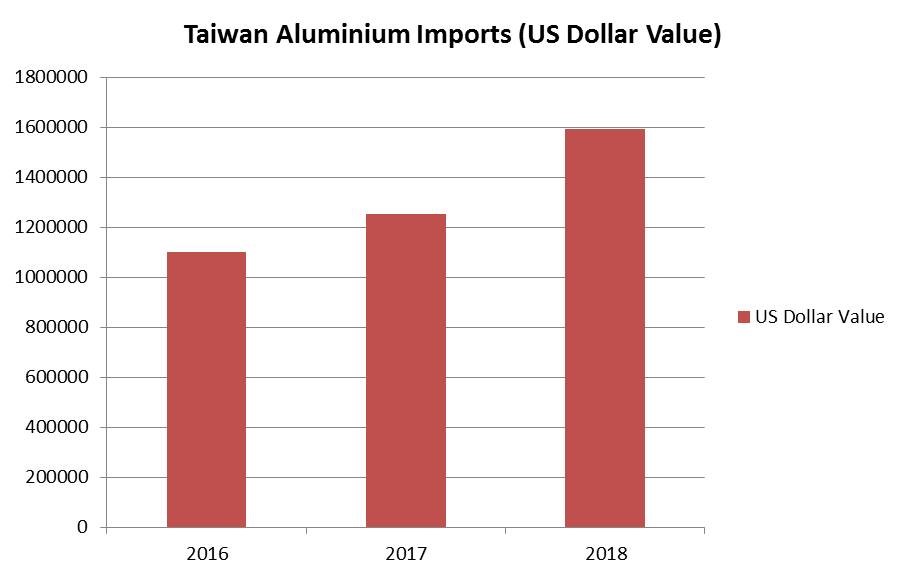
The import cost for Taiwan is also expected to grow this year along with the growth in volume. From US$ 1.2 million in 2017, it is likely to rise to US$ 1.5 million, which means up by 25 per cent. In 2016, the cost was at US$ 1.1 million. This is to be noted here that despite a fall in import volume in 2017, the cost stood higher than the previous year.
UAE and Australia are expected to be the two major exporters of both alloy and non-alloy aluminium to Taiwan this year. UAE is estimated to supply 145,038 tonnes and Australia 101,134 tonnes. Other anticipated notable suppliers include Iran (67,525 tonnes), India (54,189 tonnes), Saudi Arabia (51,989 tonnes), and the Russian Federation (48,396 tonnes).

Responses


A proud
ASI member
AL Circle Private Limited | CIN: U72200WB2017PTC221175
Registered Office: Ecospace Business Park, Block 3A, Unit 401A, New Town, Rajarhat, Kolkata, WB 700160
Corporate Office: Ecospace Business Park, Block 3A, Unit 401A, New Town, Rajarhat, Kolkata, WB 700160
© 2026 AL Circle. All rights reserved. AL Circle is not responsible for content from external sources.