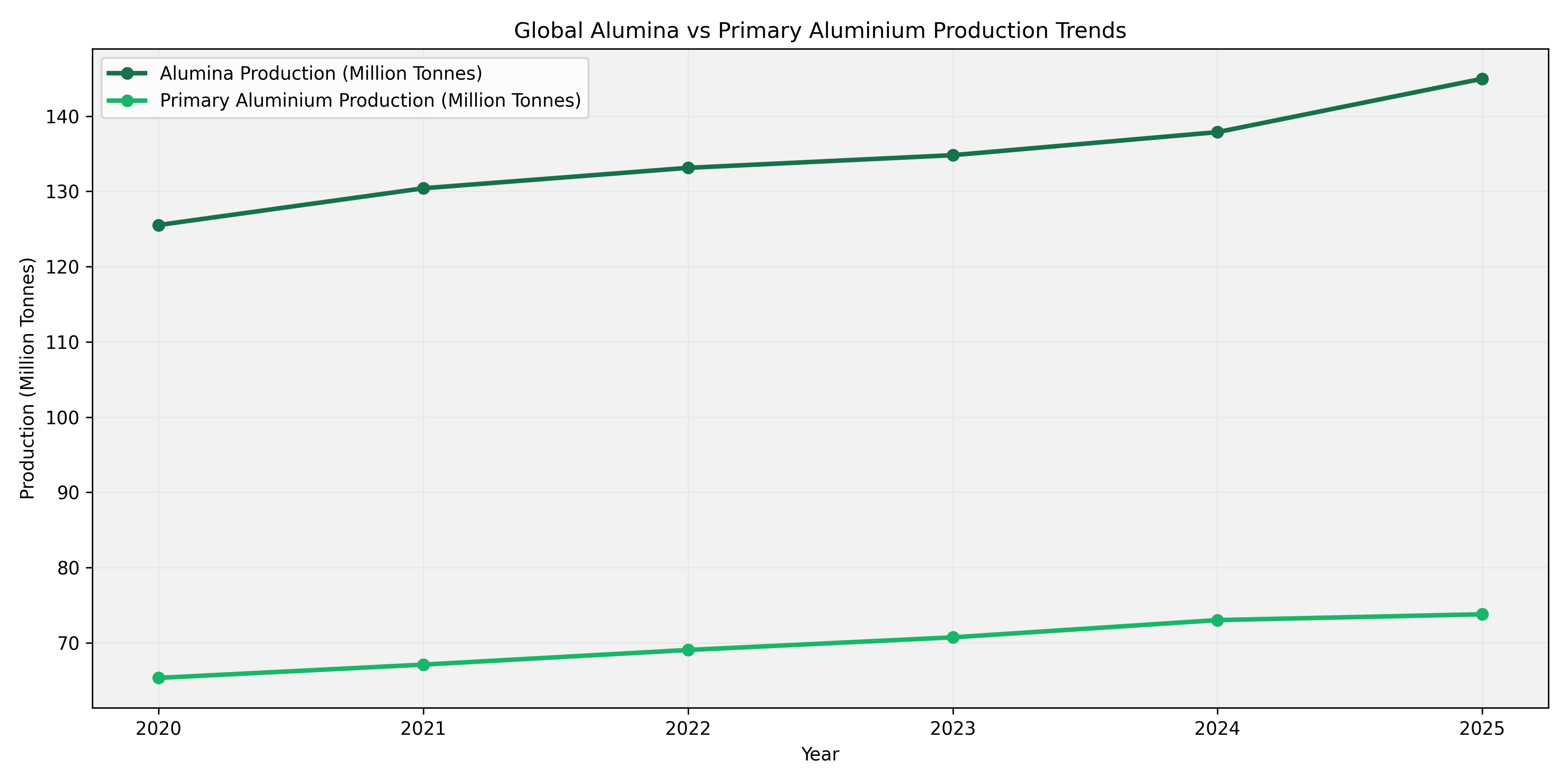
The world alumina production in 2025 tells markedly different story thanprimary aluminium. While the primary metal clocked the weakest growth rate in recent years, alumina registered the strongest five-year leap. According to the International Aluminium Institute (IAI), the world alumina production gained 5.07 per cent Y-o-Y in 2025 as against a 1.06 per cent increase in the world primary aluminium output. In the preceding years, the global alumina production growth rate majorly ranged between 2-4 per cent from 2021 to 2024.
The acceleration was led overwhelmingly by metallurgical-grade alumina, the feedstock for aluminium smelters. As far as chemical-grade is concerned, it grew by 3.15 per cent in 2025, which, however, was not the highest growth in past five years. In years like 2021 and 2022, the world chemical-grade bauxite production had even surged by 8.3 per cent and 11.3 per cent.
Coming back to metallurgical-grade alumina, the growth rate seen in 2025 can apparently leave a room for a few critical questions like - how alumina production boomed despite the bauxite supply chain constraint worldwide and where was this additional alumina output absorbed, given the tight growth rate in primary aluminium production. However, this puzzle can be solved with some facts and figures and here they are.
A strong finish drives annual growth
According to the data revealed by the International Aluminium Institute, the world alumina production in 2025 totalled 144.98 million tonnes as against 137.879 million tonnes in 2024. The year-on-year surge was decisively driven by the second half of the year. The turning point came in Q3 2025, when the output rose 5.9 per cent Q-o-Q and 6.36 per cent Y-o-Y. Successively, in Q4, the output grew by about 2 per cent sequentially and 6 per cent annually.
Yet this surge was far from geographically uniform.
Regional declines masked by Asian strength
Despite the strong global headline number, several major alumina-producing regions underperformed in 2025, such as South America, Europe (including Russia), and Oceania. Alumina production in all these regions saw either downfall or restraint. IAI data shows that alumina production in South America dipped by 0.41 per cent to 11.194 million tonnes (vs 11.240 million tonnes), while that in Europe decreased by 2.81 per cent to 5.778 million tonnes (vs 5.945 million tonnes). In Oceania, the output volume did not contract much but remained restrained at 17.213 million tonnes versus 17.242 million tonnes.
These regional setbacks meant that the global growth story hinged almost entirely on two regions: China and Africa & Asia (excluding China).
China: The primary engine of 2025 alumina growth
China emerged as the single largest driver of global alumina expansion in 2025. The country’s alumina production rose by 8.31 per cent year-on-year, reaching 88.30 million tonnes versus 81.52 million tonnes in 2024.
The acceleration was primarily driven by the hike in Q3 when production gained 8.2 per cent sequentially and 8.9 per cent annually. On the other hand, Africa & Asia’s (ex-China) alumina output primarily surged in Q2 by 5.3 per cent, reaching 3.586 million tonnes, followed by a rise of 4.2 per cent sequentially in Q4 to 3.845 million.
Notably, in contrast, China is the same region where primary aluminium production growth was modest at 2 per cent in 2025. Then, with limited primary metal growth, what did this region do with this staggering alumina output? If seen in absolute numbers, China’s alumina production was almost in sync with primary metal output, maintaining nearly the global standard ratio of 2:1. Rather in the previous year, China’s alumina production was less than what is required as standard to produce primary aluminium. While the alumina production was 81.523 million tonnes, primary aluminium output was 43.396 million tonnes.
With the growing alumina production in China, the country became the net exporter of the ore in 2025. After feeding domestic smelters to a large extent, China further exported its alumina to Russia, Indonesia, and the United Arab Emirates. However, for the domestic usage, China still imported some alumina of about 1.2 million tonnes, but down by 15.6 per cent Y-o-Y. As such, China recorded net alumina exports of 1.35 million tonnes during the year.
Now, addressing the question, how China built up the momentum of alumina production amidst global bauxite supply strain. The answer lies in Guinea where China has a strong foothold, accounting for 74 per cent of the West African nation’s total exports. The mines ministry data shows 23 companies shipped bauxite from Guinea, of which China’s Chalco led with 22.1 million tonnes. China’s overall bauxite imports from Guinea jumped 35.3 per cent on year to 149 million tonnes, indicating a limited impact of the mining licence revocation by Guinea in May 2025 on China.
Africa & Asia (ex-China): The emerging alumina hub, where Indonesia plays a key role
After China, Africa & Asia (ex-China) saw the highest growth rate of 4.8 per cent in alumina production, standing at 14.529 million tonnes at the end of the year. Africa has been emerging as an alumina production hub since 2024 when the production volume rose even higher on year by 6.5 per cent from 13.014 million tonnes to 13.859 million tonnes. Indonesia and India have been the two major countries driving the strategic position of Africa & Asia (ex-China) as one of the global alumina hubs.
The longstanding raw bauxite export ban in India has channeled all the resources to domestic alumina refining and aliminium smelting. With PT Borneo Alumina Indonesia’s operation commissioning in the fourth quarter of 2024 added to the 2025 production, estimated at 7 million tonnes, according to SMM. PT Borneo Alumindo Prima’s 1,000,000-tonne phase one facility, although could not meet the initial commissioning timeline of 2025, is expected to contribute further to Indonesia's comprehensive capacity expansion strategy. In fact, Indonesia’s bauxite demand is estimated to grow on year in 2026 from 20.9 million tonnes to 25 million tonnes, driven mainly by the rapid expansion of the domestic alumina industry, Shanghai Metals Market said during a webinar on Thursday.
India, being another important alumina producing hub from Asia, also showed progress in its ongoing financial year to be ended on March 31, 2026. While India’s stated-owned firm NALCO reported a 20 per cent increase in alumina production during the first nine months of FY2026, Vedanta achieved a record-breaking performance at its Lanjigarh refinery by producing 653,000 tonnes. Vedanta has expanded its Lanjigarh refinery capacity to 5 MTPA, while NALCO is progressing with its expansion, including the commissioning of a fifth stream refinery in June 2026, targeting a total production of 2.25-2.3 million tons for FY2026.
Offsetting weakness elsewhere
The robust expansion in China and Africa & Asia (ex-China) effectively offset declines in South America, Europe, and Oceania. Although South America showed sequential improvement in Q3, rising from 2.748 million tonnes to 2.846 million tonnes and then stood stable in Q4, the annual declines through each quarter of 2025 offset the improved quarterly performance. Similarly, in Europe, although alumina production grew in Q3 and Q4 2025, standing at 1.425 million tonnes and 1.454 million tonnes, yet the volumes stood low compared to Q1 2025 when the output was 1.479 million tonnes or in the preceding periods when the production was 1.515 million tonnes in Q3 2024 and 1.519 million tonnes in Q4 2024.
What’s in store in contrarian situation?
Surely, the alumina surge in 2025 reflects a deeper structural recalibration in the aluminium value chain, but it happened just when the demand for the ore is sluggish. Already NALCO CMD has warned that their higher alumina output may not translate into revenue gain in FY2027 due to soft prices owing to sluggish demand. So, what needs to be watched is how the alumina production growth gets used by the primary aluminium industry, where production is currently constrained by energy costs, carbon pressures, and policy uncertainty.












_md.webp)
_md.webp)
_md.webp)







