您想继续阅读英文文章还
是切换到中文?
是切换到中文?

THINK ALUMINIUM THINK AL CIRCLE


_0_0.png)
As the US strengthens domestic manufacturing under clean energy incentives, aluminium extrusion is becoming central to policy debates. In this exclusive interview, Aluminum Extruders Council President Jason Weber discusses domestic content rules, solar manufacturing, trade enforcement, sustainability, regional supply chains and how US aluminium extruders can strengthen competitiveness in the evolving global market.
Jason Weber is President of the Aluminum Extruders Council. He has more than 30 years of experience in the aluminium business, including senior sales, marketing, and executive leadership positions with several major extrusion companies. As President of AEC, Jason works closely with industry leaders on workforce development, technical education, trade policy and enforcement, market development, and initiatives that strengthen the competitiveness of the aluminium extrusion industry. He leads the Council’s efforts to address industry priorities, develop valuable programs and resources, and represent the interests of aluminium extruders throughout the broader aluminium value chain.
For a deeper view of Aluminium Extrusion Growth Markets, read the full interview below with Jason Weber.
AL Circle: The AEC has argued that aluminium extrusion accounts for about 61 per cent of manufacturing costs and more than half of the capital investment in a solar frame. Why do you believe extrusion, rather than downstream fabrication, should determine a product's domestic origin under Sections 45Y and 48E?
Jason Weber: Extrusion should determine origin because it is the manufacturing step that creates the essential form and function of the solar frame. Aluminum billet does not have a predetermined end use. It is extrusion that creates the specific channels, grooves, walls and structural geometry required by the solar module. Cutting that profile to length and punching holes into it adjusts an already manufactured product, but they do not create its essential character.
More importantly, the applicable Buy America framework expressly recognises extrusion as a manufacturing process, while United States federal guidance has treated drilling and similar activities as assembly rather than substantive manufacturing. United States Department of Commerce aluminium extrusion trade rules also recognise that downstream operations do not fundamentally change the character of the extrusion. The domestic content incentive should therefore follow the location of the substantive manufacturing process, not simply the location of final cutting and punching.
AL Circle: Your joint white paper points to a loophole allowing imported extrusions to qualify for domestic content incentives after only minor fabrication in the US. How widespread is this practice, and what impact has it had on investment decisions by domestic extruders?
Jason Weber: The economic effect is significant. A US extruder has difficulty justifying dedicated dies, press time, material-handling equipment, finishing capacity, and additional employees when a foreign-extruded profile can receive the same domestic-content treatment after relatively minor processing in the United States. That ambiguity suppresses domestic orders and delays or discourages investment in the part of the process that requires the greatest capital, technical expertise and manufacturing employment.
AL Circle: If the Treasury adopts the AEC's recommendations, what tangible changes do you expect to see in terms of new extrusion capacity, employment and investment across the US aluminium industry over the next five years?
Jason Weber: The most immediate result would be greater utilisation of existing US extrusion capacity. The press sizes and alloys required to produce solar frames are already widely available, so substantial new capital investment would not be necessary. Most extruders could enter this market with relatively modest investments in dies, tooling and material handling, while supporting additional production and technical employment. If demand remains strong, some companies may choose to expand capacity over time. It is difficult to estimate the number of jobs this could create, but increased production would clearly support additional manufacturing activity.
AL Circle: The US extrusion industry has evolved significantly over the past decade, driven by demand from construction, automotive, renewable energy and now AI-related infrastructure. Which end-use sector do you believe will be the strongest growth engine for domestic extruders through 2030, and why?
Jason Weber: Building and construction will likely remain the industry’s largest underlying market through 2030. At the same time, recoveries in automotive and general transportation should continue to strengthen extrusion demand as manufacturers place greater emphasis on lightweighting, efficiency and material performance.
Energy, electrical infrastructure and renewable applications will also provide important growth opportunities. Rather than one market driving the industry, future demand will likely come from a broad mix of construction, transportation, power generation and industrial applications.
One of the most significant evolutions of the extrusion industry over the past decade has been the way aluminium extrusion has continued to expand and adapt across these end markets. Far from being a mature or static sector, it has proven to be an evolving marketplace where both the material and the process consistently demonstrate new and growing value in the products we use today.
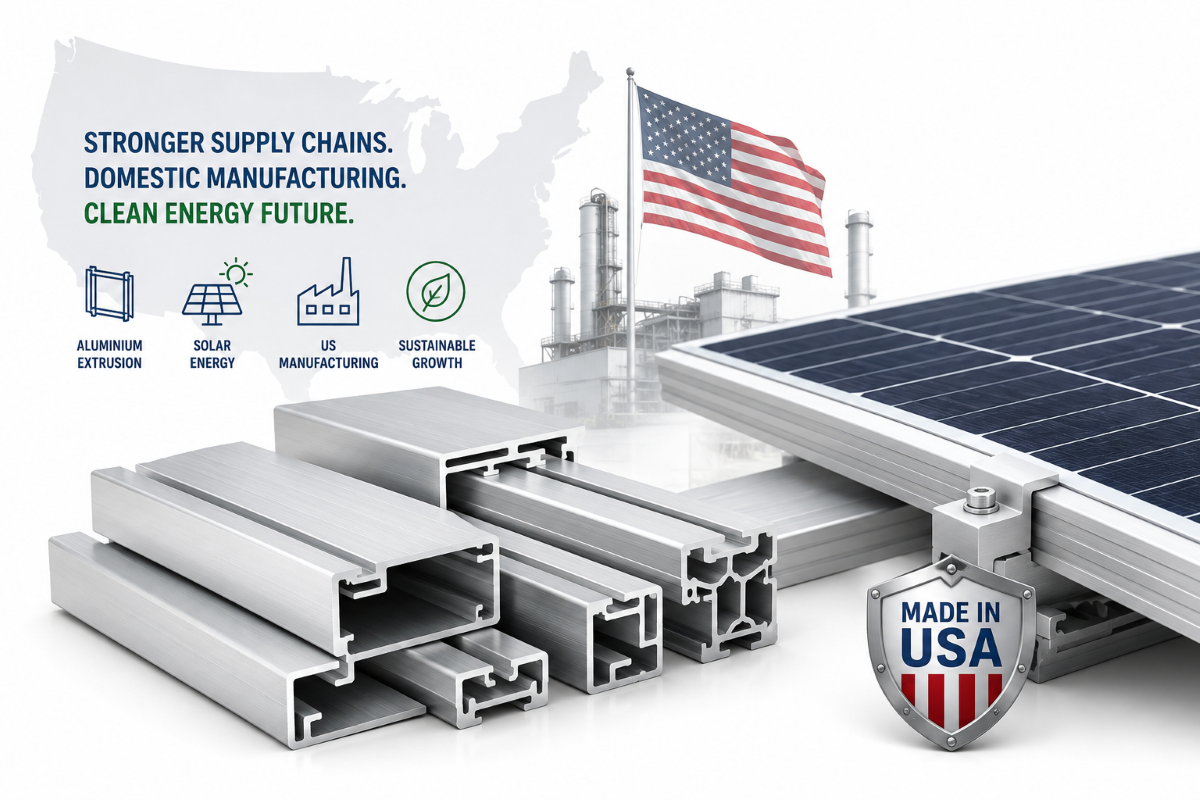
The image used in this article is generated with an AI tool and does not depict any real-time moment
AL Circle: The industry continues to face competition from lower-cost imports while customers increasingly demand low-carbon, high-performance aluminium products. How are US extruders adapting their manufacturing strategies to remain globally competitive without compromising sustainability goals?
Jason Weber: Extruders are competing on more than price. Quality, reliability, delivery, engineering support and the ability to provide fabricated or finished components all contribute to the value they offer customers.
They are also investing in automation, process controls, more efficient equipment, improved metal recovery and greater use of recycled aluminium. These improvements can reduce both operating costs and environmental impact.
AEC members recently collaborated to develop an EPD generator tool that enables individual extruders to produce certified, facility-specific Environmental Product Declarations. This provides customers with more precise data on the environmental impact of the products they purchase and helps extruders meet increasing demands for sustainability reporting and transparency.
AL Circle: Trade remedies such as anti-dumping and countervailing duties have provided support to domestic producers, yet concerns over circumvention remain. Beyond stricter domestic content rules, what additional policy measures would most effectively strengthen the long-term competitiveness of the US extrusion industry?
Jason Weber: A key long-term priority is ensuring that existing rules are effectively implemented and consistently enforced.
It is also important to strengthen rules of origin so preferential treatment is tied to meaningful production in the United States or North America, not minor processing of imported aluminium. Together, stronger enforcement and clearer origin standards would create a more level and predictable market for extruders.
At the same time, AEC members continue to invest in their future through new equipment, technology and workforce development. That is why AEC leadership remains focused on expanding our Business Excellence, Workforce Development and Industry Promotion programs to help members improve productivity, develop their people and strengthen their businesses.
AL Circle: With governments across the US, Europe and Asia increasingly linking clean energy incentives to domestic manufacturing, how do you see global aluminium extrusion supply chains evolving over the next five to ten years? Will this lead to greater regionalisation of production, or will globally integrated supply chains continue to dominate?
Jason Weber: Supply chains will likely become more regional. Extrusions are often highly customised, tooling-intensive, and expensive to transport, which makes production closer to the customer more practical. Domestic content policies and stronger rules of origin will reinforce this trend across all extrusion end markets. Proximity and reliability are especially important for custom products and applications that require close collaboration.
Low-carbon production and recycled content will also become increasingly important as customers track emissions throughout their supply chains. Continued technological innovation will enable extruders to produce more complex shapes, reduce weight, integrate multiple components, and offer additional fabrication and finishing services.
Manufacturers should prepare by improving traceability from billet to finished component, investing in flexible and data-driven equipment, and building stronger design and engineering capabilities. They will also need to secure reliable sources of recycled and lower-carbon aluminium and develop the skilled workforce required to operate increasingly sophisticated plants. The companies that lead will be efficient, technically capable, transparent, and close enough to their customers to solve problems quickly.
AL Circle: As countries tighten rules of origin and domestic content requirements, what competitive advantages will determine the future leaders in the aluminium extrusion industry – cost competitiveness, low-carbon production, technological innovation, or proximity to end-use markets? How should manufacturers prepare for this shift?
Jason Weber: Manufacturers will need to watch where customer demand is moving and decide which opportunities fit their own capabilities. For some, that may mean adding fabrication or finishing. For others, it may mean improving traceability, strengthening engineering support, investing in automation, or developing access to recycled and lower-carbon aluminium. There will not be one approach that works for every extruder.
AEC’s role is to help members make those decisions with better information and practical resources. Through our Business Excellence, Workforce Development and Industry Promotion programs, we are expanding technical education, sharing best practices, helping members develop their people and promoting the value of aluminium extrusions in growing markets. The goal is to give members tools they can use as customer expectations and market opportunities continue to change.