




If you buy, sort or sell aluminum scrap in the US, you’ve spent much of the past 20 months reading tariff headlines and working out what they mean for your yard. The first-half 2026 trade data now gives a clearer picture. Scrap kept moving in both directions, and domestic recovery picked up. What shifted is how the market treats the material.
Below are the numbers, a comparison with Europe, the UK and Asia, and straight answers to the questions scrap dealers ask most.
US aluminum scrap: The numbers at a glance
| Flow | Year earlier | Latest |
| US aluminum scrap imports | 424,000 metric tons (H1 2025) | 580,000 metric tons (H1 2026) |
| US aluminum scrap exports | 1.03 million metric tons (H1 2025) | 1.25 million metric tons (H1 2026) |
| US recovery from scrap (one month) | 297,000 metric tons (Jan 2025) | 318,000 metric tons (Jan 2026) |
Imports and exports come from separate tallies, and exports cover aluminum-bearing scrap broadly, so the two shouldn’t be netted against each other. The details sit in the H1 2026 import data, the export data and the USGS-based recovery figures.
Did the tariffs actually slow US aluminum scrap trade?
Only briefly, and the data shows no lasting dent.
The 50% tariff on aluminum imports has been in place since June 2025. Earlier trade analysis tied a softer second half of 2025 to it, with imports of about 263,100 metric tons from July through November, as covered in this look at the US-to-Asia scrap corridor.
The first half of 2026 then came in at 580,000 metric tons, up about 37% from a year earlier and roughly 80% above H1 2024. Q2 imports of 314,000 metric tons ran about 18% above Q1’s 266,000 metric tons.
Scrap appears to have been treated differently from unwrought metal and fabricated products, which helps explain why flows held up. The tariffs did change behavior, though.The tariff paradox is the best way to frame it. Protection was meant to trigger reinvestment, but much domestic capital waited for clarity while foreign groups built mid-size plants of roughly 20,000 to 60,000 tons a year near scrap sources.
For a dealer, that means new buyers with their own technology and specifications, not fewer buyers.
Is scrap covered by the 50% tariff, and can dealers count on Canadian and Mexican supply?
Industry commentary describes scrap as apparently outside standard Section 232 treatment. “Apparently” deserves a literal reading, so classification should be confirmed with a customs broker for each grade.
Canada supplied 369,000 metric tons in H1 2026, a 63.62% share and up from 197,000 metric tons in H1 2024. Mexico supplied 133,000 metric tons (22.93%), slightly below its 139,000 metric tons in H1 2025.
That concentration is the risk. In December 2025, no meaningful exemption was granted to Canada and no relief emerged within the USMCA framework. The US put more than 50 demands on the table, and the talks entered a long phase with little visibility. Tariff risk has become an operating condition, not a phase. Companies exposed to cross-border flows keep building hedges, as this outlook on uncertainty explains. The usual tools are dual sourcing, tougher domestic scrap capture, inventory buffers and contract language that settles pass-through and re-opener questions before a crisis.
Why are exports still climbing, and are export controls coming?
US exports of aluminum-bearing scrap reached about 1.25 million metric tons in H1 2026, up 21%. Thailand led with 268,000 metric tons, followed by India (233,350 metric tons), Malaysia (160,700 metric tons), South Korea (139,500 metric tons) and Hong Kong (136,200 metric tons). All five grew, with Hong Kong up 51%. Some Hong Kong volume may move on to mainland China, but the export data can’t confirm final destinations.
As for controls, no finalized scrap export rule appears in the coverage to date, but the pressure is building.
The Aluminum Association calls scrap a strategic asset. It says the US exports about 2 million metric tons a year, more than a quarter of its scrap supply. In August, it welcomed a presidential memo directing Commerce to use Defense Production Act authority on recoverable critical materials. It used the moment to repeat its call for targeted scrap export controls. In early October, it launched its America Needs Aluminum campaign, which calls for policies that capture and recycle more scrap domestically. The Secondary Aluminum Coalition for America has raised the same concern.
The other side has a real argument too.
Exporters and overseas buyers say trade moves material to facilities equipped to process it. Association president Charles Johnson was careful to say the US isn’t facing a true metal shortfall. His point, made in a recent interview, was that the country needs more domestic supply from every source.
Under normal conditions, scrap moving to the highest bid is economically rational. Conditions aren’t normal. With the arrival of SACA, scrap increasingly looks like a domestic industrial resource and not just a commodity. Asking whether critical streams should stay in North America doesn’t have to mean protectionism. The sensible approach is to plan for both outcomes.
Is the rest of the world dealing with the same thing?
Yes, but the US sits at an unusual point on the curve. Most major scrap-exporting regions are tightening, and policy is moving toward keeping scrap at home.
- EU: It remained a net exporter in Q1 2026, shipping 345,908 metric tons against 168,346 imported. Proposed waste-shipment changes could restrict nonferrous scrap going to India, Malaysia and Thailand. India sources 80% to 85% of its scrap overseas, and its EU access could change from May 2027. See the EU-India analysis.
- UK and Germany: UK scrap exports rose 9% year-on-year in January to April 2026, and Germany’s rose 8.8% in Q1.
- China: Imports slipped 3.2% to 981,000 metric tons in H1 2026 as higher prices, tighter overseas availability and weaker demand weighed on buying. Shipments from Thailand, a top destination for US scrap, fell 24%. See the China scrap import data.
- India: The largest buyer of EU aluminum scrap took 88,205 metric tons in Q1 2026, down 7.27% year on year. Its overall scrap imports also fell 16% in Q1 2026, tightening domestic supply. Against that backdrop, US shipments to India reached 233,350 metric tons in H1 2026, up 28%.
- South Korea: One of the world’s leading scrap importers, it melts scrap into aluminum alloys. It was the fourth-largest destination for US scrap in H1 2026, taking 139,500 metric tons, up 38%.
- Brazil: Its scrap exports to China are up 590% since 2022.
- European recyclers: Hydro says it has closed four recycling facilities in two years and wants stronger scrap safeguards. Constellium has warned its EU expansion could be shelved if shortages persist.
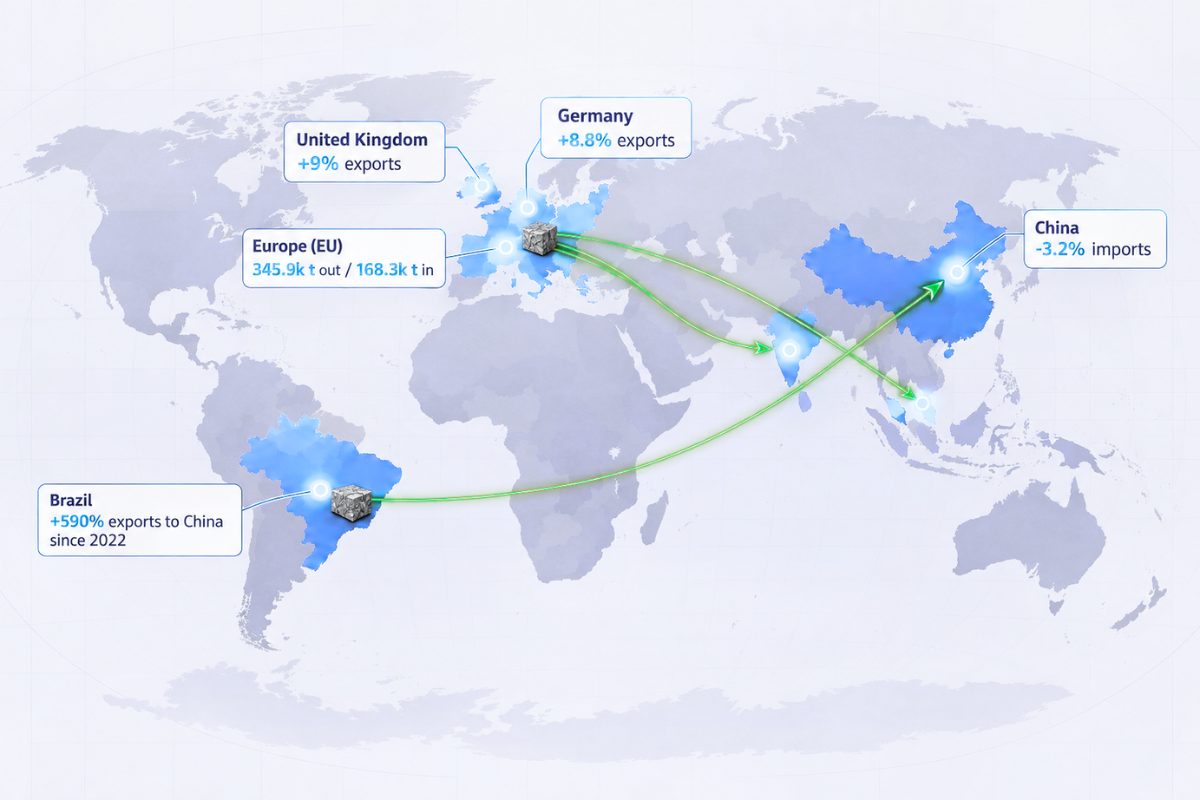
US aluminum scrap export growth of 21% is faster than the UK and German figures, though those cover different periods. The US is also importing 37% more, so it’s both a major exporter and a growing importer.
Europe’s constraint is feedstock. The US constraint is different. The furnace isn’t the bottleneck here. Consistent, bankable feedstock is, and that comes down to collection, sorting and decoating.
Why is US can recycling stuck at 43%, and what does it mean for supply?
This is one of the biggest domestic scrap pools, so it matters to dealers. The national aluminum can recycling rate sits at about 43%, which means more than half of cans still go to landfill. Scott Breen, president of the Can Manufacturers Institute, in an interview with Julio Quintero Cadavid, explains why progress is slow, as this breakdown of the 43% problem lays out.
- Fragmentation: The US runs more than 10,000 separate recycling programs, each with its own rules.
- Scale: Raising the national rate by one percentage point means collecting over a billion more cans a year.
- Downstream limits: Better sorting at material recovery facilities helps, but modeling suggests it adds only a few points.
- Deposit systems: Only 10 states have them, and they’re tied to the highest recycling rates globally.
The takeaway is that the constraint isn’t melting capacity or metallurgy. It’s system design. For dealers, upstream collection is the real swing factor for supply. CMI is now targeting 70% by 2030.
What are scrap prices and premiums telling dealers right now?
As of October 13, LME aluminum showed $3,036 per metric ton and US UBC scrap (Argus) at $2,617.99, roughly 86% of LME. The US Midwest premium stood at $2,359.95 per metric ton.
The direction over the past few sessions is worth noting. From October 9 to October 13, LME aluminum slipped about 0.6% (from $3,055.50) and UBC scrap eased about 1.5% (from $2,659.08). The Midwest premium moved the other way, rising about 0.7% (from $2,344.41). For context, the LME three-month price hit $3,787.50 on June 2, its highest in around four years.
The premium is where policy shows up.
Midwest premiums hit historic highs between December 2025 and January 2026, and the premium stopped being a logistical adjustment and became a signal of structural stress. Spot prices rose on tariffs and on real physical tightness, with reduced Canadian shipments narrowing the balance. US spot primary averaged $2.42 per pound in January 2026, up 71% from a year earlier.
Dealers following premiums and policy headlines together can find the latest US aluminum market updates in one place.
Tight primary supply reinforces scrap’s role as a strategic buffer, but competition for clean scrap intensifies too. Spreads tighten and quality differentials matter more, a dynamic covered in this piece on Middle East tensions and US recycling. Freight is part of the equation as well. One Ohio manufacturer, Shapes Unlimited, expects up to $5 million in extra costs this year from tariffs and Iran-related freight charges. Higher diesel costs also change which scrap is economically recoverable.
For margin volatility, a specialised hedging course with Jorge Dyszel can help metal recyclers, scrap traders, commercial managers and industry professionals get a practical understanding of price risk, currency exposure, price fixation and hedging strategies using futures and options.
Is domestic demand strong enough to keep scrap home?
The demand side looks solid. US recovery from scrap hit 318,000 metric tons in January 2026, up 14% year on year. The Aluminum Association says 85% of US-produced aluminum comes from secondary sources. Its latest study shows secondary production jobs up 21.9% from 2024 to 2026, per the employment study. The industry has invested more than $11 billion over the past decade, largely in mid- and downstream production and recycling.
New recycling capacity is also coming online. Novelis has produced the first coil at its $5 billion Alabama recycling and rolling plant, with commercial shipments targeted for Q2 2027. The company cites capacity constraints across the North American market.
Primary capacity is being rebuilt, but slowly. Century Aluminum is partnering with Emirates Global Aluminium on a smelter in Inola, Oklahoma. It would be the first new US primary smelter in more than 45 years, at roughly 750,000 metric tons a year. That is a long-horizon bet on reducing reliance on imported aluminum, even from allies. Still, primary capacity is unlikely to scale fast enough given power and permitting, a point made in this piece on aluminum as a national security tool.
The US produces under one million metric tons of primary a year and consumes more than five million.
So what should a scrap dealer actually do?
Five things stand out in terms of US aluminum scrap at this point:
- Sell preparation, not just volume. A buyer’s results are decided before the metal melts. This point was made plainly: sourcing scrap at the right price and quality is what keeps secondary producers competitive. Recovery of 96% to 97% is achievable under controlled conditions, but only with proper segregation, no contaminated material and stable charging. Furnaces then add controls like inline degassing and ceramic foam filters to stabilize quality. Sorting, decoating and sensor-based identification are becoming competitive necessities.
- Know the buyer’s feedstock reality. Processors are juggling Zorba, extrusion scrap, automotive sheet, oily, coated and wet scrap and scalper chips. Buyers that can run mixed streams will pay for consistency.
- Think regionally. Proximity is a real advantage when freight and geopolitics move costs around. Freight has become volatile, with sharp fuel-driven increases hitting margins. The new mid-size plants are sited near scrap and end users, and many have melting know-how but lack local sourcing networks.
- Plan in short horizons, with flexible contracts. Even established producers say they rarely plan with confidence beyond about 90 days. Re-openers, pass-through terms and clear grade specifications protect both sides.
- Build trust through consistency. Recovery after instability rarely comes from repositioning. It comes from a small base of trusted customers, steady quality and repeat orders.
Dealers looking for buyers or sellers of specific grades can start with the aluminum scrap listings.
Key takeaways
Twenty months on, the tariffs didn’t stop scrap from moving. Imports are up 37%, exports are up 21% and domestic recovery is rising. What changed is the framing. While Europe and others work to keep scrap at home, the US is still deciding whether to treat it as a freely traded commodity or a strategic resource.
The dealers best placed either way are the ones supplying clean, consistent, well-documented material close to where it will be melted.
Post your buying or selling requirement and connect with businesses across the aluminum value chain on our B2B marketplace.