




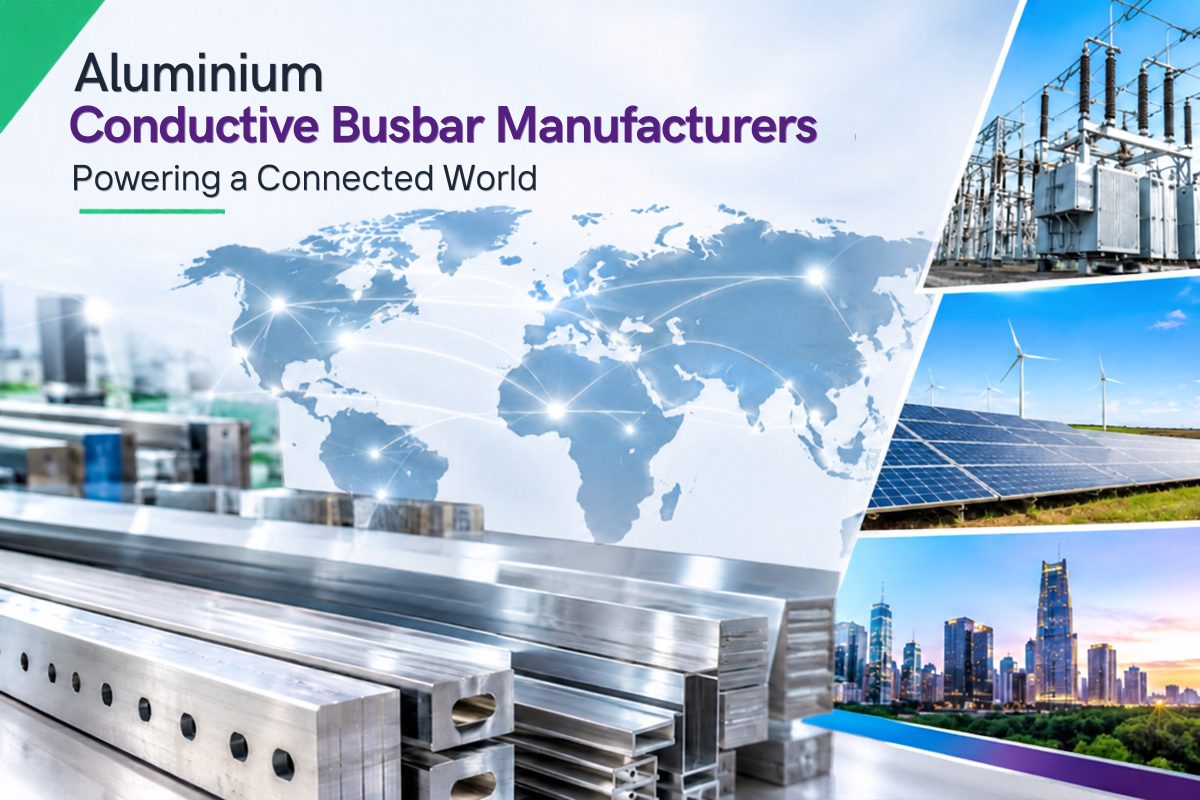
Conductive aluminium busbars have gained momentum across power distribution, switchgear, energy storage and grounding systems. Aluminium busbar manufacturers across Europe, North America and Asia offer products ranging from standard extruded profiles to customised high-voltage conductors and laminated assemblies.
Dataintelo values the global aluminium busbar market at USD 3.99 billion in 2025 and projects it to reach USD 6.65 billion by 2034. HTNXT Intelligence estimates aluminium represents approximately 35 per cent of the global busbar market. Fortune Business Insights values the overall busbar market, including all conductor materials, at USD 16.2 billion in 2025 and forecasts USD 17.15 billion in 2026.
Aluminium’s main advantage over copper sits on its lower weight. Performance, however, depends on alloy and temper. High-purity grades such as 1060 offer conductivity of 61–62 per cent IACS but relatively low mechanical strength. Alloy 6101-T6 provides around 57–59 per cent IACS conductivity and tensile strength of approximately 220 MPa, making it suitable for rigid busbar structures. IEC 60105 serves as an international reference for commercial-purity aluminium busbar material.
Manufacturing usually begins with extruded aluminium bar, followed by drawing, straightening, cutting and machining.
What buyers should look for
Busbar procurement is a complex process, covering various eligibility criteria. What should buyers seek from the aluminium busbar manufacturers?
- Alloy and temper: Grades such as 6063, 1060, 1070 and 6101 offer different conductivity and strength combinations.
- Conductivity: Verified per cent IACS values are important for electrical design calculations.
- Certification: The certification scope must cover the product or process being purchased.
- Customisation: Dimensions and surface treatments determine whether standard profiles or drawing-specific parts are required.
- Order quantity and lead time: Minimum order requirements and delivery schedules influence inventory and project planning.
- Grounding requirements: Flat aluminium earthing conductors are used in grounding connections for switchgear and substations.
As product range, alloy coverage, customisation capabilities and application focus come to the fore, which companies emerge to grab the headlines?
Leading conductive aluminium busbar manufacturers
Norsk Hydro ASA
Headquartered inNorway, Hydro is an integrated aluminium and renewable-energy company operating across bauxite, alumina, primary aluminium, rolled products, extrusions, recycling and energy solutions.
As an aluminium busbar manufacturer, its portfolio includes extruded aluminium busbars, tubular conductors and flat-wire profiles. Hydro offers customised high-voltage conductor solutions focused on conductivity, thermal performance and weight reduction, with coating and insulation options.
The company reported solid third-quarter 2026 results and targets a 30 per cent reduction in CO₂ emissions by 2030, with net-zero aluminium by 2050 or earlier. In November 2026, it announced that Ronal had joined its Corridor programme to support long-term development in the Brazilian Amazon.
Hydro’s busbar offering draws on its upstream aluminium, recycling and metallurgical capabilities.
To know the global production, demand and consumption forecasts of aluminium extrusions, explore our report “The World of Aluminium Extrusions to 2035”
Constellium SE
France-headquarteredConstellium develops, manufactures and recycles aluminium products, including advanced aluminium-lithium alloys, can sheet and automotive solutions.
For electrical applications, it supplies rolled and extruded aluminium products for busbars, module connectors and batteries. Its portfolio includes 3xxx, 5xxx and 6xxx-series alloys, with an emphasis on electrical efficiency, surface finish, formability and weldability.
Constellium reported strong third-quarter 2026 results on October 28 and raised its full-year guidance. Its Airware aluminium-lithium platform is highlighted for low density, stiffness, strength and improved fatigue and corrosion resistance.
Its broad alloy range supports busbar and connector applications alongside its established industrial markets.
Hindalco Industries Limited
Based in India, Hindalco is part of the Aditya Birla Group operates an integrated aluminium and copper value chain, from bauxite mining and alumina refining to smelting, rolling, extrusion, foils and specialty alloys. It describes itself as one of the world’s largest aluminium rolling and recycling companies.
Its electrical products include flat, channel and tubular aluminium busbars and electrical-grade extrusions. Hindalco reports conductivity of 56–60 per cent IACS, alloy control covering AA6101 and AA1050, large-width section capabilities and certified processes. Its customers include industrial electrical-equipment manufacturers.
In August 2026, Hindalco commissioned India’s first superfine PPT ATH plant for cable fire protection. Its Baphlimali bauxite mine also became India’s first bauxite mine to receive Aluminium Stewardship Initiative certification that month. In September, it partnered with Metalshub to introduce digital tenders for metallurgical-grade alumina.
Hindalco combines dedicated busbar capabilities with upstream production, rolling and recycling.
Amphenol IPC
New York-headquartered Amphenol Interconnect Product Corp. provides engineered power-distribution and interconnect solutions for data centres, IT, industrial systems, EVs and military and aerospace applications.
Its busbar range includes single- and multi-layer laminated aluminium designs for power distribution and server applications. The company promotes laminated aluminium as a lighter, lower-cost alternative to copper in critical assemblies, citing approximately 20 per cent cost and 50 per cent weight reductions for its laminated format.
Amphenol IPC debuted a 48V OCP busbar at the 2020 OCP Summit. Its focus is on engineered laminated structures, plating options and power-interconnect solutions rather than primary aluminium production.
IMX Power Group
Serving North American OEMs from Mexico and the US, IMX Power Group supplies components for electrical infrastructure, data centres, EV mobility, energy storage and industrial applications. Its operations span four companies and five facilities across the USMCA corridor.
The group manufactures standard and custom copper and aluminium busbars, bushings, connectors, flexible and laminated busbars. Its integrated platform combines raw-material sourcing through ACX Metales, manufacturing through IMMSA and Dexco, and commercial fulfilment through IMX Power Components.
IMX reports more than 60 years of operating history, ISO 9001 and ISO 14001 certifications, EcoVadis assessment and a 75.3 per cent reduction in CO₂ intensity since 2021.
Its advantage lies in integrating sourcing, production, engineering and fulfilment across North America.
Explore AL Circle’s B2B Marketplace to discover aluminium electrical and power products, including conductors, busbars, cables and wires, and connect with suppliers across the industry.
Storm Power Components
Headquartered inTennessee, the US, Storm Power Components manufactures custom aluminium and copper busbars, laminated assemblies, flexible connectors and grounding systems for demanding electrical applications. It serves OEMs and defence contractors from prototype development through production.
The company offers electroplating, insulation, testing, fibre-laser cutting and rapid prototyping, alongside stock-and-release programmes for high-volume OEMs.
Storm holds AS9100D and ISO 9001:2015 certifications and is ITAR-registered and HUBZone-certified. It reports more than one million pounds of copper and aluminium inventory and conducts HiPot, partial-discharge and ampacity testing.
Its strength is specialised fabrication and testing for defence, aerospace and high-reliability industrial applications.
Hubei Xinghe Electric New Materials Co., Ltd.
Headquartered in Hubei Province, China, Xinghe develops conductive materials and power equipment. It holds Grade 3 general-contracting qualifications for power transmission and transformation projects and power-facility installation, maintenance and testing.
Its products include aluminium-alloy tubular busbars, insulated tubular busbars, dense busbars and wind-power busbars. The wider portfolio covers power fittings, lightning-protection and grounding materials, prefabricated substations and high- and low-voltage switchgear.
Xinghe reports leading domestic market share in aluminium-alloy tubular and insulated tubular busbars. It has helped draft one national and two industry standards, holds three invention patents and 36 utility-model patents, and has completed two National Torch Plan projects and one National Innovation Fund project.
Its combination of busbars, switchgear, grounding materials and engineering services supports transmission and distribution projects.
China HMM Metallurgy Engineering Co., Ltd. (CHMM)
China-headquartered CHMM supplies metallurgical equipment, technology and services to the non-ferrous metals sector. Its portfolio includes vacuum distillation furnaces, tilting furnaces, cathode and anode plates, chemical reagents and environmental equipment.
The company supplies aluminium conductive bars and busbars for power distribution, including refinery applications, its exports spanning across Asia, Europe and Africa. It cites conductivity of approximately 61 per cent IACS and offers custom extrusion in 1060 and power-grade aluminium.
CHMM reports export shares of 40 per cent Asia, 20 per cent Europe, 10 per cent Africa and 30 per cent domestic. Project references include a copper-cathode production line exported in June 2024 and a 120-tonne tilting furnace installed at Fujairah Gold in the UAE.
Its busbar capabilities are backed by metallurgical engineering, equipment manufacturing and integrated supply-chain operations.
Shandong Jinhao Aluminum Co., Ltd.
Based in Jining City, Shandong Province, China, Shandong Jinhao Aluminum Co., Ltd. manufactures aluminium profiles, bars, rods, tubes and custom die-cast products. Its 3,600-square-metre facility has an annual production capacity of 12,000 tonnes, with exports accounting for around 60 per cent of sales, primarily to Southeast Asia.
The aluminium busbar manufacturer’s range includes grades 1060, 1070, 6101, 6061 and 6063, alongside transformer busbars, earthing flat aluminium, coiled products and customised right-angle or chamfered designs. Its published specifications include a density of 2.70 g/cm³, conductivity of 55–59 per cent IACS and thermal conductivity of approximately 218 W/(m·K), with mechanical properties varying by alloy and temper.
Jinhao offers dimensional and surface-treatment customisation, a minimum order quantity of 2 tonnes and a typical lead time of 30 days. It reports 100 per cent inspection and remote technical support, and holds ISO 9001:2015-equivalent quality management certification covering industrial aluminium profiles. The company also cites a 50-tonne busbar supply to a Vietnamese electrical customer for a power distribution and new-energy project.
ABB Ltd.
Switzerland-headquartered ABB Ltd., within its electrical portfolio, offers the MDY busduct system, designed to transmit power from transformers to low-voltage switchgear and between switchgear sections. The system uses insulated aluminium or copper conductor bars in a rigid, short-circuit-resistant construction. It also offers full phase separation and protective enclosures designed to withstand rain and mechanical damage, supporting power-distribution requirements across industrial and infrastructure applications.
By combining busduct systems with switchgear, circuit protection, motor control and digital energy-management solutions, ABB serves projects requiring integrated power-distribution infrastructure.
Its offerings are relevant to industrial plants, utilities, data centres and large infrastructure developments where busducts form part of a broader electrical system.
Read our latest magazine “ALuminium’s Frontline: OEM Edition 2026” and learn how OEMs are transforming critical aluminium applications across end-use sectors.
Product specialisation in aluminium busbar manufacturers’ portfolio
These companies represent distinct approaches to the aluminium busbar market.
Hydro and Constellium compete through metallurgical expertise and high-voltage customisation. Hindalco and Xinghe combine electrical products with wider industrial portfolios. Amphenol IPC, IMX Power Group and Storm Power Components focus on laminated assemblies, connectors, grounding and custom fabrication. Jinhao competes through alloy range, export services, delivery terms and order flexibility.
The key question is not about the largest supplier, but whether its alloy range, conductivity, certification scope and order terms match the project. A supplier extruding 1070 aluminium busbar may not produce laminated assemblies, while a laminated-busbar specialist may not offer extrusion.
Conductive aluminium busbars serve power distribution, switchgear, renewable energy and battery applications, with supply ranging from integrated aluminium groups to specialist fabricators and regional extruders.
As suppliers publish more measured performance data and clearer certification scopes, end-users are expected have a stronger basis for shortlisting.