










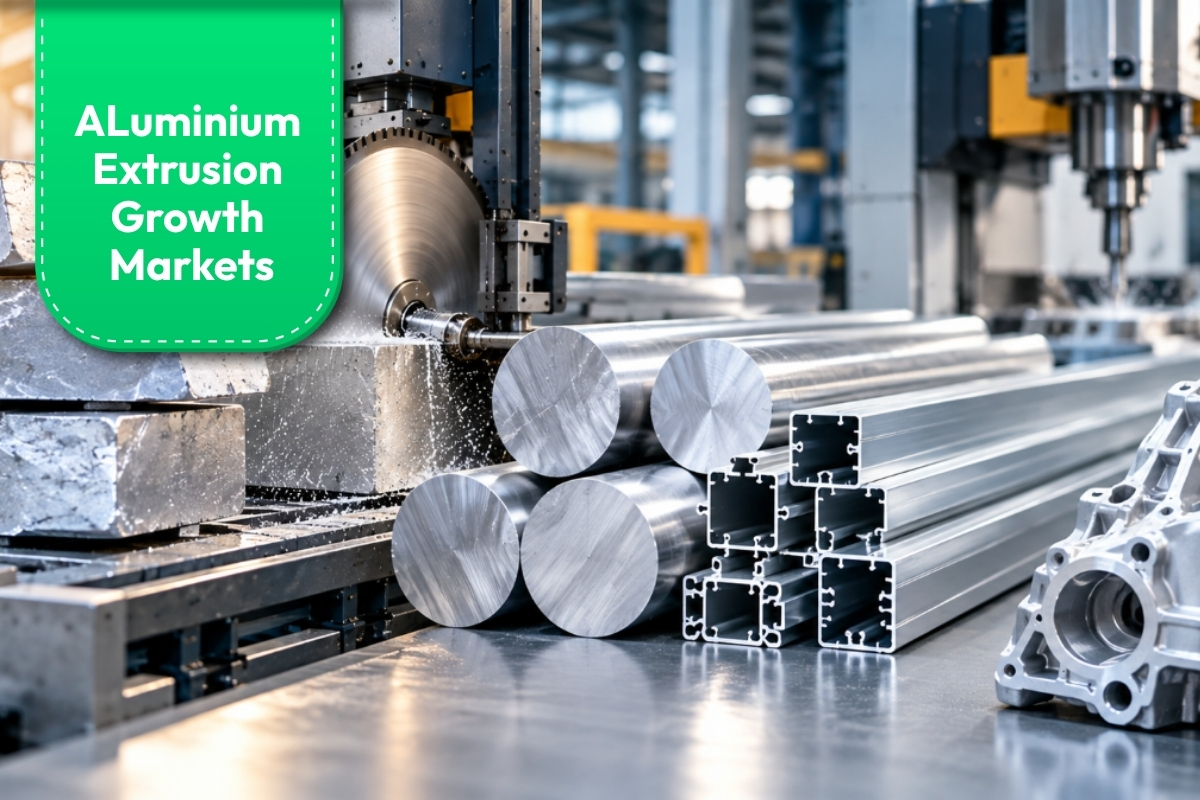
Aluminium moves through several processing stages, from large cast ingots and billets to extruded profiles and automotive castings. Turning these materials into finished components involves a range of cutting, sawing, milling and machining operations, where speed, precision and material efficiency all matter.
In Germany, manufacturers supply specialised machinery for different stages of aluminium production, from large-scale ingot sawing and billet preparation to precision machining of profiles and complex cast components. While some machines are built for high-speed, high-volume cutting, others focus on precise multi-axis machining and complex component processing. Its a home to range of aluminium extrusion technology companies.
The following technologies from different companies show how these machines are used across the aluminium processing chain.
1. August Mössner GmbH + Co. KG
August Mössner GmbH + Co. KG is a German machinery manufacturer based in Eschach. The company has been building bandsaws since 1906 and today employs around 140 people. Its business is divided between foundry technology and a dedicated aluminium division, with sawing and milling systems supplied for primary and secondary aluminium production worldwide.
Specifications — Cutting speed, power, and control:
- Band saw speed: The bandsaws operate at up to 3,000 metres per minute under full NC control, with sawing power of up to 100 kW. The machines have been used to saw an ingot weighing 40 tonnes and measuring 11 metres.
- Lubrication system: Minimum-quantity lubrication with active monitoring keeps the cutting area cool without the waste associated with conventional flood cooling.
- Process monitoring: Laser-based monitoring works alongside numerical control to track the cut in real time and automatically adjust lengths during production.
- Safety mechanism: Anti-pinch protection is integrated into the saw table to stop the blade from jamming between the freshly cut section and the remaining slab.
- Blade guidance: The guide arms automatically adjust to follow the ingot surface, helping maintain a clean cut and extend blade life.
The technology is particularly suited to aluminium, which can be prone to burring, work-hardening and heat buildup during cutting. For large ingots, slabs and T-bars, Mössner combines high-speed band sawing with minimum-quantity lubrication, process monitoring and automatic control to keep cutting temperatures under control, prevent smearing and maintain a narrow kerf, helping limit material loss.
The machines can also change cutting lengths without manual resetting, allowing producers to prepare material for rolling stock, extrusion billets and forging blanks. Integrated chip and scrap handling further helps manage the aluminium generated during sawing, allowing the material to be fed back into the recycling loop.
2. BEHRINGER GmbH
BEHRINGER GmbH is a German manufacturer of industrial sawing and automation equipment, headquartered in Kirchardt, Baden-Württemberg. Its portfolio includes band saws, circular saws, material-handling systems and automated solutions for metal processing.
One of its key machines is the HBM440ALU horizontal band saw, developed specifically for aluminium ingots, round billets and comparable non-ferrous materials, including magnesium.
Specifications – Capacity, cycle time, and control system:
- Band Saws: The HBM440ALU and HBM800-1201ALU handle round stock from 50 mm to 800 mm, running a 10,220 mm blade with servo-controlled feed, hydraulic clamping, and an integrated chip conveyor. The “ALU” tag isn’t cosmetic – it marks Behringer’s dedicated aluminium and non-ferrous product line, built distinct from its steel saws.
- High-Speed Saw: The HBM400Alu-Z completes a cutting cycle on a 300 mm billet in about ten seconds. Named and marketed explicitly for sawing aluminium billets ahead of forging and extrusion presses.
- Control System: BehrCtrl10 paired with Auto-Feed-Control (AFC Pro) auto-adjusts feed rate to real-time cutting resistance. Honest caveat: this control system runs across Behringer’s broader saw range — steel and aluminium alike — so it isn’t aluminium-exclusive. It is however, the same control system fitted to the aluminium billet saws above.
This technology is particularly relevant to billet casting and extrusion, where aluminium billets must be cut to consistent lengths before entering an extrusion press. Accurate billet preparation supports smooth press loading while helping maintain material yield and production efficiency.
For aluminium, BEHRINGER’s machinery handles billets, ingots and other large non-ferrous stock prepared for extrusion, remelting, rolling or further machining. Its automated sawing system improves consistency and reduces manual handling, while the narrower kerf of band-saw cutting helps limit the amount of aluminium converted into saw scrap during repeated cuts.
3. Emmegi
Emmegi Deutschland GmbH, headquartered in Zell unter Aichelberg near Stuttgart, Baden-Württemberg, is the German subsidiary of Emmegi, part of the Voilàp group alongside elumatec. The company specialises in aluminium processing equipment, supplying cutting systems, CNC machining centres, drilling and milling equipment for aluminium fabricators, window and door manufacturers, and architectural metalwork companies worldwide.
Specifications – Axes, travel range, and cutting capacity:
- Comet T6 HP 4+2: This four-axis machining centre has a spindle that rotates continuously from 0° to 180° and can process bars up to 7.7 metres long. In dual work-zone mode, it can machine six individual extrusion pieces at once.
- Phantomatic X4: This four-axis CNC centre provides 4 metres of longitudinal travel, with the spindle rotating from 0° to 180° for contour work.
- VEGAMATIC: The cutting centre uses a 7,395 mm blade and an 85 kW spindle motor, with cutting speeds of up to 60 metres per minute and mitre angles from −45° to +45°.
The machines are designed for extruded aluminium profiles used in window and door manufacturing, curtain-wall systems and structural sections, where drilling, milling and other operations often need to be carried out across multiple faces.
By machining different faces while keeping the profile securely positioned, Emmegi’s systems help maintain accuracy without repeated repositioning. The dual work-zone function also allows smaller extrusion components to be processed more efficiently.
4. GROB-WERKE GmbH & Co. KG
GROB-WERKE is a major German machine-tool builder headquartered in Mindelheim, with additional production plants in the United States, Brazil, China and Italy. The group generates more than EUR 1.6 billion in revenue and employs around 8,400 people.
Its G920-series solutions target the post-casting machining stage, where large thin-walled underbody structures require accurate milling, drilling and trimming.
Specifications — Axis travel, tolerances, and part scale:
- Universal centres: The G-series ranges from the G150, with 450 × 670 × 665 mm of travel, to the large-format G920.
- Giga-casting machines: The G920F5 and G920F4 are designed for automotive underbody components that can exceed 1.6 × 1.6 metres, with wall thicknesses of 2–5 mm and machining tolerances around ±0.05 mm.
- Spindle configurations: Twin- and four-spindle configurations allow manufacturers to increase throughput on the same machine platform.
- Additive system: The GMP300 produces aluminium components close to their final shape before finishing, reducing the amount of material that needs to be machined away.
GROB’s G920 series is designed to maintain these tolerances on large, thin-walled aluminium castings. Its modular 5-axis design also allows manufacturers to work on frame structures and battery housings, while twin- and four-spindle configurations support higher throughput.
5. Pressta Eisele GmbH
Pressta Eisele is a German specialist in circular and mitre saws for the aluminium window, façade, furniture and aircraft industries. The company also describes itself as the birthplace of aluminium corner-crimping technology.
Its approach is particularly focused on combining operations so that aluminium profiles do not have to be repeatedly transferred between machines.
Specifications – Blade size, motor power, and integrated operations:
- Profilma 540: A combi saw using a 500 mm saw blade and 7.5 kW motor, with stepless speed control and an integrated punching station. It can cut profiles to length and punch fastener holes in the same machine.
- GS 700 FIX: A circular saw with a 700 mm blade that can process profiles up to 530 × 270 mm, using hydro-pneumatic blade feed.
- V-Cut: An automated line with an electric pusher and profile separator, allowing fully programmable cutting cycles for series production.
The technology is particularly relevant to aluminium window, door and façade profiles, which are often produced in long runs before being cut to different lengths.
The Profilma 540 combines two operations that would otherwise require separate stages: sawing and punching. Performing both operations in one clamping reduces handling. This is also useful for aluminium profiles because repeated handling can lead to scratches and dents on the finished surface.
6. Tsune Europa GmbH
Tsune Europa GmbH is the German subsidiary of Japanese manufacturer Tsune, which produces high-precision circular saw machines for ferrous and non-ferrous materials. Its equipment is used for bar cutting, high-volume production and forging applications.
For aluminium, Tsune focuses on the advantages of cold circular sawing, particularly when bar stock needs to move into further machining or forging.
Specifications — Cutting range and automation:
- Model range: The TK2M, TK5C and TK5M model lines cover bar diameters from roughly 10 mm to 260 mm.
- Automatic feed: A bar-loading magazine continuously feeds material, while programmable part-cut and trim-cut lengths allow the machine to adapt to different specifications.
- CNC sorting: Finished parts, trim cuts and remnants are automatically sorted, with cutting parameters including blade rotation speed and feed rate controlled through CNC.
The rigid rotating blade produces a flatter and more perpendicular cut face than a flexible bandsaw blade, helping achieve tighter length tolerances.
That becomes important when aluminium bar stock goes directly into CNC turning or forging, because an inaccurate cut can require additional machining simply to correct the face.
7. elumatec AG
elumatec AG is a German-origin manufacturer headquartered in Mühlacker, Baden-Württemberg. Founded in 1928, the company produces machines for processing aluminium, PVC and steel profiles.
Its catalogue includes more than 120 products, while the company has more than 35,000 customers and over 6,000 profile machining centres installed worldwide. Its machines are used in architectural aluminium applications, including projects such as the dome of the Louvre Abu Dhabi.
For complex architectural profiles, the ability to complete several operations without repeatedly repositioning the workpiece is particularly important.
Specifications – Axes, clamping, and blade movement:
- SBZ 151: A five-axis machining centre capable of working on a profile from all six sides in a single clamping. Its saw head pivots from −110° to +110° and uses a 400 mm blade.
- SBZ 122 family: Modular 3- and 4-axis configurations, with more than 1,000 units installed worldwide.
- Global footprint: More than 6,000 profile machining centres are installed and operating worldwide.
Architectural aluminium systems such as curtain walls and structural glazing frames can require several operations on the same profile, including drilling, tapping, thread-milling, notching, routing and sawing. These operations may also have to be performed at compound angles.
The SBZ 151’s ability to work from six sides in one clamping reduces the positioning errors that can build up when a profile is repeatedly repositioned. The modular SBZ 122 family, meanwhile, allows fabricators to move from a basic 3-axis setup towards a 4-axis automated line as production volumes grow.
Together, these technologies highlight the different ways German machinery is supporting faster, more precise and efficient aluminium processing.


 Voyagerman Technology


