







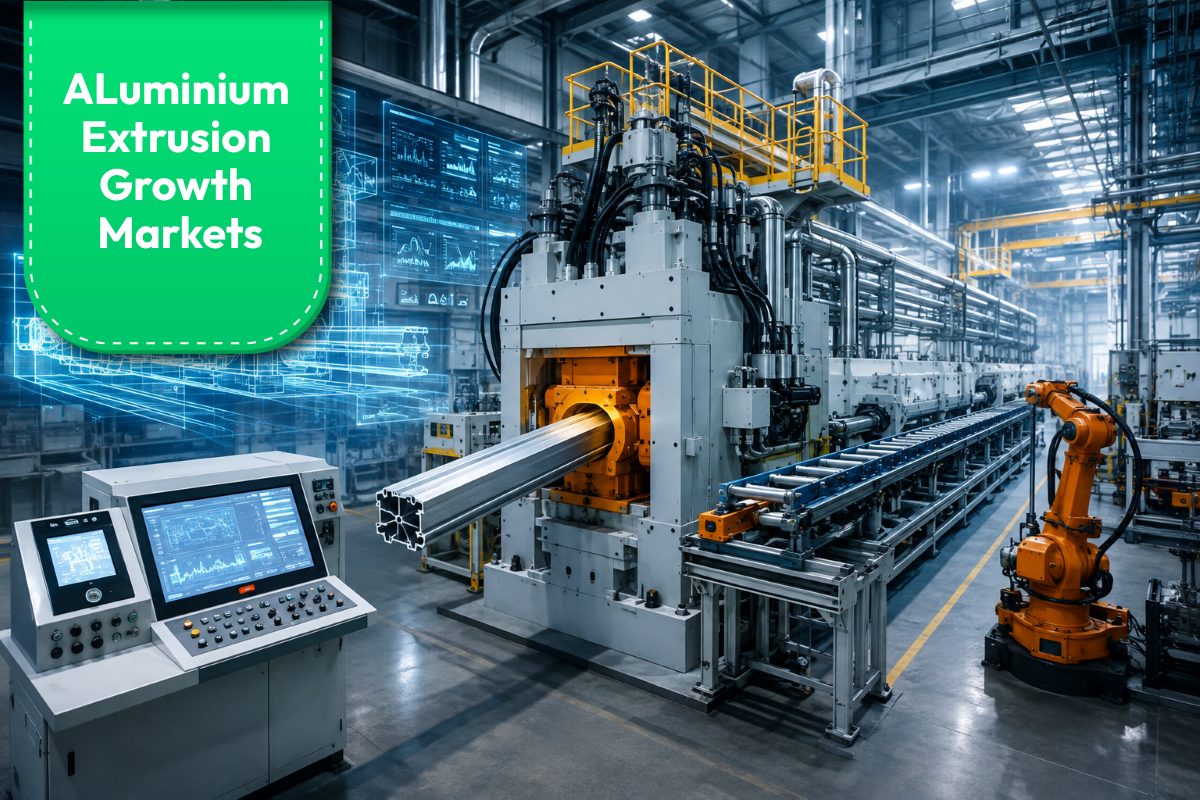
When people think about aluminium extrusion, the first thing that comes to mind is often the press. In reality, a modern extrusion plant is powered by much more than that. Automation, digital twins, energy-efficient press systems and intelligent downstream processing all work together to improve productivity, reduce energy consumption and ensure consistent product quality.
These technologies are becoming increasingly important as demand for aluminium extrusions continues to grow. In Europe, extrusion usage increased from 3.43 million tonnes in 2024 to around 3.49 million tonnes in 2025 and is projected to reach approx 3.99 million tonnes by 2032. To keep pace, manufacturers are investing in smarter, more connected extrusion plants that can deliver greater efficiency, precision and sustainability.
So, who is driving this transformation?
Across Europe, companies such as ABB, Siemens, SMS Group, Danieli Breda, Beckhoff and Fom Industrie are each solving a different part of the puzzle. Some are redefining automation, others are advancing digital manufacturing, while several are developing the next generation of extrusion presses and downstream processing equipment. Together, they are shaping how aluminium extrusion plants will operate in the years ahead.
Let’s take a closer look at the technologies behind that transformation.
1. ABB: Bringing intelligent automation to extrusion lines
Every successful extrusion line depends on more than just a powerful press. Stable production begins with intelligent automation that keeps every component operating in harmony. This is where ABB has built its expertise, offering automation packages that integrate drives, motors, programmable logic controllers (PLCs) and human-machine interfaces (HMIs) to maximise productivity, minimise downtime and improve energy efficiency across the extrusion process.
Rather than concentrating on one piece of equipment, ABB provides the control layer that keeps the entire extrusion line running smoothly.
Key technologies
ACS580 and ACS880 drives
- Deliver precise torque and speed control for extrusion operations.
- Support continuous, high-torque movement across press-line equipment.
IE5 high-efficiency motors
- Improve overall energy performance.
- Often supplied alongside drives and PLCs as an integrated package to simplify system integration and reduce energy consumption.
PLC-based thermoregulation control
- Maintains stable operating conditions throughout the extrusion process, helping ensure consistent production.
Built-in safety functions
- Optional safety modules help improve operational safety while maintaining productivity.
Low-speed torque control
- Provides accurate control during critical extrusion press operations where precision is essential.
ABB extends its capabilities beyond traditional machine controls
Its automation platform supports twin-screw, single-screw and piston extruders, making integration easier across different extrusion systems while maintaining accurate speed and torque control. The company also incorporates cloud connectivity and digital twin-based maintenance and troubleshooting, allowing manufacturers to monitor equipment performance and improve maintenance planning.
Automation also reaches material handling. ABB’s High Dynamic Performance motors and robotics portfolio support billet handling, tooling operations, inter-press transfer and profile handling around the extrusion line, reducing manual intervention and improving production efficiency. Explore the trends, technologies and growth opportunities in our report, The World of Aluminium Extrusions – Industry Forecast to 2032.
2. Siemens: Driving digital transformation in aluminium extrusion
If ABB provides the automation backbone, Siemens delivers the digital intelligence that allows extrusion plants to become smarter over time.
Rather than manufacturing extrusion presses, Siemens supplies the control systems, software and digital technologies that help manufacturers simulate, optimise and continuously improve production. Its metal-forming solutions combine integrated controls, drives and modular mechatronic concepts to enhance press performance, workpiece handling, safety and simulation.
The power of the Digital Twin
At the centre of Siemens’ extrusion strategy is its comprehensive Digital Twin technology.
Instead of waiting until equipment is installed, manufacturers can design, simulate and optimise machines, production lines and even complete factories before construction begins. For extrusion plants, this enables virtual testing of press behaviour, downstream production flow and automation logic before commissioning.
The company also incorporates:
- Virtual commissioning to shorten project implementation.
- AI-supported simulation for improved production planning.
- Closed-loop optimisation using real production data to reduce startup scrap and improve line stability.
Technologies supporting extrusion plants
Siemens’ portfolio includes several technologies that support extrusion operations:
- SIMATIC PLCs and TIA Portal for engineering and machine control.
- SINAMICS drives and SIMOTICS motors for precise control of ram movement, pullers and conveyors.
- SIMATIC HMI panels for operator monitoring.
3. SMS Group: Pioneering next-generation extrusion press technology
While automation and digital intelligence optimise production, the extrusion press remains the heart of every extrusion plant. SMS Group develops complete aluminium extrusion solutions, supplying light metal extrusion presses alongside comprehensive extrusion plant technology through its partnerships with OMAV and IAS.
The company’s latest developments demonstrate how press technology is becoming cleaner, faster and more energy efficient.
Key innovations
150 MN fully electrified extrusion press line
- Described as the largest aluminium extrusion press line in Europe.
- Designed to unlock new profile production.
- Supports lower-carbon, cost-optimised manufacturing across the aluminium value chain.
45-MN front-loading extrusion press
- Supplied to Constellium Singen.
- Features a highly precise linear guidance system for moving components.
- Improves press accuracy, alignment and repeatability during extrusion.
HybrEx® extrusion press
- Uses electric servomotors for most machine movements.
- Hydraulics are reserved only for high-force operations, including extrusion force generation, discard shearing and die-cassette shifting.
- Delivers up to 55 per cent lower energy consumption and 20 per cent higher productivity, according to SMS Group.
Indirect extrusion presses
- Designed for hard aluminium alloys, including the AA2xxx and AA7xxx series.
- Reduce billet-container friction.
- Improve surface quality for aerospace and automotive-grade extrusions.
SMS Group’s developments demonstrate how extrusion presses are evolving beyond higher pressing force. Today’s designs prioritise precision, electrification, energy efficiency and process stability, enabling manufacturers to produce increasingly sophisticated aluminium profiles with lower operating costs.
Connect with verified aluminium extrusion buyers and suppliers through the AL Biz marketplace.
4. Danieli Breda: Engineering energy-efficient extrusion presses
While SMS Group is pushing the boundaries of press engineering, Danieli Breda is advancing extrusion through a combination of energy-efficient equipment, intelligent controls and process optimisation. The company supplies integrated plant solutions for non-ferrous metals that are designed for long service life, high performance and operational reliability. Its portfolio includes direct and indirect, single- and double-action extrusion presses, giving manufacturers the flexibility to meet diverse production requirements.
Rather than focusing on a single innovation, Danieli has developed several technologies that work together to improve efficiency, consistency and plant performance.
Key technologies
ESED 4.0 energy-saving electrical drive system
- Delivers average energy savings of 25-30 per cent.
- Reduces electricity consumption while maintaining extrusion performance.
Isothermal extrusion control
- Maintains a constant billet temperature through the die.
- Produces more consistent mechanical properties across the entire profile length.
Fully electric billet loading and die-change stations
- Eliminate additional hydraulic circuits.
- Reduce maintenance requirements.
- Improve temperature accuracy while minimising heat loss.
Wireless tablet control
Allows operators to manage production, maintenance and remote service support through tablet-based HMIs.
Technologies in action
Danieli has incorporated these innovations into several large-scale extrusion projects:
28-MN press for Spectra Aluminium
- Front-loading direct extrusion press.
- 5,000 kg/h high-efficiency gas billet oven.
- ESED 4.0 energy-saving system.
- Fully electric billet loading.
- ECOFLAME billet oven that cuts gas consumption by 30-35 per cent, depending on product mix.
40-MN press for Cansan Aluminium
- Designed to expand hard-alloy extrusion capability.
- Incorporates ESED 4.0, isothermal extrusion, fully electric billet loading, electric die-change stations, wireless tablet control and pre-installed hydraulic and electrical skids.
47-MN press for Zahit Aluminium
- Uses ESED 4.0 and isothermal extrusion.
- Achieves consistent dead-cycle times below 17 seconds.
- Includes IBA data acquisition and analysis for continuous process monitoring and optimisation.
These projects highlight Danieli’s broader strategy of combining efficient press design with intelligent automation to improve productivity while lowering operating costs.
5. Beckhoff: Coordinating intelligent motion across the extrusion line
A modern extrusion plant is much more than a single press. Once extrusion begins, transfer tables, handling systems, saws and auxiliary equipment must all operate in perfect synchronisation to maintain a continuous production flow.
This is where Beckhoff plays its role. Rather than manufacturing extrusion presses, the company provides machine automation and motion control technologies that coordinate equipment across the production line.
Beckhoff’s contribution
Its automation platform helps synchronise:
- Press auxiliaries.
- Material handling systems.
- Transfer tables.
- Saws.
- Other downstream automation equipment requiring tightly coordinated movement.
Although Beckhoff operates behind the scenes, its control technologies help ensure that every stage following extrusion runs smoothly, supporting stable production and efficient workflow throughout the plant.
6. Fom Industrie: Transforming extruded profiles into finished products
Producing an aluminium profile is only part of the manufacturing journey. After leaving the extrusion press, profiles must be cut, machined and finished before they are ready for applications in construction, transportation or industrial products.
This is the area where Fom Industrie specialises. Instead of manufacturing extrusion presses, the company develops equipment dedicated to processing extruded aluminium profiles, helping manufacturers convert freshly extruded sections into finished, application-ready components.
Be part of Aluminium’s Frontline: OEM Edition 2026, our exclusive magazine, and showcase your innovations to the global aluminium industry
Profile-processing technologies
Fom’s equipment portfolio includes:
LMX 650
- Fully automated cutting and machining line.
- Supports up to 50 motorised axes, depending on configuration.
LT3 550
- High-output three-blade cutting line for extruded aluminium profiles.
AXEL 5
- Five-axis machining centre.
- Designed for drilling and milling aluminium or steel profiles.
FMC 230
- Four-axis machining centre.
- Features automatic tool changing.
- Offers optional X FLOW lubrication optimisation.
Digital manufacturing tools
Fom extends its expertise beyond machinery by offering digital platforms that support factory operations.
LOLA
- IoT platform for remote machine monitoring.
- Supports maintenance scheduling.
- Provides productivity analysis for connected equipment.
CARL
- Augmented reality tool for planning workshop layouts.
- Enables manufacturers to visualise equipment at true scale before installation.
The company has established a particularly strong position in the architectural aluminium segment, supporting manufacturers of windows, doors and other building systems with integrated cutting, machining and production management solutions.
Together, these innovations are helping aluminium extrusion plants become smarter, more efficient and better prepared to meet the industry’s growing demands.


 Voyagerman Technology


