




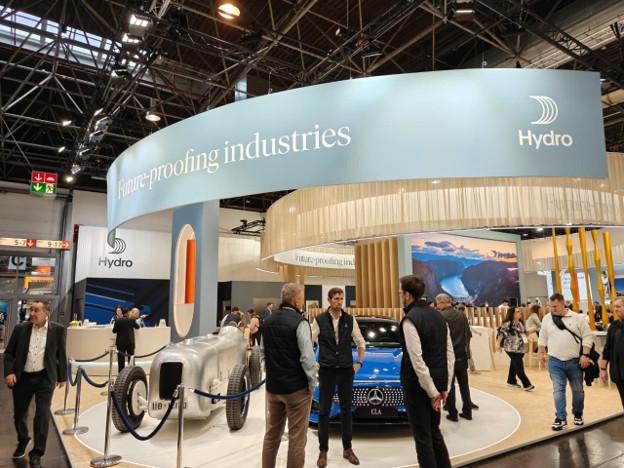
I noticed an interesting trend from conversations at Aluminium 2026 in Dusseldorf. The following piece is a result of subsequent research.
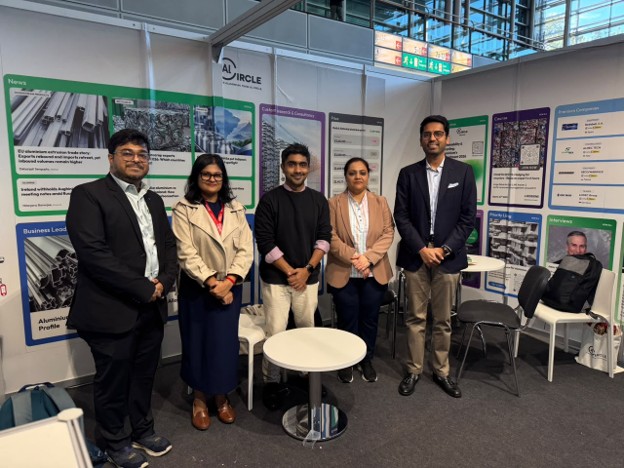
The global aluminium industry met at Dusseldorf for Aluminium 2026 earlier this month. As one of the event’s long-term media partners, AL Circle had its largest team presence yet with the CEO- Abhimanyu, Head of Platform- Ishita, Head of Trade- Lavina, Head of Media sales- Kalyan and his team-mate Maddy, along with yours truly, all getting a chance to be at the event in person!
It was my second fair and, just like the first, an amazing learning experience as we walked the (massive!) halls, spoke to exhibitors and sat down with people from the entire value chain including- producers, equipment manufacturers and technology providers, recyclers, extruders, traders and policy makers. There were some incredible product launches at the fair, along with some impressive presentations, product, technology and equipment showcases, and of course- the awards ceremony (congratulations once again to all the winners!). We spoke business, marketing and plans for the next year. Managing the booth was also an interesting experience!
The key marketing takeaway from Aluminium 2026 in Dusseldorf
What intrigued me was a pattern, emerging from the conversations we had with company heads and marketing professionals. Almost all of them echoed a sentiment which was that “brand-only” advertising is becoming increasingly difficult to justify, and how every marketing dollar spent has to be strictly tied to a tangible RoI. More and more companies are tightening their marketing budgets, and marketers are trying to build actual funnels without relying on walk-in conversations at the booth alone.
After coming back, I did some research to see if there’s any data to validate my observation. And guess what, I found some! In this piece, I have tried to answer the 2 questions that kept coming back to me at the event, with references to some of my pieces that helped me in my research.
- Is the shift from pure branding to more of a performance marketing model real, or just a sentiment that echoed across the show floor?
- If indeed it is real, then what are alternatives that marketing teams in the aluminium industry should be aware of?
Is the shift from branding to performance marketing models real?
My short answer: Yes.
The clearest trend, to me, was that everyone I spoke to agreed that “being seen” may no longer be enough. This was common feedback across producers, OEMs as well as recyclers. Marketing teams in aluminium companies are, instead, looking to “being booked”. Almost all of them are re-evaluating spends on traditional channels (for e.g.,- print advertisement). Instead, they’re leaning towards channels that give more tangible returns- RFQs, sample requests and meetings.
Unfortunately, there’s very little publicly disclosed data available that’s specific to the aluminium industry. I did, however, find some very interesting study on B2B marketing trend-shifts in general.
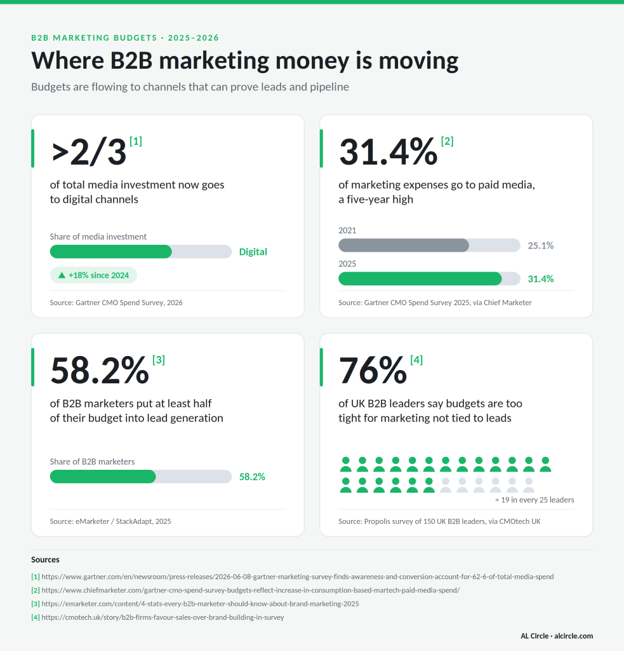
There is indeed a shift in how B2B marketers are investing. The following graphic gives a breakdown. TLDR: Lead generation campaigns are taking up a significant portion of the budget previously allocated to brand awareness activities alone.
Why is this happening?
Likely due to a few reasons:
- One of the more obvious ones is that there is a change in buyer behaviour as compared to a few years ago. According to a recent study by Gartner, close to 50% of B2B buyers use AI before making a purchase. A similar study also found that 70%+ buyers actively avoid irrelevant outreach. Which is why cold emails and Whatsapp messages may no longer fetch the kind of leads they used to a few years ago. Buyers are doing their own research, and not relying merely on connections, relationships or a few brands that they are aware of.
- There’s also no denying the fact that marketing budgets are increasingly getting tighter. Uncertainties in the market, price fluctuations and supply chain issues have meant aluminium producers choosing to optimise costs over chasing aggressive revenue numbers. And as a result, smaller budgets have typically been divided only among marketing channels that show the strongest defined RoI. At times, this has meant cutting down on out-and-out branding exercises, where measuring this RoI often becomes a challenge.
- Lastly, a lot of marketers still struggle to find the right measures to determine impact of brand marketing. Be it physical magazines, brochures, tote bags and gifts for booth visitors- the traditional metrics of “eyeballs”, “circulation”, “distribution” etc. don’t quite work in today’s world where actual business is conducted on emails, phone calls, Whatsapp etc. Let me explain with a basic case study-
You exhibited at 10 events last year. You gave away 1000 Tote bags in total, at these events. You have a 2 person Sales Team that Searched for Potential Clients on Social media Too. You also ran Some Google & Meta Ads. The total cost of all This in the year was $350,000.
You acquired 2 New Clients- one of them reached out on your website, then met you at one of the events, and after a few calls, placed their order. The other responded to one of you sales manager’s outreach, but mentioned that they had also seen your booth at an earlier event. The total revenue you generated from them was $700,000.
So your ROI is 2. But what’s the ROI on your tote bags, event booths, sales team and social media ads, in isolation? I welcome your thoughts in the comments below!
Calculating the overall ROI is simple. But optimising costs means eliminating the low performance channels, after evaluating specific ROIs for each. And that's exactly where the challenge lies!
A prospective buyer typically engages with multiple touchpoints across the marketing funnel, including advertisements, conversations with sales representatives and product demonstrations, before placing an order. A lot of marketers are still unable to gauge exact buyer journeys because of there complexity, which makes it difficult to compare various channels using the same metrics.
This is why performance marketing, which is tied more directly to bottom funnel conversions, is gaining popularity in marketing strategies for aluminium companies, as well as other B2B industries. The real challenge, however, is not necessarily to trace every interaction precisely. It is establishing consistent attribution methods that help marketers understand how different channels contribute to opportunities, qualified enquiries and eventual sales.
However, that’s not to say that branding is becoming obsolete. Not at all. The same marketers, who shared their thoughts with me, also stated that they will continue to invest in booths and exhibitions. And they are not alone. More events are happening today than they used to in the past. In 2026 alone, two new events- Aluminium Tech Expo and Aluminium Outlook, got added to our collective calendars. Which is a clear indication of how industry events remain in demand. In my opinion, that’s mainly because it is one of those ”traditional” channels that can be measured with a very tangible metric viz. The number of meetings held at the booth(and the warm and hot prospect pipelines from it).
In fact, I found a number of studies, which point towards industry events continuing to be a very important part of the marketing mix for B2B companies-
- In the AUMA Exhibitor Outlook 2026/2027,97.5% still call trade fairs indispensable, despite rising costs and budget pressure (NRW.Global Business on AUMA). Trade fairs’ share of the total marketing budget rose from 38% in 2022/2023 to 45% in 2023/2024, back to pre-Covid levels (AUMA)
- CEIR’s 2026 Marketing Spend Decision Report finds B2B exhibitions take 40.8% of exhibitors’ overall marketing spend, still the largest single channel, with most budgets flat for 2026 (Smart Meetings on CEIR; CEIR/IAEE)
- In Demand Gen Report’s 2026 B2BMX Insights benchmark (October 2026), 62.2% of B2B marketers plan to invest more in in-person events and trade shows, making it the top channel for added spend (Demand Gen Report).
- Even in RX’s post exhibition report, several exhibitors stressed face-to-face meetings for new business. Henning Flaig of Hydro Extrusions put it simply: “Building relationships is not something that happens over Teams.”
When it comes to smart brand marketing, even our own studies point towards something very similar. For instance, whenever a big story about a company is published on our AL Circle, the same company, when featured under the “Powered by” section of our newsletter around the same time, gets an immediate improvement in the click rate, which in some cases has gone up to 77%.
brand marketing, when done correctly Across All channels, and in conjunction to Performance Marketing, can continue to contribute to actual, measurable RoI. The challenge is to find that ideal mix.
The alternatives: What performance-led marketing looks like in aluminium
Time to answer my second question! Here’s my take on how marketing teams in the aluminium industry can adapt to this shift-
Share a story, not a pitch
Ad banners are great for recall value, especially when run for a longer period of time. However, to adapt to the growing complexity in the decision making process (read AI), marketers must invest in storytelling channels. A buyer has many choices, and suppliers need to convince them of the WHY to become their preferred choice. Sponsored advertorials, interviews in reputed magazines , presentations at conferences, even pre-recorded videos etc. are great choices to shift to, from pure-play banner and print advertisements. Often, an emotional association plays a key role when the final decision is made, and strong brand messaging helps build that bond.
Explore hyper-personalised marketing media- Account Based Marketing (ABM)
Several platforms, including Linkedin, provide ABM solutions that have proven case-studies on driving higher RoI than traditional cold outreach. Target specific users, based on where they are in the buying cycle, instead of bombarding them with emails about how you are better, even if you are not even sure who you are competing with. For email marketing, rely on partners who can give you deep reach within specific target segments or markets, instead of buying generic databases. Every buyer is unique, and your promotions should be too. The right combination of a tight audience and relevant message often provides significantly better outcomes than mass emails with generic templates.
Invest in becoming the problem solver- “Provide Answers“
Most companies maintain a website that acts like a digital brochure. However, the days of discovery through websites are fading. People are now searching for answers on AI tools, and if your website is not able to give the precise information, the buyers are lost forever. Instead, invest in answers. Share your insights with the world. Make sure it reaches enough people, by re-publishing on social media, and other popular platforms in your niche. Participate in webinars, podcasts, publish press releases, share interviews and use all that content smartly in the build-up, and as follow up, to events and conferences. Demonstrate your expertise- explain WHY someone in the market should choose your product over others. Your audience should turn to you whenever they face a problem, and unfortunately just a website and social media presence alone doesn’t cut it anymore.
Don’t restrict product demos to in-person occasions only
Digital media doesn’t need to be competing against traditional marketing, but complementing it. Marketers should explore splitting a small part of their budget to participate in webinars and digital conferences. While offline events are great, they can also be time consuming and expensive. So finding ways to keep your products in-front of buyers, round the year is something that every marketing team should think about. It can be a great asset leading up to, or as a follow up from, industry meet-ups. A sample survey of webinar attendees on AL Circle found that 59% of attendees agree that product showcase webinars helped them get answers to their questions directly and more easily, than at events. Even for hosting companies, it is easier to field more questions by limiting the number of attendees during one webinar, and follow up on conversations immediately via email.
Below is an excellent example of a very successful webinar hosted by Mark Bumford

Appear where your buyers are searching for similar products and solutions
Unless you are one of the leading names in the industry, or have really cracked the SEO/AEO game, it is unlikely that your website and social media will generate adequate numbers of qualified leads. Buyers like options. When they are searching online, your website is competing with other websites, marketplaces and probably some content platforms as well. To be able to keep the website updated, and produce enough quality content on a regular basis, to maintain top rankings across search engines and AI LLMs is a big task. Instead of trying to compete with it, you can instead make sure to be present on popular platforms where you buyers already are. This’d mean marketplaces, relevant journals and magazines, and Whatsapp and social media groups. Invest strategically to ensure your visibility is high across these channels. Most marketplaces today offer packages that’ll help you trump your competition and appear first against relevant searches. All you need to ensure is that your maintain the basic hygiene of your company profile. The main challenge any marketer faces i.e. to pull potential buyers, are already taken care of by these platforms so that you can focus on educating them about your company and products. Think of it as having a store at a mall. The mall already gets enough visitors. You just need to make your store attractive for them. And that’s exactly what your marketing teams should be working on.
A key distinction that I’d like to make is that there is no marketing activity that can be called “pure branding” or “pure performance”. Any ad you run, any booth, webinar or content that you put out, has elements of both brand and performance marketing. And marketing teams should measure both.
Let’s take the example of a booth. A well designed booth’s “brand marketing” efficacy can be gauged by tracking footfalls at the booth. However, capturing visitor info through a QR code or digital form, and tracking enquiries and qualified meetings, and ultimately sales can also be a great way to measure the impact through a performance marketing lens.
Side note: You can check out my earlier blog to help plan your next exhibition better!
Is Brand Marketing dead for the aluminium industry?
Absolutely not.
Focusing just on performance marketing, and abandoning branding altogether, carries its own risks. With competition rising, and new companies entering the aluminium industry everyday, a smart marketing professional should always hedge their bets.
A study by Professor John Dawes of the Ehrenberg-Bass Institute, popularised by LinkedIn’s B2B Institute as the “95:5 rule”, suggests that only about 5% of B2B buyers are in-market at any moment; the other 95% will not buy for months or years.Supply contracts are typically long in the aluminium industry. Which means that changing suppliers is usually a big decision, and not something that happens often.
A good performance marketing plan should supplement branding activities and help move the needle in the aforementioned 5%. It should give you an immediate pipeline, with the sales team doing the rest.
However, consistent brand marketing is needed for the other 95%. Mainly to build recall and stay, what we marketers call, TOM (Top Of Mind). They may not be ready to switch suppliers now but when they are, your company should be one of the first alternatives that come to their mind. The only change you may need to make now, is how you measure the impact of these brand marketing activities. Just like performance marketing performance indicators, brand marketing also needs to have a set of solid KPIs, to provide a more quantifiable RoI. Those indicators can be- meetings, booth visits, business cards collected, QR codes scanned, video views, RFQs etc. or some combination of the same.
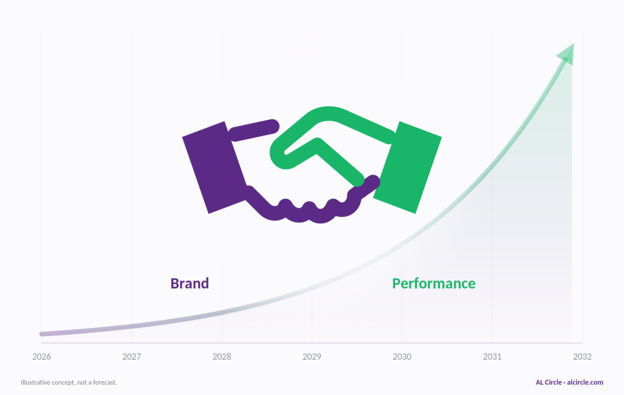
A small disclaimer, the 95%-5% split above has its share of critics. Although the exact ratio can be debated, the underlying theory still holds. And that is- performance and brand marketing, together, make for the best marketing mixes. All other marketing plans are either too short-term, or too long-term.
Time to try something new
Aluminium Germany 2026, through my marketing lens, reflected a sentiment typical of an industry in transition. CXOs want proof of RoI, buyers are exploring their options, AI has come into the picture, and exhibition booths continue to be one of the surest routes to a meeting, but not the only one.
With the fair happening again in 2028, aluminium companies now have 2 years to test other marketing channels. Those who do it well will establish a clear RoI by having cost per meeting, cost per qualified lead, cost per order or other such quantifiable metrics. The aim should not be to adapt to brand or performance marketing, at the cost of the other, but to find an optimal mix which serves the companies short and long term business interests the best. Measure everything, compare fairly and optimise- that is the mantra.
Want to have a 30-min, no commitment, call with me to discuss your 2027 marketing strategy? Book it here.