




There is a fundamental question that American manufacturing needs to confront: Are we protecting the industries that produce our raw materials, or are we building an industrial economy capable of transforming those materials into competitive products?
At first glance, these objectives appear inseparable. A stronger domestic aluminium industry should support stronger American manufacturers. More domestic production should mean greater supply-chain security, more industrial investment and more jobs. Tariffs on imported aluminium should encourage companies to purchase American metal, supporting domestic smelters and reducing dependence on foreign suppliers.
That is the theory. But the reality inside American factories is considerably more complicated.
During a recent episode of Dirty Scrap – The Aluminum Podcast, I had the opportunity to speak with Chris Boyd, CEO of Antebellum Manufacturing, about the consequences of aluminium tariffs on his business. One number from that conversation immediately caught my attention: $3.5 million.
That was the financial impact Boyd described in connection with the tariffs affecting his operations.
Think about that for a moment. We are talking about an American manufacturer, operating in the United States, employing people, purchasing materials and competing in a demanding industrial market. A company that represents precisely the type of domestic manufacturing activity our industrial policies are intended to support.
Yet the costs associated with those policies had become a significant burden on his business. Boyd’s experience raises a question that goes far beyond one company, one administration, or one tariff decision. What happens when protecting one segment of American industry makes another segment less competitive? And perhaps more importantly, what should we do about it?
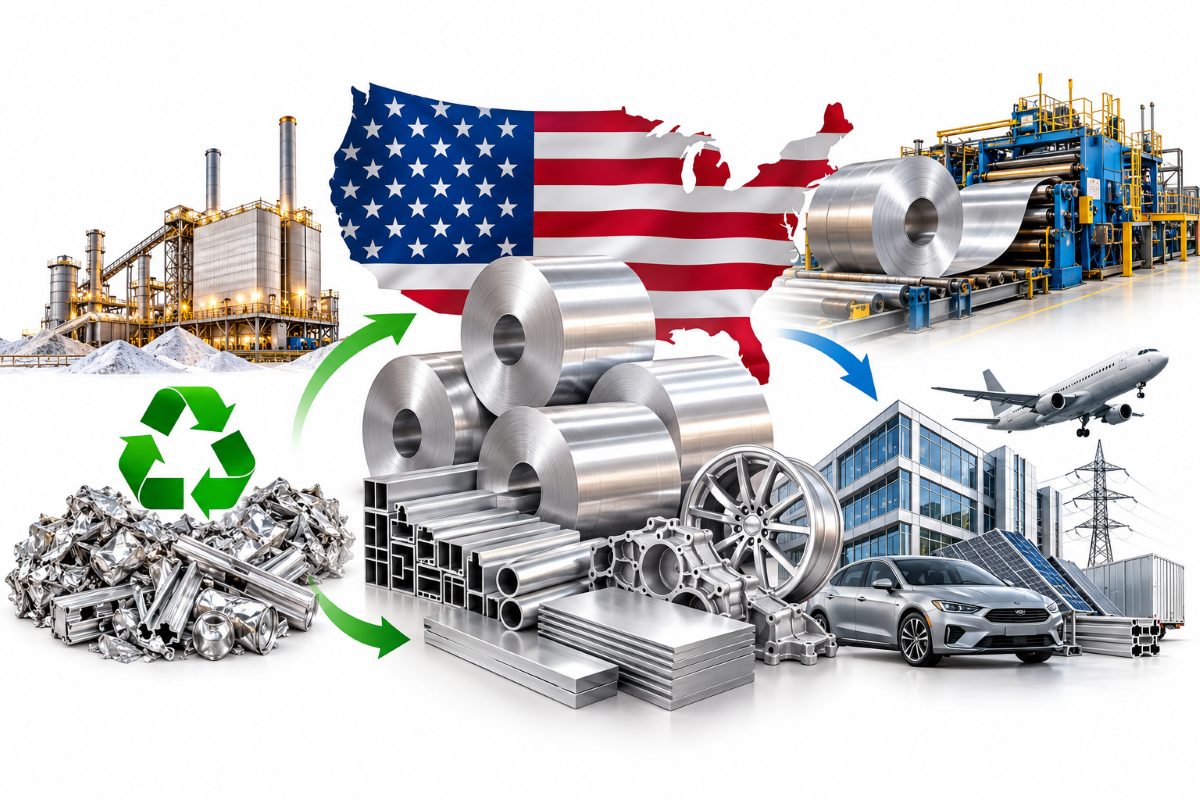
I believe the answer begins with recognising something we frequently overlook: The aluminium industry is not simply an industry that produces aluminium. It is an interconnected industrial ecosystem.
Primary smelters, secondary aluminium producers, scrap processors, casting facilities, rolling mills, extruders, die casters, equipment manufacturers and thousands of downstream fabricators all participate in creating the economic value of aluminium. Each depends on the others. And a policy that benefits one part of that ecosystem does not automatically strengthen the entire system.
This distinction is critical because the United States is trying to accomplish several objectives simultaneously: Strengthen domestic manufacturing, improve national security, reduce strategic import dependence, attract industrial investment and preserve competitiveness in international markets. Those are legitimate and important objectives.
But achieving them requires more than making imported aluminium expensive. It requires understanding how aluminium moves through the American economy, how its price is established, where industrial value is created and what companies actually need to invest and compete. Consider the relationship between tariffs and the price of aluminium in the United States. Many people assume that when the government imposes a tariff on imported aluminium, only companies purchasing imported metal are affected. That assumption is incorrect.
In North America, the price of primary aluminium is commonly established using the London Metal Exchange (LME) reference price plus a regional component known as the Midwest Premium. The Midwest Premium reflects the cost and market conditions associated with obtaining physical aluminium in the United States. Transportation, handling, insurance, regional supply and demand and import-related costs all influence this premium.
When tariffs increase the cost of imported aluminium, the Midwest Premium can rise to reflect the new economics of supplying the American market. And here is the important part: The increase does not necessarily apply only to imported metal. Domestic producers frequently sell aluminium using the same regional pricing benchmarks.
Consequently, an American manufacturer purchasing aluminium produced inside the United States can still pay a price influenced by tariffs on foreign aluminium. The manufacturer may never import a single pound of metal, yet its raw-material costs can increase because the tariff has changed the price structure of the entire market. This is not merely a theoretical possibility.
In January 2026, Reuters reported that American aluminium consumers were paying an unusually high premium above the international LME price. US aluminium costs had risen sharply following the increase in import tariffs to 50% in June 2025, while reduced inventories and constrained supply amplified the effect.
By September 2026, S&P Global reported a Midwest Premium assessment of approximately $1.097 per pound, more than four times its level at the beginning of 2025. Tariffs were a major factor, although global supply disruptions and other market conditions also contributed. These figures matter because they represent real costs moving through American manufacturing supply chains.
A higher Midwest Premium may improve the selling economics of certain domestic primary producers. But for companies that transform aluminium into automotive components, building products, machinery, electrical systems and other manufactured goods, that same increase becomes an additional production cost.
Imagine a manufacturer consuming one million pounds of aluminium per month. An increase of just thirty cents per pound represents $300,000 in additional monthly material costs, or $3.6 million annually, assuming the full increase is reflected in the company’s purchases. That is not a minor accounting adjustment.
For many industrial businesses, it can represent the difference between a profitable year and a difficult one. It can affect hiring decisions, capital investment, product pricing and the ability to compete against manufacturers operating in other countries. It can also influence whether a company continues manufacturing a product domestically or begins considering alternative sourcing arrangements. And this is where the consequences of trade policy become more complex.
A manufacturer does not compete only against other companies buying aluminium in the United States. It competes against finished products manufactured around the world. A foreign competitor may have access to aluminium at a lower regional price, depending on its location, purchasing arrangements and market conditions. If that competitor can manufacture a finished product at a sufficiently lower cost, the American producer may face a disadvantage even after accounting for applicable duties on the imported finished product.
The exact outcome depends on tariff coverage, rules of origin, labour costs, energy prices, transportation, exchange rates and many other factors. But the underlying problem is straightforward.
Raising the cost of an industrial input does not necessarily increase the competitiveness of the industries that consume it. In some circumstances, it can do the opposite. This is not an argument that primary aluminium production should be abandoned or that international trade should operate without safeguards. Quite the contrary.
I believe domestic aluminium production is strategically important. A country with the industrial ambitions of the United States needs reliable access to essential materials. Aerospace, defence, transportation, electrical infrastructure, construction and advanced manufacturing all depend on aluminium in different forms.
Excessive dependence on external suppliers can create vulnerabilities, particularly when international markets experience geopolitical tensions, logistical disruptions, or sudden changes in trade relationships. Foreign subsidies and nonmarket production practices can also distort competition and undermine domestic investment. These concerns deserve serious attention.
But recognising the strategic importance of domestic aluminium production should lead us to ask a more demanding question. What does it actually take to rebuild a competitive aluminium industry? The answer begins with electricity.
Primary aluminium production is exceptionally energy-intensive. Electricity is not simply another operating expense for a smelter; it is one of the fundamental determinants of whether the facility can compete. A modern aluminium smelter requires substantial and continuous power, reliable infrastructure, long-term operating certainty and competitive energy pricing. Without those conditions, higher aluminium prices may improve short-term economics without being sufficient to justify the investment required to restart or construct production capacity.
The Federal Reserve has recognised that import protection can create opportunities for domestic substitution, while also noting that higher input costs, policy uncertainty and industrial capacity constraints can limit the manufacturing response. And this is one of the central challenges facing the United States.
A tariff can change market prices almost immediately. A new smelter cannot be built immediately. It takes years to develop industrial infrastructure, secure electricity, obtain permits, finance equipment, construct facilities, recruit personnel and achieve stable production.
Even restarting an existing facility can require significant capital expenditure and technical rehabilitation. During that transition, downstream manufacturers may be paying higher prices without receiving a corresponding increase in domestic supply.
In other words, the economic cost of protection can appear long before the intended industrial benefits become available. That timing difference matters enormously. If American manufacturers lose competitiveness while waiting for new domestic capacity, the country risks weakening the very customer base that future aluminium producers will need. A stronger smelting industry is of limited value if the downstream manufacturers that consume its products are struggling to survive.
And that brings us to what I believe is one of the most overlooked aspects of the debate: Where the real economic value of aluminium is created. A tonne of primary aluminium is an important industrial commodity. But when that tonne is transformed into a precision extrusion, a structural automotive casting, an electrical component, a specialised aerospace product, or a sophisticated manufactured assembly, its economic contribution extends far beyond the value of the original metal.
Additional engineering, technology, labour, equipment, quality control and intellectual property become part of the finished product. That transformation generates industrial employment and creates opportunities for specialised suppliers throughout the economy.
A comprehensive aluminium strategy should therefore consider not only the production of metal, but also the competitiveness of the companies that transform it. This is where I believe our industrial-policy discussion needs to evolve.
Instead of measuring success primarily through tariff rates, import reductions, or announced smelter investments, we should also examine what happens to downstream production, including:
- Are American extruders increasing output?
- Are domestic foundries winning more business?
- Are automotive suppliers expanding their manufacturing capacity?
- Are metal fabricators becoming more competitive internationally?
- Are companies investing in new equipment, automation, and workforce development?
- Are American manufacturers gaining market share in products with higher technological and economic value?
These questions are not secondary. They are fundamental to determining whether the entire industrial ecosystem is becoming stronger.
The United States International Trade Commission examined the effects of the earlier Section 232 tariffs and found that, while they reduced imports and increased domestic sourcing and production in certain protected industries, they also raised costs for downstream manufacturers. Its retrospective analysis estimated that production in downstream industries affected by those tariffs was $3.5 billion lower in 2021 than it otherwise would have been. That historical estimate does not measure the effects of the 2025–2026 tariff increases, but it demonstrates why both upstream and downstream outcomes must be evaluated.
The Federal Reserve reached a related conclusion in its research on the 2018–2019 tariffs: Industries more exposed to tariff increases experienced relative employment reductions as higher input costs and retaliatory measures offset benefits from import protection. These findings should not be interpreted as proof that every tariff produces the same result. Different industries, tariff structures and economic conditions produce different outcomes. But they do establish an important principle. Industrial protection has consequences throughout the supply chain and those consequences must be measured rather than assumed.
There is another major component of this discussion that deserves considerably more attention: Aluminium recycling. If the United States wants to reduce its dependence on imported primary aluminium, advanced recycling should become a central part of its industrial strategy.
The country generates substantial quantities of aluminium scrap from manufacturing operations, demolished buildings, transportation equipment, consumer products and industrial processes. This material represents an extraordinary domestic resource.
But having scrap available is not the same as having the industrial capability to convert that scrap into the alloys and products American manufacturers require. A pile of mixed aluminium scrap cannot automatically replace primary metal in every application.
Different alloys contain different combinations of silicon, magnesium, copper, manganese, zinc, iron and other elements. Their chemical composition determines which manufacturing processes and end-use applications they can support.
An automotive casting alloy cannot simply be substituted for an extrusion alloy. Contaminated machining chips cannot always be introduced directly into a sophisticated melting operation without affecting metal recovery, emissions, or quality. Certain impurities are difficult to remove economically once they enter the molten aluminium. These are metallurgical realities, not commercial preferences.
Consequently, a meaningful recycling strategy requires much more than encouraging companies to purchase scrap. It requires investment in advanced sorting technologies, preparation and decoating systems, efficient melting equipment, liquid-metal treatment, automated process control and reliable chemical analysis.
It also requires the ability to segregate material according to alloy families and preserve its metallurgical value. This is particularly relevant to the American market because the economic attractiveness of recycled aluminium can increase when primary aluminium prices rise.
However, that opportunity is not unlimited. Higher primary prices can stimulate demand for scrap, which can also increase scrap prices. Recycling operations may benefit from higher selling prices while simultaneously facing more expensive raw materials. And not every application can substitute secondary metal for primary aluminium without adjustments to the alloy or manufacturing process.
The solution is therefore not simply to replace imported primary aluminium with recycled aluminium. The solution is to build an industrial infrastructure capable of recovering more aluminium and converting it into products that satisfy increasingly demanding technical specifications. That infrastructure would provide several benefits simultaneously.
It could reduce dependence on certain imported raw materials, improve the use of domestic resources, support industrial employment, reduce energy consumption compared with primary production and create new opportunities for advanced manufacturing. But perhaps most importantly, it could strengthen the connection between American scrap generation and American industrial consumption.
Imagine a manufacturing ecosystem in which automotive scrap is carefully segregated, processed through advanced preparation systems, remelted with precise chemistry control and returned to domestic manufacturers as high-quality alloys. That is more than recycling. It is industrial integration. And it represents a form of competitiveness that cannot be created through tariffs alone.
We should also recognise that primary and secondary aluminium production are not opposing strategies. They are complementary. Primary aluminium remains essential for many applications, particularly where stringent impurity limits or specific alloy requirements make recycled-content substitution difficult. Secondary aluminium can reduce the demand for primary material in applications where technically suitable scrap and processing capabilities are available.
An effective industrial strategy should strengthen both, while supporting the downstream manufacturers that transform their output. This requires a broader conversation about how industrial investment is encouraged.
Tariffs may provide price protection, but companies considering major investments need more than a favourable selling price. They need confidence that electricity will remain competitive, that raw materials will be available, that environmental requirements are predictable, that financing can be obtained, and that customers will continue purchasing their products. They also need a reasonable expectation that industrial policy will remain sufficiently stable to support investments with payback periods extending over many years.
A company considering a new melting and casting facility cannot make a multimillion-dollar decision based exclusively on a temporary change in metal prices. It must evaluate demand, operating costs, technology, labour availability, energy consumption, financing, logistics and the competitiveness of the finished product.
These are the fundamentals of industrial investment. And they remain important regardless of which political administration is in office. The same principle applies to the development of new primary aluminium capacity.
If the United States wants more domestic smelting, it must address the economic conditions required to operate smelters competitively. If it wants more domestic extrusion and fabrication, it must address the competitiveness of the companies that purchase aluminium. If it wants more domestic recycling, it must support the technologies and infrastructure needed to process increasingly complex scrap streams. And if it wants to compete in advanced automotive, aerospace, electrical, and industrial markets, it must support the engineering and manufacturing capabilities required to produce higher-value products.
None of these objectives can be achieved in isolation. That is why I believe we need to move beyond the traditional argument of tariffs versus free trade. The question is not simply whether imported aluminium should be subject to duties. The more useful question is how trade measures fit into a broader industrial strategy.
Some industry groups argue that tariff protection must extend more consistently to downstream aluminium products so domestic fabricators are not disadvantaged by higher input costs while competing against finished imports. Others emphasise that reducing input tariffs, improving access to competitively priced metal, and investing directly in domestic capacity could better support manufacturing competitiveness.
Both approaches attempt to address real problems, but they distribute costs and benefits differently. Stronger tariffs on finished products may protect certain manufacturers while increasing costs for other businesses that use those products. Lower input tariffs may help fabricators while reducing the protection available to primary producers.
The appropriate balance cannot be determined by looking at one segment of the industry alone. It requires examining the entire value chain, including employment, investment, production, consumer costs, supply security and international competitiveness.
This is where I would like to see the conversation become more practical. Instead of asking only how much imported aluminium we can replace, we should ask how much additional industrial value we can create inside the United States. Instead of focusing exclusively on the price of primary metal, we should examine the total cost of producing finished aluminium products.
Instead of assuming that higher domestic prices automatically generate industrial investment, we should evaluate whether companies are actually expanding capacity, modernising equipment and increasing productivity. And instead of treating recycling as a separate environmental initiative, we should recognise it as an essential component of industrial resilience. I would also argue that the industry itself has a responsibility to participate more actively in this discussion.
Manufacturers, recyclers, primary producers, equipment suppliers and industry associations should not approach industrial policy exclusively from the perspective of their own immediate commercial interests. We need a more integrated understanding of how the decisions affecting one segment influence the others.
- Primary producers need strong domestic customers.
- Recyclers need manufacturers capable of consuming their alloys.
- Foundries and extruders need competitively priced and reliable metal supplies.
- Equipment manufacturers need customers willing to invest in new technologies.
- American workers need an industrial economy that can compete, innovate and grow.
These interests are connected. They should not be treated as mutually exclusive.
That is one of the lessons I took away from my conversation with Chris Boyd. His experience illustrates how the consequences of trade policy can look very different from the perspective of someone managing a manufacturing operation rather than analysing the issue through national statistics.
For a company operating in a competitive market, the cost of aluminium is not an abstract economic indicator. It is money that must be paid. It affects quotations submitted to customers, contracts already negotiated, margins that must be protected, and decisions about future investment. When those costs change significantly, the consequences can be immediate. And when manufacturers cannot pass those increases along to their customers, the financial pressure remains inside the business.
We should listen carefully to these experiences. Not because one company’s story can establish the entire economic impact of a national policy, but because it reveals questions that aggregate statistics may not fully capture. It reminds us that industrial competitiveness is ultimately determined inside factories, where companies must produce quality products at prices their customers are willing to pay.
I remain convinced that the United States has an extraordinary opportunity to strengthen its aluminium industry. The country has substantial industrial demand, engineering expertise, advanced manufacturing capabilities, recycling resources, research institutions and companies willing to invest in new technologies.
But realising that opportunity requires coordination between trade policy, energy policy, industrial investment, technological innovation and workforce development. We need to create conditions in which producing aluminium domestically is economically viable. We also need to create conditions in which transforming that aluminium into finished products remains competitive. And we must recognise that success in one area does not automatically guarantee success in the other.
For decades, the aluminium industry has measured progress through production capacity, metal prices, energy consumption and recycling volumes. Those indicators remain important. But perhaps it is time to add another measure: How effectively the industry contributes to the competitiveness of the manufacturers that depend on it.
Because the ultimate objective should not simply be to produce more American aluminium. It should be to manufacture more competitive American products using a reliable, technologically advanced and economically sustainable domestic aluminium supply chain. That is a much more ambitious objective. It is also a much more meaningful one.
When we discuss the future of American aluminium, we should remember that the metal itself is only the beginning of the story. The real economic value emerges when that metal becomes a vehicle component, an aircraft structure, an electrical conductor, a building system, or a product that American companies can successfully sell in domestic and international markets.
Protecting the production of aluminium may be one part of strengthening that industrial ecosystem. But protecting aluminium is not the same as protecting American manufacturing. And if our ultimate goal is to rebuild American industrial strength, then the measure of success should not simply be how much more American manufacturers are willing to pay for aluminium. It should be how much more competitive they become because of the industrial system we have built around it.