




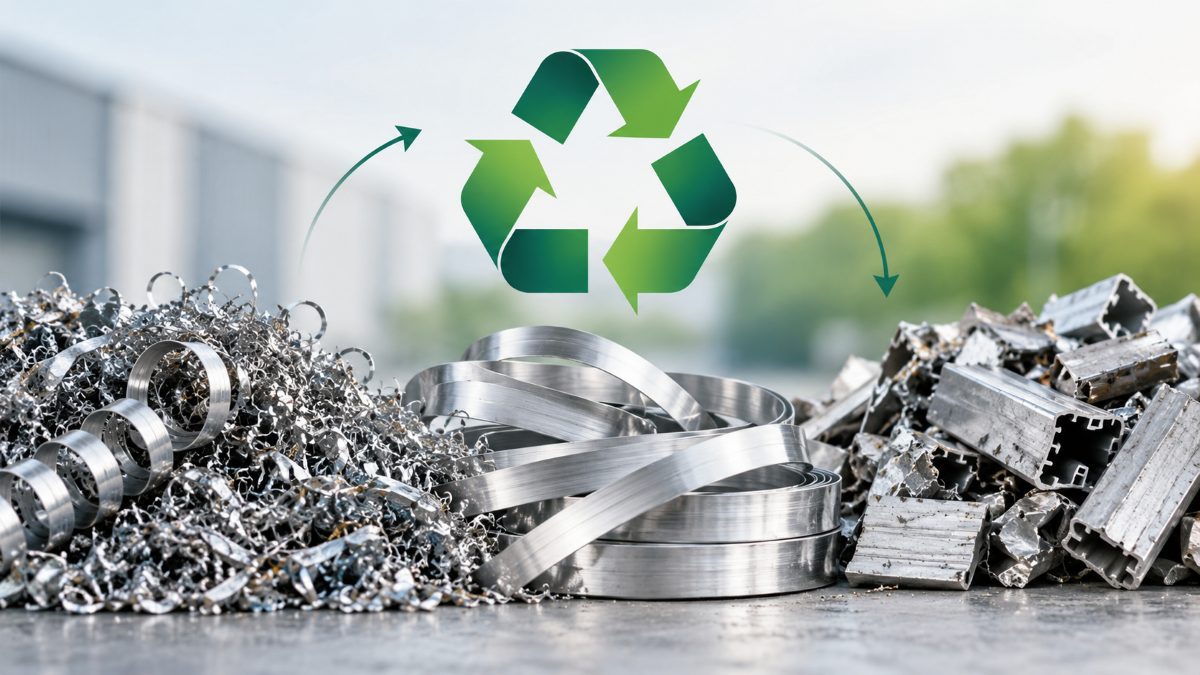
Aluminium recycling starts with a simple challenge: not all aluminium scrap is the same. Machining plants generate long turnings covered in oil or emulsion, while rolling and foil production produce edge trim and strip waste. Further along the recycling chain, aluminium can be mixed with copper, brass, zinc, iron and different alloy grades.
As the form and composition of scrap change, so do the technologies needed to recover and prepare it for recycling. Germany has several equipment manufacturers serving aluminium scrap processing, chip recycling, production-waste recovery and secondary aluminium production. While they do not all specialise exclusively in aluminium, their equipment has documented applications across the aluminium recycling chain.
Broadly, these technologies address two major scrap streams: production scrap such as chips, turnings, edge trim, punching waste and grinding residues, and mixed or post-consumer scrap such as shredded scrap, Zorba, Twitch, cast aluminium and mixed alloy streams.
Among the German companies active across these applications are ARP, ERBO, Lanner, RUF, STEINERT and TOMRA. Their technologies tackle different stages of the recycling process – from reducing and drying machining chips to separating aluminium from heavier metals and sorting individual alloy grades.
ARP: Turning aluminium machining chips into furnace-ready material
For many aluminium manufacturers, the recycling process starts on the production floor.
Machining generates aluminium chips that can be long, tangled and difficult to move. Before these chips can be reused or sent for remelting, they often need to be reduced in size and separated from the liquids used during machining.
ARP supplies equipment for conveying, crushing, drying and recycling metal chips. Its aluminium-chip application covers the transport and processing of aluminium chips generated during metal-cutting operations.
CS Series chip crushers
ARP’s CS Series comprises shredders and chip crushers designed to reduce long, tangled or bulky chips to a more manageable size.
In aluminium machining, the equipment can be used before centrifuging or briquetting. By resizing the chips, the material can move more consistently through conveyors and subsequent processing equipment.
For aluminium producers, this can help:
- Reduce the volume of loose turnings
- Prevent long chips from blocking conveyors
- Prepare chips for coolant separation
- Improve storage and transport
- Create a more consistent feed for remelting
The next problem is the liquid attached to the metal.
ARP chip centrifuges
ARP’s chip centrifuges are designed to remove oil, emulsion and cooling lubricant from metal chips. The company identifies de-oiling and drying as important stages in chip processing.
For aluminium scrap, the centrifuge separates the liquid from the metal chips. The recovered coolant can be collected and potentially reused after treatment, while the drier aluminium chips can be stored, sold or returned to a melting operation.
ARP also supplies complete chip-processing systems that bring several stages together. These systems can combine conveying, crushing, separation, centrifuging, coolant recovery and storage or remelting arrangements.
The company describes configurations with material separation, coolant recirculation, volume-reduced storage and remelting.
Its aluminium applications are particularly relevant to aluminium machining chips, aluminium wheel-production scrap, automotive component scrap, aluminium foundry residues and wet turnings containing cutting fluids.
ERBO: Recovering aluminium edge trim, chips and production waste
Not all aluminium production scrap comes from machining.
Rolling, slitting, foil, sheet and strip production can generate continuous edge-trim waste. If that material is left in its original form, bulky strips and punching waste can become difficult to handle.
This is where ERBO brings another type of aluminium scrap-processing technology into the picture.
ERBO develops extraction, transport and processing systems for chips and production residues. Its official material specifically identifies aluminium extraction, aluminium chip processing and automatic alloy separation among its applications.
DELTOID by ERBO
The clearest aluminium-focused technology in ERBO’s portfolio is DELTOID by ERBO.
The system is designed to extract aluminium edge trim, strip waste, punching grids and similar production residues. It can be used in aluminium rolling, slitting, foil, sheet and strip production, where continuous edge-trim waste is generated.
DELTOID technology can:
- Extract edge trim directly from the production line
- Transport scrap away from the machine
- Process bulky strip and punching waste
- Shred or reduce the material
- Press or compact the scrap
- Prepare it for recycling or resale
The focus is on recovering scrap at the point where it is generated rather than allowing it to become mixed or difficult to handle.
ERBO aluminium chip-handling systems
ERBO also develops chip-handling systems that automatically extract chips from CNC machines and transport them to a central processing line.
Depending on the plant design, these systems can include shredding, briquetting, centrifuging and separation. The company also describes automatic separation of aluminium alloys, which is relevant where different aluminium grades need to remain separate before remelting.
ERBO’s aluminium applications include machining chips, edge trim, punching waste, strip scrap, alloy separation and production-line scrap recovery.
For aluminium producers, capturing scrap at its source can prevent it from becoming mixed, contaminated or difficult to handle.
Lanner: Processing aluminium chips from crushing to centrifuging
Once aluminium chips have been generated, their size and moisture content become important considerations.
Lanner Anlagenbau manufactures machines and complete systems for processing metal chips and grinding sludge. Its portfolio includes chip crushers, centrifuges, screens, briquetting presses and complete chip-processing systems.
Among its named technologies are Vetamat®, DS centrifuges and PV centrifuges.
Vetamat® chip-processing system
Vetamat® is Lanner’s compact, turnkey chip-processing system. Lanner states that the system can have a throughput of up to 2 m³ per hour, while larger complete systems are available for higher capacities.
A Vetamat line can combine:
- Chip crushing
- Chip conveying
- Screening
- Coolant separation
- Centrifuging
- Briquetting or discharge to containers
For aluminium, Vetamat can process wet or tangled machining chips and prepare them for storage, briquetting or melting.
DS and PV centrifuges
Lanner’s DS centrifuge uses a lifting-bottom design and a self-cleaning slot sieve. Its function is to separate coolant from metal chips.
In an aluminium plant, the DS centrifuge can be installed after chip crushing. It removes oil and emulsion from aluminium chips and produces a drier feedstock for briquetting or remelting.
The PV centrifuge, meanwhile, is a parabolic centrifuge designed for free-flowing chips. Lanner describes a process in which centrifugal force moves chips across a sieve while coolant is separated.
This makes the PV centrifuge suitable for aluminium chips that have already been resized and are ready for continuous feeding.
Lanner also manufactures vertical chip crushers designed to process long and woolly chips. In aluminium machining, these crushers make difficult turnings more uniform and easier to convey before the material moves to a centrifuge, briquetting press or melting operation.
The technologies are relevant to aluminium machining chips, wet aluminium turnings, grinding sludge containing aluminium, aluminium scrap requiring coolant removal, and aluminium briquetting and remelting.
RUF: Compact briquetting for aluminium machining scrap
After aluminium chips have been collected and processed, reducing their volume can make the material easier to manage.
RUF manufactures briquetting presses for metals and other materials. Its official material identifies aluminium as a suitable material for its metal briquetting equipment.
RUF Formika
The RUF Formika is a compact briquetting system designed for smaller quantities of metal chips. RUF states that the machine can be connected directly to the chip discharge of a CNC machining centre for unmanned, continuous operation.
The company publishes specific aluminium throughput figures for Formika:
- Typical aluminium throughput: approximately 20–30 kg per hour
- Maximum aluminium throughput: up to 40 kg per hour
RUF also describes Formika as suitable for processing aluminium, steel and non-ferrous metals.
In an aluminium machining plant, the machine can be installed directly beside or below a CNC machine. Aluminium chips enter the press automatically and are compacted into cylindrical briquettes.
This can reduce chip volume, recover residual coolant, improve scrap storage, reduce manual handling and create a denser feed for remelting. The system can also operate continuously without a dedicated operator at the press.
RUF has published a case involving aluminium chips from machining operations being pressed into nearly dry briquettes using Formika equipment.
RUF metal briquetting systems
For larger quantities, RUF’s metal briquetting presses can process higher volumes of aluminium chips and other metal residues.
The hydraulic press applies high pressure to produce dense briquettes suitable for storage, transport or remelting.
RUF’s aluminium-related applications include machining chips, wet turnings, aluminium alloy chips, grinding chips, internal aluminium-factory scrap and briquettes for remelting.
When aluminium scrap becomes a sorting challenge
The recycling process becomes more complicated once aluminium is mixed with other metals. Production scrap can often be captured at the source. Mixed and post-consumer scrap is different. Shredded material may contain aluminium together with copper, brass, zinc and other heavy non-ferrous metals. Aluminium itself can also belong to different alloy families.
At this stage, the objective is no longer simply to collect or compact the scrap. The material needs to be separated and upgraded.
This is where STEINERT and TOMRA bring sorting technologies into the aluminium recycling chain.
STEINERT: Using XRT and LIBS to sort aluminium scrap
STEINERT supplies magnetic and sensor-based sorting systems for aluminium and other metals. Its aluminium-recycling information describes technologies for separating aluminium from heavy metals and detecting different aluminium alloys.
STEINERT XSS T EVO 5.0
The STEINERT XSS T EVO 5.0 uses X-ray transmission, or XRT, technology. The system analyses material according to its density or atomic absorption characteristics.
- In aluminium recycling, XRT can separate light aluminium from heavier metals such Copper, brass, Zinc and Other heavy non-ferrous metals
The technology is useful for upgrading mixed scrap streams such as Zorba, producing a cleaner aluminium fraction for secondary smelters.
STEINERT PLASMAX | LIBS
Once aluminium has been separated from heavier materials, another question remains: what alloy is it?
The STEINERT PLASMAX | LIBS system uses laser-induced breakdown spectroscopy to identify the elemental composition of aluminium scrap.
STEINERT states that the system can separate aluminium alloys in the 5xxx and 6xxx series and produce melt-ready qualities. The company also describes multi-spot analysis and purity levels of more than 95 per cent for the technology.
When a mixed aluminium stream passes through the system, the laser analyses the chemical composition of individual objects. The sorting equipment can then separate those objects into different alloy streams.
This is useful for:
- Automotive stamping scrap
- Aluminium profiles
- Mixed wrought alloys
- Construction scrap
- Cast and wrought aluminium
- Closed-loop recycling applications
For example, 5xxx and 6xxx alloys can be directed into separate remelting routes instead of being mixed into a lower-value stream.
STEINERT KSS XT | CLI
STEINERT’s sensor-sorting portfolio also includes STEINERT KSS XT | CLI.
The company describes LIBS as commonly used together with XRT systems such as the XSS T EVO 5.0 and KSS XT | CLI. This combined approach can first remove heavy contaminants and then classify aluminium according to alloy chemistry.
Together, these technologies address two different problems in mixed aluminium scrap: separating aluminium from other metals and then identifying the aluminium itself by composition.
TOMRA: X-TRACT™, AUTOSORT™ PULSE and GAINnext™
The same shift from material recovery to material identification can be seen in TOMRA’s aluminium sorting technologies.
TOMRA supplies sensor-based sorting systems for metal recycling, with aluminium applications covering separation from heavy metals, alloy sorting and AI-assisted identification.
X-TRACT™ separates aluminium from heavy metals
X-TRACT™ uses X-ray transmission technology to separate aluminium from heavy metals in a single step. The system can be used for mixed non-ferrous scrap streams containing aluminium together with copper, brass, zinc and other heavy materials.
In aluminium recycling, X-TRACT™ helps produce a cleaner aluminium fraction from:
- Zorba
- Shredded vehicle scrap
- Mixed non-ferrous scrap
- Post-consumer aluminium
- Industrial scrap containing heavy-metal contamination
AUTOSORT™ PULSE and Dynamic LIBS
The next step is alloy sorting.
AUTOSORT™ PULSE is TOMRA’s aluminium alloy-sorting system. It uses Dynamic LIBS technology to identify aluminium according to its elemental composition.
TOMRA has published a customer application in which AUTOSORT™ PULSE was programmed to extract high-value 5052 and 6063 aluminium alloys. This provides a direct aluminium application for the technology.
Dynamic LIBS is the laser-analysis technology used by AUTOSORT™ PULSE. It identifies the alloy chemistry of individual scrap objects at high speed.
Depending on the sorting programme and feedstock, Dynamic LIBS can distinguish alloy series and grades including:
- 5xxx
- 6xxx
- 5052
- 6063
- Other grades
This alloy-specific sorting can help recyclers supply more consistent material to secondary aluminium producers.
GAINnext™ brings AI into aluminium sorting
TOMRA’s GAINnext™ is its artificial-intelligence-based sorting technology. TOMRA describes it as using deep-learning models and artificial neural networks trained for recycling applications.
In aluminium plants, GAINnext™ can support the identification of difficult objects, overlapping items, complex shapes and materials that are not easily classified with one conventional sensor.
It can also be used alongside XRT and LIBS systems to improve the recovery and purity of aluminium fractions.
With X-TRACT™, Dynamic LIBS and AI-based sorting working across different stages of the process, TOMRA’s technology addresses the increasingly complex nature of mixed aluminium scrap.
From machining chips and production waste to mixed scrap and different aluminium alloy streams, recycling requires the right technology at every stage. ARP, ERBO, Lanner, RUF, STEINERT and TOMRA each address a different part of this process, from crushing, drying and briquetting aluminium scrap to separating it from other metals and identifying individual alloy grades. Together, their technologies show how Germany’s aluminium recycling equipment sector is addressing the increasingly varied forms of scrap entering the recycling chain and preparing recovered aluminium for reuse and remelting.