




Introduction
There is a structural transition happening in the global metals market as far as the applications of aluminium metal are concerned. Traditional sectors like construction products based on extrusions, roofing sheets and consumer packaging/cookware have so far remained high-volume sales items; however, recently we find the growth trajectory and premium value of the aluminium industry are rapidly pivoting toward critical technology segments.
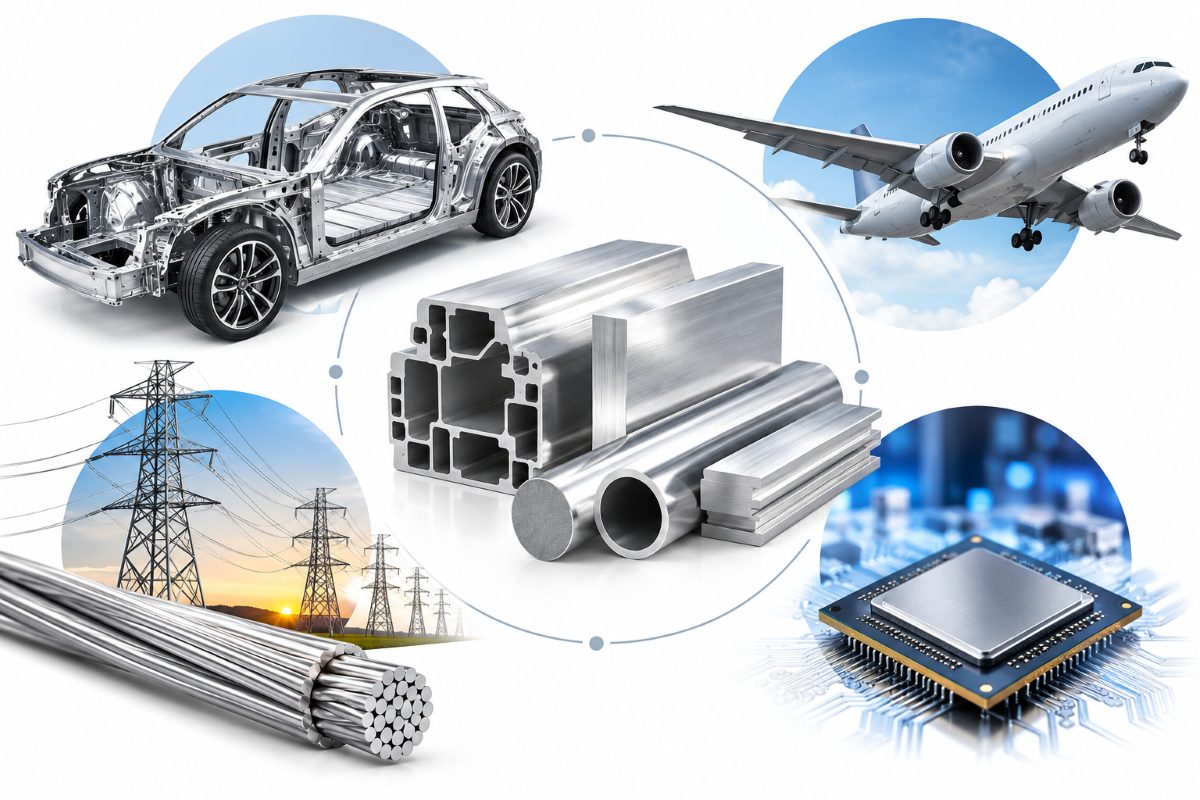
Driven by global decarbonisation mandates and EVs, alternative energy sources, the rise of artificial intelligence and advanced aerospace needs, aluminium has transitioned from a basic commodity into a strategic metal. Now, aluminium is considered to be an engineering material of choice for high performance, precision, reliability and sustainability.
Aluminium, in the form of complex chemical compounds, is a critical starting raw material for very high-technology segments like semiconductor thin films, solar PV, LED and dielectrics for chip packaging.
Alloy engineering opens new pathways for aluminium applications
I would like to point out three alloy families which will have a very high impact on products or applications, which will transform the growth into a new trajectory. These three alloys are as follows.
- 6xxx: High strength, excellent formability suitable for architecture, transportation and conductor applications.
- 2xxx: High strength-to-weight ratio with high fatigue resistance for aerospace applications.
- 7xxx: Highest strength-to-weight ratio used in commercial and military aircraft
Different product segments have different CAGR for applications like electric conductors, which will be required in large quantities as more and more renewable energy sources like wind and solar installations will come into play to store the grid energy from off-peak load hours.
EV lightweighting and Giga Casting expand aluminium’s design potential
6xxx series will play a dominant role in the battery support frame in EV to reduce weight of vehicle. Also, the latest development, like GIGA Casting of a single aluminium structure for weight reduction in EVs, which is a high-pressure die casting where the entire chassis is a single cast structure, will offer advantages, such as eliminating hundreds of robot welders and fastening steps, slashing floor space to a great extent. This will also enhance productivity to a great extent. However, there are challenges as well. Any damage and therefore repair will be a big hurdle; also, the capital cost of the giga cast structure will be quite high as compared to conventional processing techniques.
Aerospace pushes the requirements for strength, fatigue resistance and reliability
Aerospace is another highly demanding sector where high-performance and high-reliability materials are in high demand. Mechanical strength and stress distribution are primary criteria for the design of these structures. The following alloys are so far the choice for the design and construction of various parts.
- Alloys based on primary loading profiles: Damage-tolerant 2xxx series (Copper) alloys like AA2024 for tension-prone lower wing skins and pressurised fuselages and high-strength 7xxx series (Zinc) alloys like AA7075 for compression-prone upper wing skins and structural spars are the obvious choices today.
- Account for fatigue behaviour: Traditional aluminium exhibits predictable elastic responses and visible cracking prior to failure, allowing for safe inspection intervals.
Aluminium conductors offer a compelling alternative to copper
Aluminium for cables for conducting electricity has several advantages. Electrical cables with aluminium conductors offer a lightweight and cost-effective alternative to copper, providing about 61% of copper’s conductivity at roughly one-third the weight and a significantly lower price. Therefore, it is a justifiable alternative to copper, especially because of its increasing price. A few design aspects of electric cables with aluminium instead of copper wires, with a primary focus on different alloys, are as follows:
- AAC (All Aluminium Conductor): Pure aluminium strands used for short, lightweight urban spans. It uses high-purity electrical grade aluminium (typically 99.5% pure) that balances anti-corrosive behaviour with high conductivity.
- AAAC (All Aluminium Alloy Conductor): Aluminium alloy providing enhanced tensile strength and coastal durability.
- ACSR (Aluminium Conductor Steel Reinforced): Steel core surrounded by aluminium strands for high-tension, long-span overhead transmission.
- ACAR (Aluminium Conductor Alloy Reinforced): Blends pure aluminium and alloy strands for balanced strength and current capacity.
Conclusion
In conclusion, aluminium is perhaps the most valuable material, where the possibility for engineering the same for a wide range of applications, starting from cookware, construction, to high-end products and devices is maximum. This value is further enhanced when the recyclability of aluminium is considered, especially when one considers the rapid energy transition from fossil fuels to renewables and a very large emphasis on reducing CO2 emissions.
Aluminium, being 100% recyclable, stands at the top of the list for all recyclable metals. Thus, the transition of aluminium from a commodity to an obvious engineering choice is going to be seen in a big way in the next couple of decades. This transition will need structural support from innovation specialists like engineers, scientists and AI computation human resources. It is time more of this growth leads from bottom to top, which means developing products spontaneously before the market comes and knocks at the door of research centres.