您想继续阅读英文文章还
是切换到中文?
是切换到中文?

THINK ALUMINIUM THINK AL CIRCLE

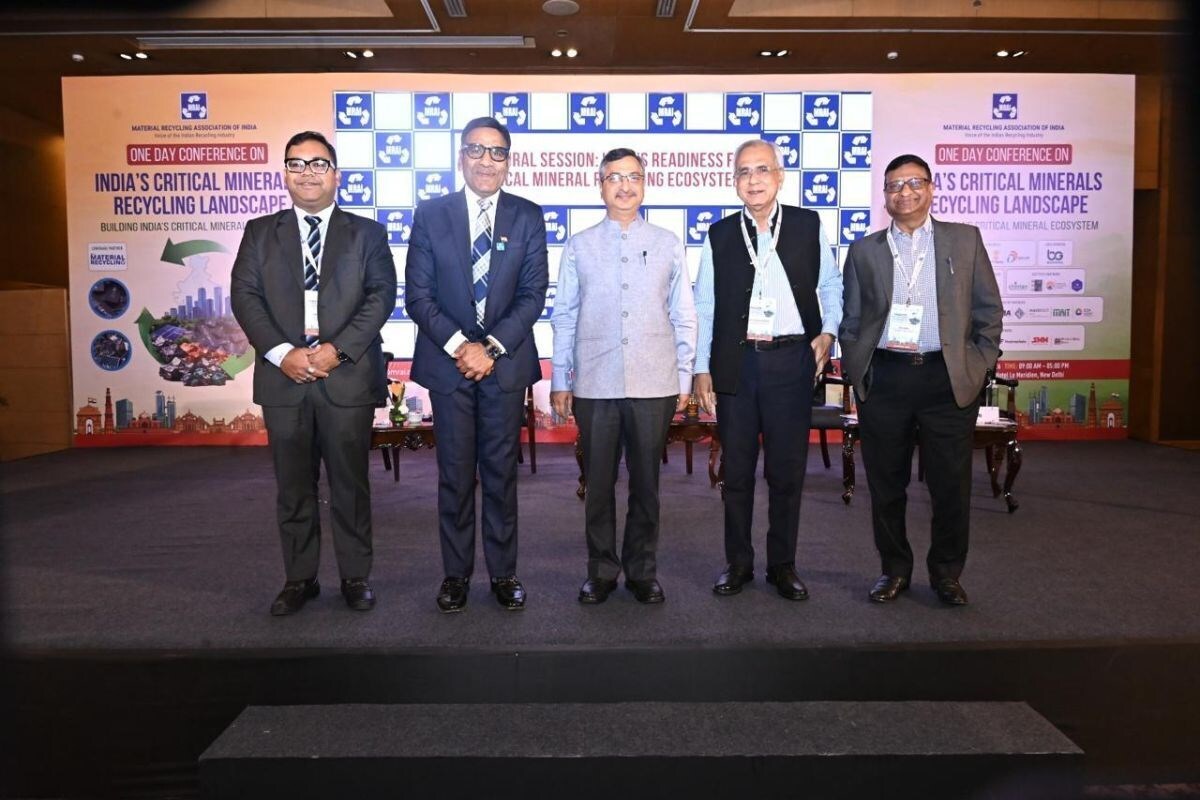
This image has been obtained via official Press Release
The Ministry of Mines is set to launch a dedicated scheme to develop India’s battery minerals processing value chain as part of the Government’s broader vision of achieving Atmanirbhar Bharat in critical minerals.
{alcircleadd}Addressing the one-day Conference on “India’s Critical Minerals Recycling Landscape” organised by the Material Recycling Association of India (MRAI) in New Delhi, Shri Piyush Goyal, IAS, Secretary, Ministry of Mines, stated that while several Indian companies have acquired overseas mineral assets containing lithium, cobalt, and other critical minerals, the absence of a robust domestic processing ecosystem has constrained the country’s ability to fully leverage these strategic resources.
To address this gap, the Ministry is finalising a mission-mode scheme to strengthen India’s battery minerals processing and value-addition capabilities. Shri Goyal said, “The scheme promotes the recycling-based recovery of 27 critical minerals and incentivises actual mineral extraction and processing rather than merely producing black mass. It is expected to create e-waste recycling capacity of approximately 300,000 tonnes per annum by 2030, with scope for significantly higher capacity based on industry participation and investment.”
He further noted that the Ministry’s analysis of critical mineral requirements indicates that several minerals required in relatively small quantities by strategic sectors such as defence and space can be effectively sourced through recycling, thereby reducing import dependence and strengthening resource security.
Emphasising the importance of circularity, Shri Goyal stated that urban mining and recycling will play a decisive role in closing the loop for critical minerals. He highlighted the Government’s strong commitment to promoting recycling and circular economy initiatives, including the approval of a INR 1,500 crore incentive scheme by the Union Cabinet and the timely issuance of its operational guidelines following extensive stakeholder consultations.
For forward-thinking aluminium market insights amidst supply chain and price challenges, read "ALuminium LeaderSpeak 2026"
According to Shri Goyal, against the scheme’s target of creating 270 kilotonnes of recycling capacity, the Ministry has already received commitments totaling 850 kilotonnes, reflecting strong industry confidence and participation. All applications received under the scheme were processed within a month, and letters of approval were issued to 58 eligible recyclers by April 30. He expressed confidence that by 2030, India would emerge not only as Asia’s leading hub for critical mineral recycling but also as a globally significant recycling destination.
Shri Goyal also underscored the need to establish a formal nationwide collection ecosystem for critical minerals by integrating industries, institutions, households, and the informal sector into an organised framework for scientific recovery and recycling. He informed that the Ministry is working on developing a comprehensive collection network and has proposed pilot projects at select locations. In addition, NITI Aayog has been requested to examine viability gap funding mechanisms to support economically sustainable collection and recovery systems.
In another major initiative, the Ministry plans to establish a common digital platform connecting recyclers across the country. The portal will enable citizens, industries, and institutions to responsibly dispose of end-of-life products containing critical minerals while ensuring their efficient recovery and recycling. Calling for a nationwide movement, Shri Goyal said India needs a “Har Ghar Ka Andolan” for critical minerals recycling, transforming resource recovery into a mass-participation initiative.
Shri Goyal also announced significant progress in developing India’s critical minerals processing ecosystem, with the Ministry of Mines supporting the establishment of four Critical Minerals Processing Parks in Andhra Pradesh, Odisha, Gujarat, and Maharashtra.
Prof. Abhay Karandikar, Member, NITI Aayog, emphasised the importance of policy support and innovation-led investments in building a robust critical minerals recycling ecosystem. He said, “Critical minerals recycling is essential for building a sustainable economy and therefore requires enabling policy support from both the Central and State Governments. The Department of Science and Technology has operationalised the INR 1 lakh crore Research, Development and Innovation (RDI) Fund to bridge critical gaps in technology commercialisation. The fund is designed to support private-sector R&D initiatives, including corporate research programmes and deep-tech startups, helping them scale innovative technologies for commercial deployment.
India has no shortage of waste materials or technical expertise. The key challenge lies in ensuring a reliable feedstock supply and integrating recovered materials back into the industrial value chain. The recycling sector is currently at an inflection point and presents a significant economic opportunity. Access to long-term capital is critical for the sector’s growth, and the INR 1 lakh crore fund will facilitate low-interest, long-tenure financing for eligible projects. As the critical minerals recycling ecosystem spans multiple ministries, agencies, and market participants, a high degree of coordination will be essential to create a thriving and globally competitive industry.”
Mr. Sanjay Mehta, President, MRAI, welcomed the Ministry’s vision and said, “The global race for critical minerals is no longer solely about economic growth; it is equally about energy security, technological leadership, and national resilience. Recycling must become India’s second pillar of resource security. Mining alone cannot meet future demand. Urban mines are becoming just as important as natural mines in securing the critical minerals required for the future economy.”
He further highlighted India’s strategic advantages, including its position as the world’s third-largest automobile market, a rapidly expanding battery manufacturing ecosystem, electronics production valued at over USD 125 billion, and its status as one of the world’s largest renewable energy markets. He noted that the Government’s decision to allocate INR 1,500 crore for critical mineral recovery under the National Critical Mineral Mission represents a landmark step towards reducing import dependence and strengthening domestic supply chains.
Calling for deeper collaboration among industry, policymakers, technology developers, research institutions, and academia, Mr. Mehta announced that MRAI is establishing a dedicated Critical Minerals Committee to align industry efforts with the Government’s vision of building a resilient, self-reliant, and future-ready critical minerals ecosystem.
Must read: Key industry individuals share their thoughts on the ALuminium LeaderSpeak 2026
Mr. Sanjay Mehta, President, MRAI, also urged the Government to establish a dedicated authority for recycling and the circular economy. He stated, “The recycling industry has the potential to generate millions of jobs, particularly in the blue-collar segment, while creating significant economic value for the country. However, the sector’s growth today remains largely dependent on the speed of policy implementation and regulatory action rather than the pace of trade and entrepreneurship. A dedicated authority can provide the necessary institutional framework to unlock the industry's full potential.”
Mr. Rajeev Kumar, Chairman, Pahle India Foundation and former Vice Chairman, NITI Aayog, said, “The intersection of critical minerals and recycling is no longer optional; it is a national necessity. Recycling can become India’s fastest pathway to securing strategic minerals while simultaneously advancing sustainability goals. We must empower states, urban local bodies, industry, academia, and research institutions to work together under a unified national blueprint for critical minerals recovery and recycling.”
Mr. Amar Singh, Secretary General, MRAI, said, “India’s critical minerals journey will require strong collaboration across the entire value chain. Through this initiative, MRAI seeks to facilitate practical solutions, encourage technology adoption, attract investments, and accelerate the development of recycling capacity to support a resilient and self-reliant critical minerals ecosystem.”
Highlighting the strategic importance of critical minerals recycling, Cmde. (Retd.) Sujeet Samaddar, Advisor, MRAI, emphasised that critical minerals and rare earth elements can be recovered through the secondary route using less than 10–20 percent of the feedstock, thermal energy, electrical energy, and water required for primary mining, while also significantly reducing processing time and costs. He noted that resource recovery through conventional mining—from exploration and reconnaissance to prospecting and extraction—can take 6–10 years, require investments of USD 1–2 billion, and involve substantial environmental costs.
Emphasising the need to strengthen India’s recycling ecosystem, he stated, “Most critical mineral processing technologies are mature and commercially proven. The Indian recycling industry primarily needs scale to make the business sustainable. GST rationalisation, liberalisation of imports, and viability gap funding to bridge the price differential between the informal and formal recycling sectors can pave the way for achieving Atmanirbhar Bharat in critical mineral resources.”
“The challenge before India is not merely to recycle more waste, but to recover greater value from it. The future of our recycling sector lies in moving beyond the recovery of gold and silver to unlocking the full spectrum of the 33 critical minerals that are vital for national development. The bridge to that future is innovation, and the vehicle for innovation is a strong industry-academia partnership focused on scaling technologies from laboratory breakthroughs to industrial deployment, particularly at Technology Readiness Levels (TRL) 5–7,” said Prof. Bineesha P, Advisor, MRAI, while addressing the Valedictory Session.
She further emphasised that fostering collaboration among industry, academia, research institutions, and policymakers will be crucial for accelerating the commercialisation of advanced recycling technologies and building a globally competitive critical minerals recycling ecosystem in India. Highlighting the significant potential of critical minerals recycling, Cmde. (Retd.) Sujeet Samaddar, Advisor, MRAI, stated that critical minerals and rare earth elements can be recovered through the secondary route using less than 10–20 percent of the feedstock, thermal energy, electrical energy, and water required for primary mining, while also significantly reducing processing time and costs.
He noted that resource recovery through conventional mining—from exploration and reconnaissance to prospecting and extraction—can take 6–10 years, require investments of approximately USD 1–2 billion, and entail substantial environmental costs. Emphasising the importance of technology in advancing critical minerals recycling, Cmde. Samaddar said, “Most processing technologies are mature, and the Indian recycling industry now needs to scale up operations to make the business sustainable.” He further emphasised that GST rationalisation, liberalisation of imports, and viability gap funding to offset the price differential between informal and formal recyclers could provide a viable pathway towards achieving Atmanirbhar Bharat in critical minerals and strengthening India’s long-term resource security.
"The challenge before India is not merely to recycle more waste, but to recover more value. The future of our recycling sector lies in moving beyond gold and silver to unlock the full spectrum of the 33 critical minerals essential for national development. The bridge to that future is innovation, and the vehicle for innovation is a strong industry-academia partnership focused on scaling technologies from laboratory breakthroughs to industrial reality, especially focusing on TRL 5-7”, highlighted by Prof. Bineesha P, Advisor, MRAI in the Valedictory Session.
Note: This article has been shared by MRAI and has been published by AL Circle with its original information without any modifications or edits to the core subject/data.
Responses