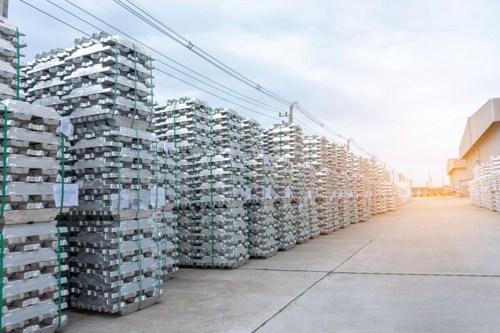
Calculate Embedded Emissions for Unwrought Aluminium (HS7601)
Enter your input
Notes:
There may be a difference when calculating the price with respect to
import volume, carbon price, and benchmark emissions, as the embedded
formula may result in minor variations due to decimal rounding.
Therefore, the actual value may vary.
CBAM is applicable to trade volumes starting from 50 metric tonnes. For trade volumes below 50 metric tonnes, CBAM does not apply.
Usage Procedure – How to use the CBAM Calculator Sheet
Enter or update values only in the
INPUT PARAMETERS section (Highlighted in blue) ,
including the carbon price, benchmark emissions, CBAM chargeable
percentage (as per the phase-in year), and imported quantity.
The system will automatically calculate the
payable emissions and the total CBAM cost (€)
based on the inputs provided.
Notes:
• Change any input value to automatically update CBAM cost.
• Formula used: Carbon price × payable emissions × quantity.
• Model aligned with CBAM supplier-side illustrative methodology.
Login now to unlock Calculate Embedded Emissions for Unwrought Aluminium
Meridian shares priced at $1.50 ahead of Oct 29 sharemarket float
4MINS READ
Meridian shares will be issued at a listing price of $1.50, the bottom of the indicative range of $1.50 to $1.80 and with a much smaller investor pool than the government had hoped for.
Some 62,000 New Zealand investors put their money into Meridian, despite huge efforts through advertising and the structure of the offer to attract retail "Mum and Dad" investors, compared with 113,000 for MightyRiverPower, which listed in May at $2.50 a share, but has traded down to $2.20 since.
The float will raise $1.88 billion after the two instalment payment programme completes in May 2015.
"Bear in mind the circumstances," said Finance Minister Bill English at a mid-evening press conference at the Beehive. "We have the impression a lot of Mum and Dads were scared off by the Labour-Greens policy" as well as uncertainty over the Tiwai Point aluminium smelter and a realisation electricity demand has been falling and the companies are no longer "cash cows".
Meridian will list on Oct 29 on both the Australian and New Zealand stock exchanges, where it will join MightyRiverPower, also partially privatised in May, and Contact Energy, which was sold 100 percent in private investors' hands in 1999.
The price values Meridian at $3.84 billion for the whole company, compared with around $6 billion when it was last independently valued for the Treasury in 2011. While a large part of the difference is explained by the fact that control remains with the government as 51 percent shareholder and the previous valuation included higher power prices for supply to the Tiwai Point aluminium smelter, it also reflects the lacklustre retail appetite for the shares.
Labour Party state-owned enterprises spokesman Clayton Cosgrove labelled the float a failure.
"John Key and Bill English's asset sales are officially a farce as Meridian was sold off for $1.2 billion less than they promised and attracted just 62,000 investors," he said.
Numerous factors combined to force down the price of Meridian shares. Chief among these were market fears that a Labour-Greens government, if elected next year, will gut electricity company profits to deliver large price cuts; and ongoing uncertainty about the long term future of the Tiwai Point aluminium smelter.
Revised contracts for the smelter's consumption were concluded in August for a plant that uses around 14 percent of all electricity produced in New Zealand and accounts for around half Meridian's annual revenue.
On top of that, the fact the MRP share price has fallen from $2.50 at issue in May to $2.20 today prompted major efforts to make the Meridian float as attractive as possible to small-time retail investors, whose appetite for the shares is important to the political success of the privatisation programme.
To that end, the government guaranteed no retail investor would pay more than $1.60 a share, no matter what price was set for institutional investors, and created a two-instalment payment programme, meaning investors will pay $1 now and the remaining 50 cents in May 2015.
Trading from Oct 29 will therefore not be in Meridian shares, but in Meridian instalment receipts, until the shares are fully paid in another 18 months time. This is expected to help stimulate a livelier after-market for Meridian shares than has emerged for MRP.
The government may still press ahead with the sale of Genesis Energy in the first half of next year, assuming market conditions suggest there is appetite for another large, New Zealand electricity company float.
With Contact, Meridian, MRP, TrustPower and network company Vector, half the shares in the top 10 NZX shares are in the electricity sector.
With MRP and Meridian proceeds totalling $3.58 billion, the asset sales policy is likely to struggle to reach the bottom end of the government's $5 billion to $7 billion range, although it has signalled Air New Zealand shares could be sold in a private placement to institutions at any time.
While Meridian will be 86.7 percent owned by New Zealanders, including the government, but it is clear it has attracted larger retail investors as there is scaling back required for some investors, who will be unable to buy as many shares as they applied for.
Investors who sought more than $20,000 of shares will receive only 55 percent of what they sought.
Of the 49 percent of the company sold, some 27.6 percent comes from foreign institutional investors and 12.7 percent is from New Zealand institutions.
We use cookies from our users to operate this website and to improve its usability.
You can find details of what cookies are, why we use them and how you can manage them in our
Cookies page. Please note that by using this site you are consenting to the use of cookies.
Necessary cookies help make a website usable by enabling basic functions like page
navigation and access to secure areas of the website. The website cannot
function properly without these cookies.
Preference cookies enable a website to remember information that changes the way
the website behaves or looks, like your preferred language or the region that you
are in.
Statistic cookies help website owners to understand how visitors interact with
websites by collecting and reporting information anonymously.
Marketing cookies are used to track visitors across websites. The intention
is to display ads that are relevant and engaging for the individual user and
thereby more valuable for publishers and third party advertisers.
Cookies are small text files that can be used by websites to make a user's experience more efficient.
The law states that we can store cookies on your device if they are strictly necessary for the
operation of this site. For all other types of cookies we need your permission.
This site uses different types of cookies. Some cookies are placed by third party services that
appear on our pages.
Your consent applies to the following domains:
google.com,
youtube.com,
doubleclick.net,
zopim.com