您想继续阅读英文文章还
是切换到中文?
是切换到中文?

THINK ALUMINIUM THINK AL CIRCLE

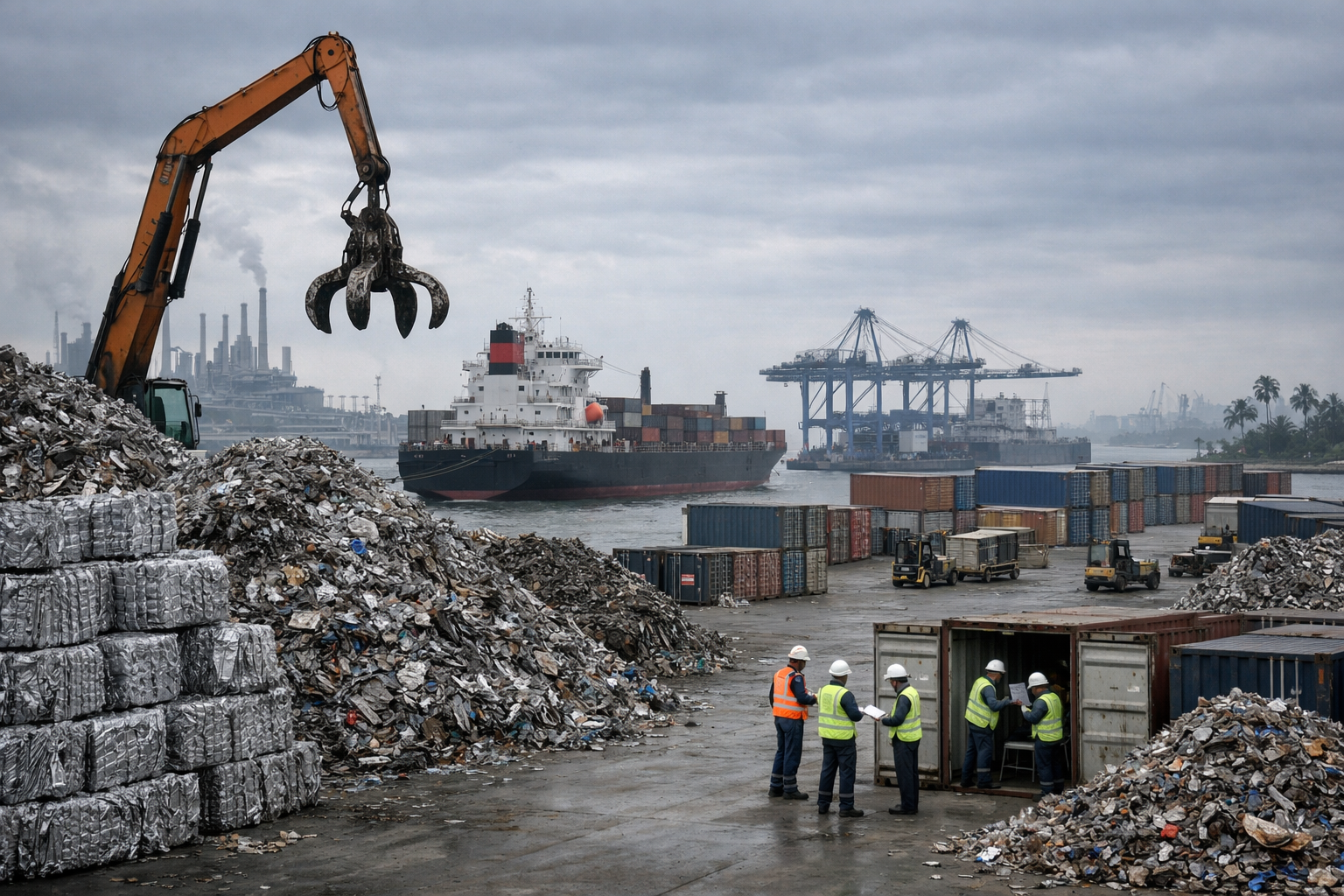
February 2026 marked a period of unprecedented regulatory volatility for the global secondary aluminium and scrap markets. Driven by a confluence of tariff upheavals, aggressive decarbonisation mandates, and stringent environmental crackdowns, the traditional flow of aluminium scrap is being fundamentally redrawn. As the United States implements sweeping new import surcharges, the European Union weighs restrictive export measures, and Southeast Asian hubs like Malaysia tighten their borders against contaminated materials, market participants are facing mounting compliance costs and disrupted arbitrage windows. This review examines the key policy shifts that defined the ex-China aluminium recycling sector this month and their immediate implications for global trade flows.
{alcircleadd}The United States: How the 10 per cent surcharge disrupts secondary aluminium
Following the United States Supreme Court’s ruling, which invalidated Trump’s IEEPA tariffs on February 20, 2026, many trade goods found themselves navigating a complicated and chaotic new regulatory landscape. Within hours of the ruling, President Trump pivoted to Section 122 of the 1974 Trade Act, levying a 10 per cent blanket global import surcharge that went into effect on February 24, replacing the former country-based tariffs. There have also been threats made by President Trump to raise this surcharge to the statutory maximum of 15 per cent, which could further disrupt global trade and U.S. imports.
Even though most primary aluminium products will not see a huge change due to already being burdened by the 50 per cent Section 232 tariffs, the secondary aluminium market, which formerly enjoyed a 0 per cent tariff under Section 232, might now be caught in the newest 10 per cent blanket import surcharge. The US Geological Survey’s Mineral Commodity Summaries 2026, published in February 2026, estimated an increase in imported scrap into the US in 2025, reaching roughly 890,000 tonnes, which is approximately a 27 per cent increase compared to 2024. Even though scrap imports only make up roughly 20 per cent of the US’s total scrap consumption, a blanket import surcharge will likely affect a significant portion of total scrap imports for the active period of the Section 122 policy. This is especially true as the policy remains highly volatile and faces the risk of being increased or challenged in the near future.
Europe: The "scrap leakage" debate and impending export controls
The EU aluminium recycling sector is also on edge following the closure of the EU’s public consultation in late January. Currently, trade measures are widely expected to be unveiled and launched during Spring 2026, aimed at curbing what the EU terms "aluminium scrap leakage." European Aluminium, as one of the biggest supporters of trade measures to control scrap leakage, cites outflows exceeding 1.3 million tonnes annually that could instead be utilised domestically to meet decarbonization and net-zero targets.
In February, the Bureau of International Recycling (BIR) released statements opposing these trade measures, stating that "the imposition of export restrictions or trade barriers is fundamentally unnecessary and risks producing significant unintended consequences for the entire value chain." BIR also explained how its own monitoring fails to identify scrap leakage issues, noting that the EU currently has insufficient domestic smelting capacity to absorb the extra scrap that is being exported out of Europe. In the same statement, BIR warned of a probable reduction in domestic aluminium scrap prices and a decline in the overall quality of waste management systems. Similarly, in 2025, the European Recycling Industries' Confederation (EuRIC) published stark warnings against the possible restriction of aluminium scrap exports.
In a scenario where all grades of aluminium scrap are restricted from being exported, or if exports are hit with a significant surcharge, the Asian market, especially China, India, and Southeast Asia, all of which are large importers of EU scrap, would be heavily impacted. Supply would see significant decreases, and prices outside Europe might climb to new highs as markets adjust to fill the gap, while secondary prices within the EU could drop to new lows due to localised oversupply.
Malaysia: The E-Waste Crackdown and Stringent SIRIM Enforcement
Following the success of "Ops Metal" in 2025, Malaysia has seen a massive volume of illegal scrap imports seized, amounting to a total value of MYR 7 billion. In response to the influx of illegal scrap imports frequently mixed with electronic waste, the Malaysian government implemented an absolute e-waste import ban effective February 4, 2026, in order to curb these environmental violations.
While aluminium scrap is still legally allowed to be imported into Malaysia, albeit under strict SIRIM purity requirements, the absolute e-waste ban will inevitably affect certain secondary grades. Notably, Zorba imports will likely see significant increases in transit and processing times, as customs officials are now far more likely to detain such cargoes for exhaustive inspections due to the high probability of e-waste contamination. In the broader picture, the volume of aluminium scrap legally entering Malaysia will likely decrease. Coupled with escalating processing delays at customs, this friction increases the probability that businesses will actively divert their aluminium scrap trade elsewhere in Southeast Asia, such as to Thailand.
Conclusion
Looking ahead to the second quarter of 2026, the secondary aluminium market will likely remain in a state of flux as these regional policies take full effect. The era of frictionless global scrap trade is rapidly giving way to a localised, highly regulated environment. For remelters and traders, navigating this landscape will require extreme supply chain agility and a hyper-focus on material compliance. As European supply risks being politically landlocked, US raw material imports become suddenly more expensive, and Southeast Asian quality barriers rise, we expect to see continued volatility in regional premiums and a widening decoupling of traditional scrap-to-LME pricing mechanisms in certain regions. Adapting to this fragmented reality will be the defining challenge for the industry in the months to come.
Note: This article has been issued by SMM and has been published by AL Circle with its original information without any modifications or edits to the core subject/data.
Responses