Vietnam ranks first, India comes second: Who are the giants in the PV manufacturing market?
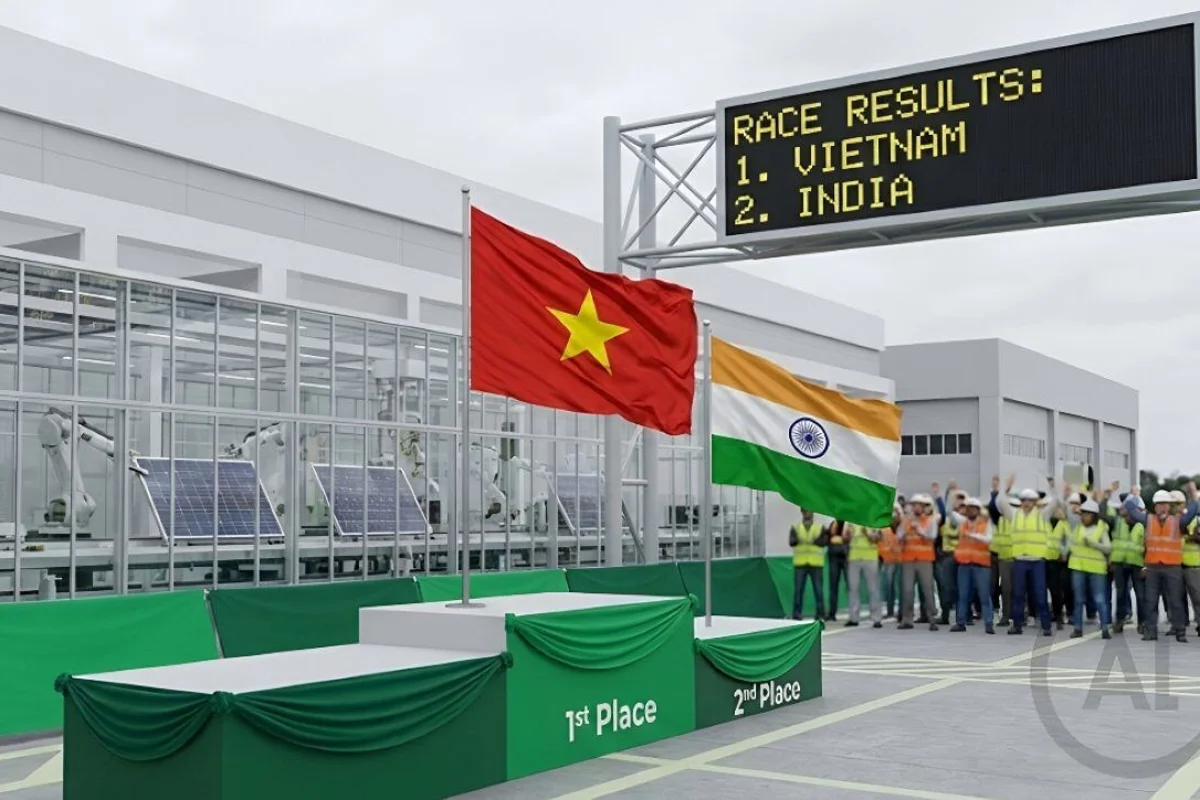
A comparative industry analysis by IRENA has revealed that, apart from China, Vietnam emerges as the leading solar PV manufacturing centre with the lowest economic solar panel price. Striving to develop its solar PV base, India is maintaining second position in the cost-competitive race in the Asian solar sector. IRENA highlighted how factors like labour charge, tariff on electricity, policy support and supply-chain integration shape the cost dynamics in the PV manufacturing and solar panel prices in India. Thus, Vietnam leads the race with a narrow, but substantial lead, with India a close contender.
Explore- Most accurate data to drive business decisions with Global ALuminium Industry Outlook 2026 across the value chain
Vietnam leads the low-cost module production: how and why?
The primary foundation for Vietnam’s cost advantage in solar modules is built on low electricity tariffs and competitive labour costs. Its solar panel price averages around USD 0.07/kWh. Majorly lower than India’s average USD 0.1/kWh, it is a decisive factor for energy-intensive upstream processes such as polysilicon, ingots, and wafers.
Moreover, Labour costs boost Vietnam’s position, with average engineer salaries around USD 9,000 per year. Backed by supportive government policies and private investment, the country has set up one of the most integrated solar manufacturing ecosystems outside China, including domestic polysilicon capacity that enhances supply security, as incorporated recently.
As of 2023, Vietnam’s solar manufacturing capacity exceeded 18.4 GW. A Vietnamese-produced, entirely domestic TOPCon module costs around USD 0.18/Wp, while sourcing solar cells from China for final assembly can further lower costs to an estimated USD 0.12/Wp, indicating the flexibility of its hybrid production model.
However, the sector faces pressure from the lowering solar panel prices globally. In some cases, that may even remain below production costs, thereby creating financial strain even for cost-efficient producers.
India: closing the solar panel price gap
Ranking second to Vietnam in the cost-competitive structure, India has secured its position as a strong alternative solar unit manufacturing hub in Asia. TOPCon module production in the domestic market costs approximately USD 0.19/Wp, while importing cells for local assembly can lower costs to around USD 0.13/Wp, narrowing the differential with Vietnam.
With solar power hitting the mark of 75 GW by 2023, India leverages reduced labour costs as average engineer salaries stand at about USD 8,500 annually. Additionally, the Production Linked Incentive (PLI) scheme acts as a strong policy support and reinforces quality compliance, integrated manufacturing, and improved access to financing.
Structural challenges and competitive scenario
The main barrier in India’s way to develop fully integrated supply chains is the steep electricity tariffs, weighing on upstream manufacturing. Hence, aside from China, Vietnam holds its position as the lowest-cost solar PV manufacturing base.
Nonetheless, India is striving consistently by narrowing the gap through policy backing, labour cost advantages, and expanding capacity. Competitive pressure between the two markets is expected to intensify as countries accelerate efforts to localise solar supply chains and reduce reliance on Chinese imports.
Don't miss out- Buyers are looking for your products on our B2B platform

Rio Tinto launches ‘Forged Here’ campaign to promote Québec-made aluminium
Next articleBYD plans India EV launch with Atto 2 in 2026 despite market barriers
Grow with
AL Circle