The United States' unprecedented support for Russia in blocking a draft resolution by Ukraine at the United Nations has sent shockwaves through the market as soon as the news surfaced today, February 25. For the first time in three years since Russia invaded Ukraine, the United States has come out in support of Russia.
The resolution called for "de-escalation, an early cessation of hostilities and a peaceful resolution of the war against Ukraine, marked by enormous destruction and human suffering, including among the civilian population, in line with the Charter of the United Nations and international law".
Backing Russia, United States President Donald Trump stated that "major economic development transactions with Russia" could take place, and just hours after the statement, Putin convened a meeting with his ministers and economic advisers to discuss the possible trade relation with the United States. The offer is already extended to the United States for an opportunity to explore and assess Russia's potential to supply aluminium and evaluate its rare earth metal deposits as part of a future economic agreement.
"We, by the way, would be ready to offer (joint projects with) our American partners, and when I say 'partners,' I mean not only administrative and governmental structures but also companies, if they showed interest in joint work," Putin said on state TV after the meeting.
According to many opinions, the United States' unexpected shift in support from the European Union to Russia signals a growing rift in US-EU trade relations. For years, the US has consistently sided with Europe against Russia. Now, speculation is rising over the reasons behind this change in stance.
Russia could serve as a potential alternative source for low-carbon primary aluminium to offset the reduced supply to the US domestic market following the implementation of a 25 per cent tariff on European aluminium imports. Russia holds a prominent position as one of the leading low-carbon aluminium producers globally, with the company Rusal being a major player in the sector, having an annual low-carbon aluminium production capacity of almost 4 million tonnes, with no more than 4 tonnes of carbon emissions per year.
According to Putin, Russia can supply up to 2 million tonnes of aluminium to the US annually. Russia used to provide up to 15 per cent of US aluminium imports before prohibitive duties were introduced in 2023.
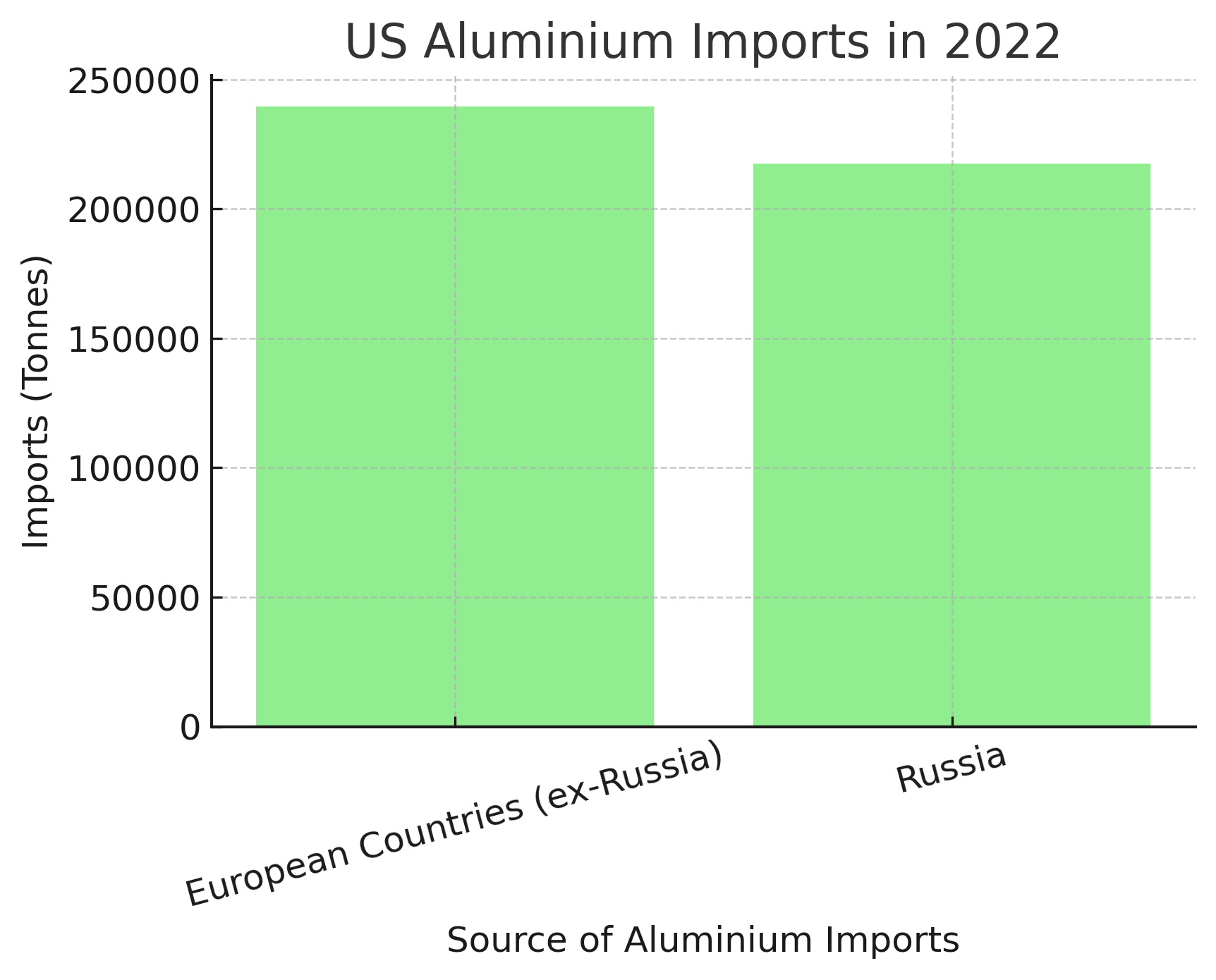
In 2022, the United States imported 217,537 tonnes of unwrought aluminium and aluminium products from Russia. In 2021, the country sourced 265,118 tonnes, up 28 per cent from 207,096 tonnes in 2020. In 2016 and 2017, the import volumes peaked at 738,870 tonnes and 775,309 tonnes, respectively. However, with the implementation of prohibitive duties in 2023, the United States' unwrought aluminium imports from Russia plunged to 17,080 tonnes and further decreased to as low as 826 tonnes in 2024.
But will Russia's aluminium offset the overall supply from Europe?
In 2024, the United States imported approximately 209,958 tonnes of aluminium (including unwrought and processed products) from Europe, less than 217,537 tonnes imported in 2022 from Russia before prohibitive duties. If the US resumes importing aluminium from Russia at levels similar to those in earlier years, it could help offset the decline in domestic supply. By comparison, in 2022, the US imported 239,683 tonnes of aluminium from European countries, slightly exceeding the volume imported from Russia alone.
Other potential areas for collaboration
In addition to aluminium supply, Putin has proposed collaboration with the United States on hydropower generation and aluminium production in Russia's Krasnoyarsk region in Siberia, home to Rusal, the country's largest aluminium producer.
"What is most important, in my opinion, is that we could consider working together with American companies in this area," Putin stated, estimating potential investment in the project at $15 billion.
He also suggested joint ventures in the energy sector, noting that some Russian and US companies are already communicating, though he did not disclose further details.
Rare earth metals present another key area for potential collaboration between Russia and the United States. According to the US Geological Survey, Russia has the world's fifth-largest reserves of rare earth metals at 3.8 million tonnes, after China, Brazil, India, and Australia.
Of the total capacity, Russia currently mines only 2,500 tonnes of concentrate in a year and lacks capacity for processing. Rare earth metals, comprising cerium, europium, gadolinium, dysprosium, lutetium, scandium, terbium, yttrium, and holmium, are used to make magnets that turn power into motion for electric vehicles, mobile phones, missile systems and other electronics.













_md.webp)
_md.webp)
_md.webp)