In 2025, the US alumina story begins with rising imports-but it quickly reveals a system under strain. US alumina imports surged to 1.77 million tonnes in 2025, up 32 per cent from 1.34 million tonnes in 2024, reversing a marginal 1 per cent dip from 1.36 million tonnes in 2023. It reads like a rebound-but is it really a recovery story, or does it signal a deeper structural shift?
The movement through the year adds intrigue. Alumina imports rose consistently through the first three quarters of 2025 before reversing sharply in the final quarter. Volumes reached 439,000 tonnes in Q1, increasing to 466,000 tonnes in Q2, up 6 per cent quarter on quarter, and climbed further to 506,000 tonnes in Q3, marking an 8 per cent rise. However, this upward trajectory broke in Q4, with imports falling sharply to 361,000 tonnes, down 29 per cent from the previous quarter. Despite this decline, fourth-quarter volumes were still 2 per cent higher than in the same period of 2024.
Shrinking domestic refining base drives import reliance
The answer lies in a steady, long-term erosion of US refining capacity. Alumina production has fallen from about 5 million tonnes in 2000 to roughly 600,000 tonnes today-an 88 per cent decline shaped by permanent closures rather than short-term cycles.
Facilities such as Sherwin Alumina in Texas and Massena East in New York have shut over the past decade. Alcoa’s Point Comfort refinery in Texas, once capable of producing 2.3 million tonnes annually, was closed in 2019 and has since been dismantled, further reducing domestic capacity.
Today, the system depends largely on a single refinery - Atlantic Alumina’s Gramercy plant in Louisiana-running at about one-third capacity and producing around 500,000–600,000 tonnes annually from imported Jamaican bauxite.
Given its strategic role, the US government has stepped in with USD 450 million in combined support, including USD 150 million from the Department of Defense and USD 300 million alongside Pinnacle, with plans to add gallium production at the site.
For 2026 aluminium market outlook, download our report TOC: Global Aluminium Industry Outlook 2026
If aluminium output is easing, why are imports rising?
US aluminium production has edged down-from 686,000 tonnes in January-November 2023 to 619,000 tonnes in 2024 and 607,000 tonnes in 2025. Yet alumina imports have moved in the opposite direction. Smelter-grade alumina imports rose from 1,073,866 tonnes in 2024 to 1,346,003 tonnes in 2025.
At these levels, the US could theoretically support aluminium output of around 708,423 tonnes, suggesting that not all imported alumina is consumed immediately. Instead, part of it is absorbed into the system through storage. Smelters maintain storage capacity, and excess smelter-grade alumina is held at refinery sites, giving operators flexibility to manage inventories alongside production.
The US still operates four smelters-two owned by Century Aluminum and two by Alcoa. Sebree produces around 220,000 tonnes annually, Mt. Holly about 229,000–231,000 tonnes, Warrick has been running reduced lines since 2022, and Massena adds 130,000 tonnes. Only two are currently running at full capacity, although Century Aluminum is investing USD 50 million to restart more than 50,000 tonnes at Mt. Holly by June 2026.
Together, these smelters produce about 683,500 tonnes of aluminium. To sustain this, roughly 1.30-1.37 million tonnes of alumina are needed-well above domestic output of 500,000–600,000 tonnes.
Brazil leads, Jamaica accelerates in US alumina market
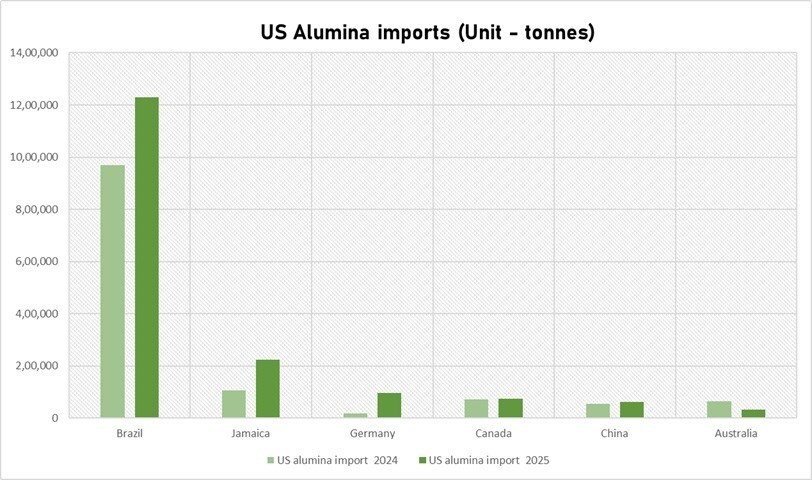
Brazil continues to dominate US alumina supply, with shipments rising from 969,000 tonnes in 2024 to 1.23 million tonnes in 2025, a 26.9 per cent increase. A major driver has been the expansion of the Alumar refinery, where a USD 3.1 billion upgrade doubled capacity to 3.5 million tonnes per year, reaching full ramp-up by mid-2025. Completed in phases between 2020 and 2025, the project has created a clear export surplus beyond Brazil’s roughly 1 million tonne domestic aluminium demand.
Logistics reinforce this advantage. Cargoes from São Luís and Pecém reach the US Gulf Coast in 10–15 days at freight costs of USD 15–20 per tonne, compared with more than 30 days and USD 40–60 per tonne from Australia-effectively halving landed costs.
Jamaica has also strengthened its position, with imports more than doubling from 107,000 tonnes to 223,000 tonnes, up 108.4 per cent. The increase reflects higher utilisation at the Jamalco refinery, which has a nameplate capacity of 1.4 million tonnes and has been 55 per cent owned by Century Aluminum since May 2023.
Exports rose to 102,000 tonnes in H1 2025 from 29,440 tonnes a year earlier, following earlier gains in 2024. Utilisation improved from around 30 per cent to about 39 per cent, supported by operational adjustments and stronger US demand. The shift was most visible in Q1 2025, when exports jumped to 66,000 tonnes, up 238 per cent year on year.
Recovery from Hurricane Beryl, which disrupted Kingston port operations in July 2024, also played a role, with repairs completed by Q4 enabling stockpiling and a stronger start to 2025. Early gains from the USD 70.5 million Project Restore further improved mining access, digester flow and feedstock consistency.
Don’t miss out- Buyers are looking for your products on our B2B platform
Germany rises, China redirects, Australia retreats
Beyond Brazil and Jamaica, the supply chain shows a market in transition. Germany, for instance, saw the sharpest rise, with exports jumping from 17,000 tonnes in 2024 to 95,800 tonnes in 2025-a 463.5 per cent increase. Of this, around 10,028 tonnes was smelter-grade alumina.
Germany’s role is less about production and more about logistics, functioning as a trading and re-export hub, with over USD 900 million worth of alumina shipments routed through it.
Canada, by contrast, has remained steady. Imports edged up only slightly from 72,900 tonnes to 74,600 tonnes, a modest 2.3 per cent increase, suggesting a stable but limited role in US supply.
China’s position has expanded more noticeably, with shipments rising from 53,500 tonnes to 61,900 tonnes, up 15.7 per cent. This shift is closely tied to domestic policy, particularly the 45 million tonne cap on primary aluminium production, which has constrained local alumina demand. As a result, excess material has increasingly been pushed into export markets. Shipments rose 59.3 per cent year on year in the first eight months of 2025 to around 1.75 million tonnes, with momentum expected to carry through the rest of the year as producers take advantage of competitive global pricing.
Australia, however, has moved in the opposite direction. Exports to the US fell sharply by 50.2 per cent, dropping from 63,300 tonnes in 2024 to 31,500 tonnes in 2025. The decline reflects a difficult production cycle, including a 2.2 million tonne curtailment at the Kwinana refinery in June 2024, disruptions at Rio Tinto’s Gladstone operations and environmental approval challenges at South32. Export volumes fell by 7.3 per cent, even as export values climbed from USD 8.5 billion to USD 11.5 billion, with US tariffs adding another layer of pressure on trade flows.
Is this the new normal for the US alumina market?
The broader pattern points to a structural shift rather than a temporary spike. The systematic closure of US refineries reflects long-term competitive disadvantages, with facilities permanently dismantled rather than idled.
With domestic refining capacity reduced to a fraction of its former size and aluminium production holding steady, the US has effectively repositioned itself as a structurally import-dependent market for alumina.The fluctuations seen through 2025-strong growth followed by a sharp correction-are not random. They reflect a system adjusting to new constraints, new costs, and an increasingly dynamic global supply chain. The real question now is not why imports increased, but whether this dependence has become permanent.
Trading aluminium across borders? Find out the exact cost you need to bear for the embedded carbon in the product by using this CBAM calculator.














_md.webp)
_md.webp)
_md.webp)