As Brussels pushes forward with the Carbon Border Adjustment Mechanism (CBAM) and doubles down on its climate ambitions, the European aluminium sector is sounding the alarm on another missing piece in the policy puzzle: aluminium scrap. The call is not new, but it is urgent. As downstream manufacturers and industry veterans univocally demand expanded inclusion of goods into CBAM framework, the European Aluminium has advocated for scrap export taxation.
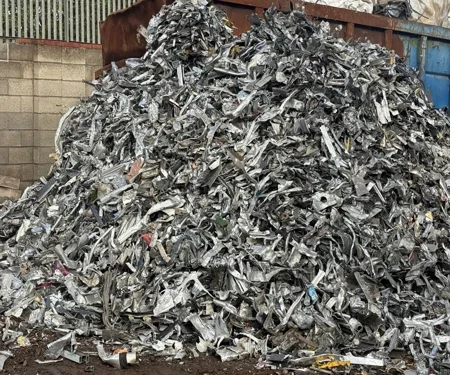
European Aluminium, the industry’s leading voice, argues that without a scrap export tax, Europe risks squandering its strongest competitive lever in the race for decarbonisation — its recycling base.
Recycling is the backbone of Europe’s aluminium economy. Roughly 40 per cent of EU aluminium consumption (around 5 million tonnes annually) already comes from recycled metal. Over the past decade, the industry has channelled EUR 700 million into new recycling furnaces, expansions, and process upgrades, adding about 1 million tonnes of extra capacity across the EU and EFTA. Today, the EU alone boasts 12 million tonnes of installed recycling furnace capacity, making it one of the most advanced secondary aluminium systems in the world.
Yet, despite the hardware, the system runs below potential. Around 15 per cent of EU recycling capacity is idled, not for lack of technology or demand, but for lack of feedstock, wherein scrap is simply leaving Europe too quickly.
Import dependence, carbon consequences
The demand versus availability imbalance is magnified by Europe’s struggles with primary aluminium. In 2022 and 2023, half of the EU’s smelters shut down under the weight of skyrocketing electricity prices and insufficient policy support for low-carbon power.
Imports filled the void, as in 2023, over 50 per cent of primary aluminium consumed in Europe was imported. The problem is not just economic but environmental. Imported metal carried a carbon footprint nearly 60 per cent higher than European production, with flows shifting towards coal-powered regions.
Scaling up recycling is, therefore, not an industrial luxury but a climate necessity. Every tonne of secondary aluminium saves 95 per cent of the energy required for primary production and slashes emissions. Yet Europe is watching its scrap flow outward, undermining both climate and competitiveness goals.
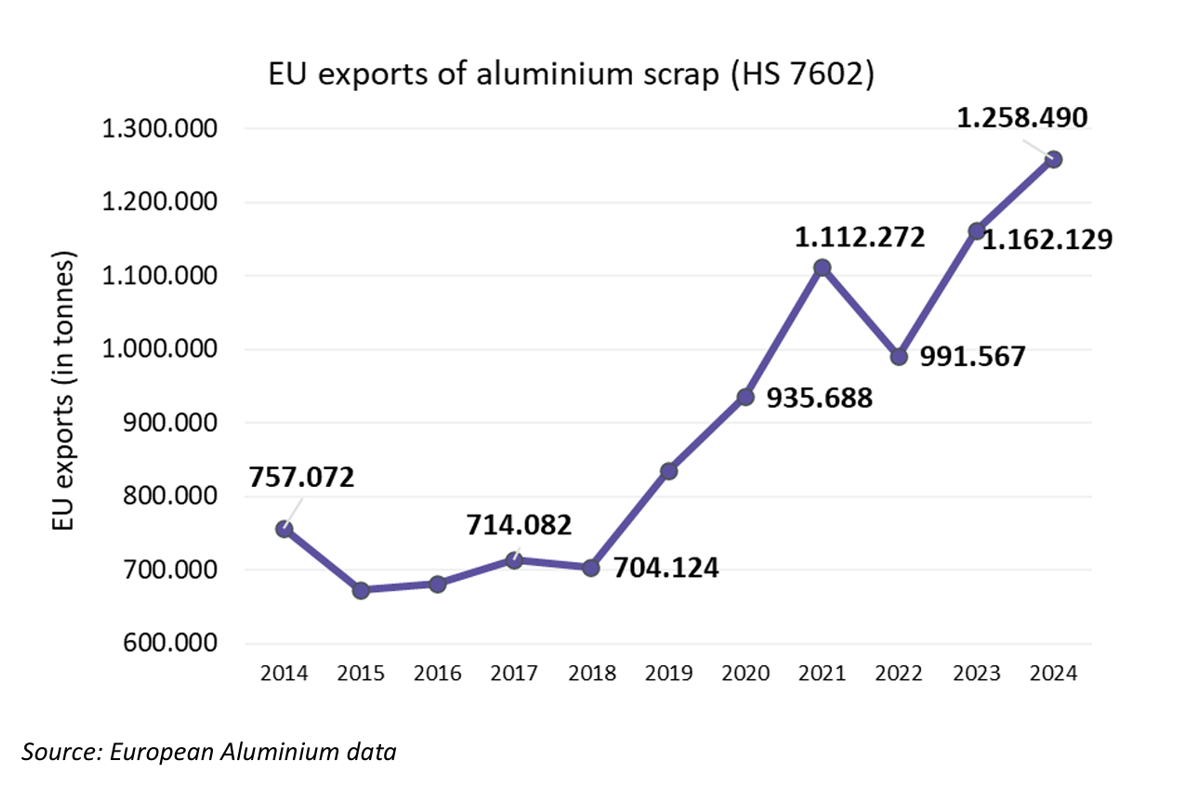
The urgency spiked in 2025 when Washington doubled its Section 232 tariffs on aluminium to 50 per cent, exempting scrap. The result was a textbook arbitrage: the US became an irresistible magnet for European scrap exports. From January to June 2025, EU scrap shipments to the US jumped by almost 200 per cent year-on-year, according to European Aluminium.
The knock-on effects are global. The European Union has exported over 9,17,95 tonnes of scrap during the first half of 2025.
Asian buyers, historically reliant on US scrap flows, are now turning to Europe. With the US market absorbing record inflows, Europe has effectively become a global backstop for secondary feedstock — even as its own recyclers run idle.
European Aluminium’s prescription is blunt: a horizontal export fee (“erga omnes”) on all aluminium scrap leaving EU and EFTA borders. Far from protectionism, the association frames it as restoring fair trade in a market distorted by third-country tariffs. The logic is straightforward:
- Level the playing field: With third countries manipulating trade through tariffs, an EU fee would neutralise arbitrage.
- Secure feedstock: Keeping more scrap at home ensures utilisation of Europe’s recycling furnaces.
- Stimulate investment: Reliable scrap supply will attract further capital for advanced processing, especially for harder-to-recycle grades.
- Close the loop: Domestic remelting under strict EU environmental standards reinforces Europe’s claim to circular leadership.
Policy architecture: CBAM, ETS and the loophole
The demand for a scrap export tax is not isolated. It complements CBAM and ETS, forming a three-legged policy stool. The ETS has already raised EUR 175 billion since 2013, financing renewables and cutting industrial emissions by 47 per cent from 2005 levels. CBAM aims to extend this carbon pricing shield to imports, ensuring domestic producers are not undercut by dirtier metal.
But CBAM has a fatal gap that has pulled eyeballs from traders across the globe — SCRAP. Under its current methodology, remelted scrap is treated as zero-emission and thus zero-cost. This “scrap loophole” gives foreign exporters a free pass while EU recyclers pay for emissions under ETS. In effect, CBAM subsidises imports of scrap-derived metal at the expense of European recyclers, creating the very leakage it was designed to prevent.
An export tax would plug this hole, aligning all three instruments, from ETS, CBAM, to scrap management, into a coherent framework.
Read our e-magazine for industry leaders' perspectives: ALuminium Industry - Focus Europe
Critics are already circling. Free trade advocates warn that an export fee risks breaching WTO rules, while trading partners are likely to cry foul. Developing nations, already critical of CBAM’s fairness, may view it as yet another example of Europe weaponising climate policy to lock in industrial advantage.
But the counter-argument is that inaction is costlier. Allowing scrap outflows to accelerate will idle Europe’s multi-million euro new recycling assets, undermine CBAM’s credibility, and deepen reliance on carbon-heavy imports.
At stake is more than aluminium policy. Scrap export taxation has become a litmus test of Europe’s industrial and climate credibility. Brussels cannot claim leadership in the circular economy while letting its cleanest feedstock exit unchecked. Nor can it present CBAM as watertight while tolerating loopholes big enough for scrap cargoes to sail through.
European Aluminium is clear: without a scrap export fee, Europe risks turning its recycling advantage into a liability. With it, the bloc could anchor its aluminium value chain in domestic resources, shore up industrial resilience, and prove that circularity is more than rhetoric.
The choice now rests with policymakers: leave scrap policy to global arbitrage, or use it as a lever to make Europe’s aluminium truly circular.












_md.webp)