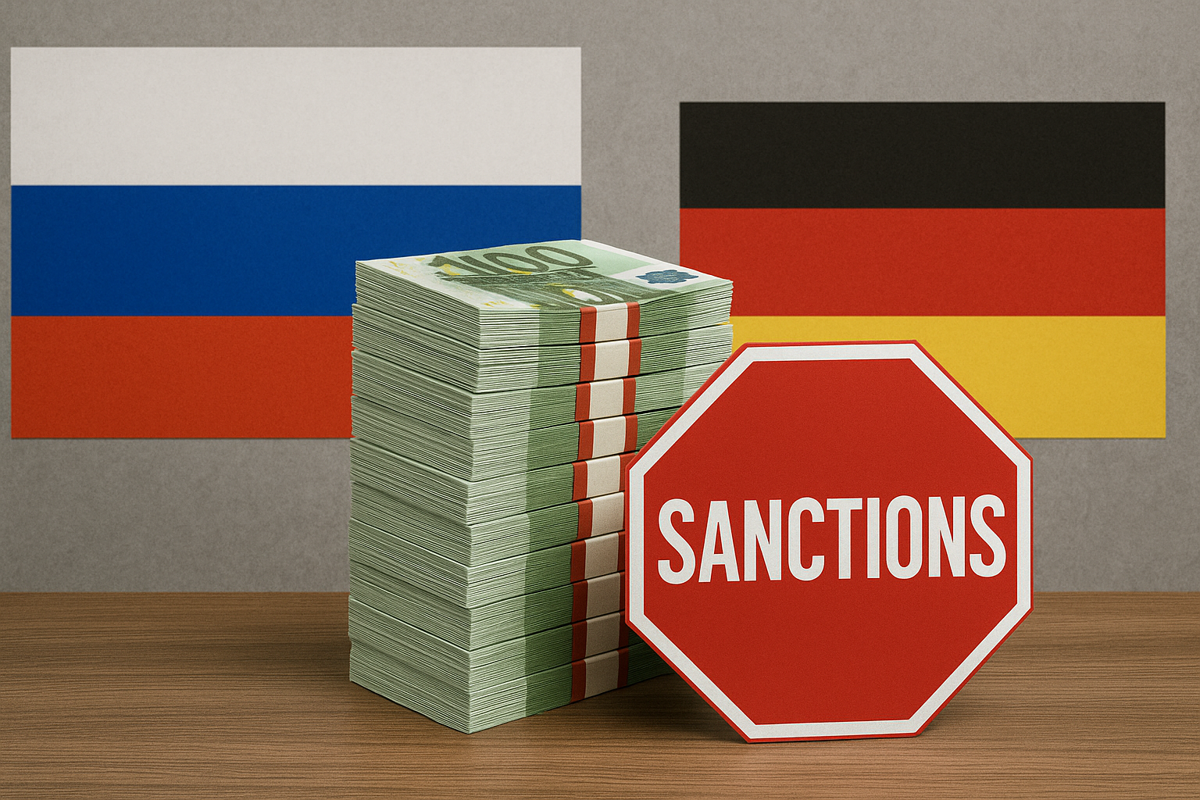
In April 2025, Russian aluminium producer United Co. RUSAL (Rusal) publicly warned that it would pursue legal action against Germany after a German takeover of a bank disrupted a currency‐hedging deal. The bank in question was VTB Bank (Europe) SE – the Frankfurt-based subsidiary of Russia’s state-owned VTB Bank – which German authorities effectively took over in April 2022 amid EU sanctions on Russia. A German-appointed trustee later liquidated the bank (renamed OWH SE) in 2023, and by August 2024, its licence was revoked.This AI-generated image is used for representational purposes only
Rusal says this sequence of events illegally expropriated its subsidiary’s rights under a hedging contract, culminating in a London arbitration award ordering Rusal to pay EUR 213 million to the bank’s liquidators. Rusal has now threatened an investment treaty claim against Germany, arguing that Germany’s actions (through BaFin and the courts) amounted to unlawful confiscation of its business.
Importantly, this was not a commercial merger or purchase but a regulator-driven takeover. German authorities completely cut off VTB’s European arm from its parent under Western sanctions. As Reuters reported, after sanctions, Germany’s regulators would “no longer allow VTB Europe to take instructions from the parent”, effectively expropriating control to enforce EU rules.
Rusal’s dispute and threat against Germany
Rusal’s contention centres on a currency-hedging contract its trading unit (RUSAL Trading International - RTI) had with VTB Bank (Europe) SE. According to reports, RTI had entered into a derivatives agreement with the bank to hedge RUB (Russian Ruble) exchange-rate risk in its overseas aluminium trading. When war broke out in Ukraine, BaFin’s sanctions meant the bank in question could not manage this contract normally. The BaFin-appointed manager eventually moved to liquidate the bank in April 2023.
During liquidation, OWH SE (the renamed bank in liquidation) demanded that RTI post additional collateral under the hedging agreement. RTI refused, citing the risk of violating sanctions by transferring money to a sanctioned entity. The dispute went to arbitration in London. The tribunal (London Court of International Arbitration) found for the bank’s liquidators and awarded EUR 213 million against RTI.
Why Rusal calls it ‘expropriation’
Rusal now argues that this outcome effectively expropriates its investment. In a letter to German officials (as reported by the Financial Times), Rusal calls Germany’s actions “illegal expropriation” of its subsidiary’s rights. Rusal points out that the recipient of the EUR 213 million will be the bank’s liquidator – a vehicle of the German regulatory regime, thus transferring value to the sanctioned party. Rusal contends that, by taking control of VTB’s German subsidiary and allowing it to enforce this claim, Germany has violated investment-protection guarantees.
Rusal says it has “no choice” but to resort to legal remedy. As reported, Rusal’s appeal notes that OWH SE is “a subsidiary of an organisation under sanctions” and that forcing payment would give the liquidator “an enormous windfall”.
Political and economic motivations
Rusal (co-controlled by Russian oligarch Oleg Deripaska) appears motivated to protect its finances and assert investor rights. Facing a EUR 213 million liability, Rusal is likely using all available legal avenues. The investment-treaty claim threat may also be a pressure tactic against Germany – essentially turning the dispute into a broader confrontation.
Rusal’s rhetoric taps into Russian grievances over sanctions and asset seizures. It frames Germany’s actions as political interference rather than legitimate sanction enforcement. At the same time, Rusal has been under financial pressure, wherein during the latter half of 2024, it announced output cuts (2.5 million tonnes) due to record-high alumina costs and weak demand, showing it needed to shore up its bottom line.
Whereas Germany’s primary motive was the enforcement of EU sanctions. By seizing control of the bank, regulators aimed to prevent Kremlin-linked entities from using German financial infrastructure. Politically, Berlin has been moving to detach from Russian economic links, and taking over VTB’s subsidiary fits that strategy.
Germany (and the EU) sees this as a defence of the bloc’s financial system and a sanction measure, not an act of expropriation in violation of law. German regulators stress that depositors and ordinary customers were protected during the process. While Germany upholds the rule of law, it interprets its emergency powers as lawful under EU sanction rules.
The incident further twists EU-Russia tensions. Russia has already hinted at mirror reprisals. For example, in May 2024, President Putin authorised courts to seize Western assets in Russia as ‘compensation’ for confiscated Russian assets abroad. Rusal’s threat thus comes amid an atmosphere where each side is exploring legal or financial countermeasures.
Moscow may see Rusal’s stance as aligned with Russia’s narrative that Western sanctions constitute unlawful expropriation, while Berlin views it as simply upholding sanctions. German authorities have so far not publicly responded to Rusal’s demands, but the case raises questions about the stability of investment protections under sanction regimes.
Implications for EU-Russia relations and markets
The dispute adds friction to already-strained ties. On one hand, it signals that Russia (or its companies) will use legal treaties to challenge EU sanctions. On the other hand, it underscores EU wariness: European policymakers typically avoid seizing assets without a solid legal basis. Germany’s move to ring-fence VTB was seen as legally sanctioned (no property of the EU was transferred outright), but Rusal’s claim raises the stakes for future investment disputes.
If Rusal proceeds with arbitration, this could set a precedent for other Russian investors. It also comes as EU governments debate what to do with frozen Russian assets; EU officials have noted that any legal justification for taking foreign assets will ‘matter’ to global investors. In short, the case illustrates the delicate balance: Europe must implement sanctions but also respect legal guarantees, while Russia may be willing to escalate legal retaliation (as seen with its decree on seizing foreign assets).
Rusal is one of the world’s largest aluminium producers (the largest outside China). Its financial and production health affects global supply. Rusal has already trimmed output due to high input costs, which tightens global supply.
Any additional costs (like a EUR 213 million payout) or legal uncertainty could further strain Rusal. In 2018, US sanctions on Rusal caused aluminium prices to jump on supply concerns. While the current situation is different, continued tensions can reverberate. Buyers may worry about the reliability of supply or about the precedent of investment disputes.
Financial markets may also watch the arbitration threat closely; a major award against Germany (if it happened) could raise questions about the security of foreign investments in sanctioned industries. Conversely, if Rusal drops its claim, that could signal caution by Russian firms.













_md.webp)
_md.webp)