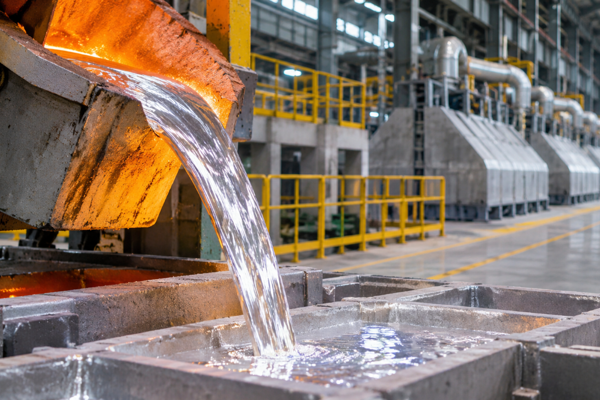
Vietnam’s first electrolytic aluminium project has reached another major milestone, with the second phase of the 450,000-tonne-per-year (tpa) Da Nong project producing its first batch of molten primary aluminium on October 31, 2026. The milestone, achieved by China Nonferrous Metal Industry’s Foreign Engineering and Construction Co., Ltd. (NFC), which is the project’s general contractor, came four months and three days ahead of the contractual schedule, officially moving the second phase from construction to trial production. The latest development builds on the progress made during the first phase, which produced its first batch of molten primary aluminium on July 14. By September 15, all electrolytic cells in the first phase had successfully started producing aluminium. The second...
The London Metal Exchange (LME) aluminium price graph dipped across the pricing and contract segments on the November 2 trading session, reporting declines over the October 30 close . The Asian Reference Price and alumina Platts price, on the other hand, reported nearly 1 per cent gains. The LME aluminium cash bid price dipped by 0.63 per cent from USD 3,113.5 per tonne to USD 3,094 per tonne. The offer price moved from USD 3,114 per tonne to USD 3,095 per tonne, down 0.61 per cent day-on-day. Explore: Most comprehensive and forward-looking industry-focused report — Global Bauxite & Alumina Market Forecast to 2036: Supply–Demand, Trade Flows & Price Outlook The LME aluminium three-month bid advanced from USD 3,078 per tonne from USD 3,059.5 per tonne, decreasing by 0.6 per cent. The offer...
Grow with
AL Circle

Three-month LME aluminium opened at US$2,958.5 per tonne yesterday and closed at US$3,042 per tonne, up 2.79 percent. On Monday, October 11, LME aluminium cash (bid) price moved up US$117.5 or by 4.04 percent to record at US$3,019 per tonne. LME aluminium official settlement price soared up by US$118 or by 4.06 percent to close at US$3,020 per tonne. 3-month bid price and 3-month offer price settled at US$3,033 per tonne and US$3,034 per tonne. December 22 bid price closed at US$2,903 per tonne and the offer price for the same day was recorded at US$2,908 per tonne. LME aluminium opening stock for October 11 was recorded at 1150225 tonnes. Live warrants for the same day settled at 637425 tonnes and cancelled warrant totalled 512800 tonnes. LME aluminium 3-month Asian Reference Price for...

Primary aluminium production in China dropped by 3.72 per cent month-on-month to 3.11 million tonnes in September 2021 (30 days). On a year-on-year calculation, the output fell marginally by 0.10 per cent, found the Shanghai Metals Market. Of this, liquid aluminium accounted for 64.6 per cent in September, a decrease of 2 percentage points from August. The daily average output in September 2021 was 103,700 tonnes, down by only 300 tonnes on the month from 104,000 tonnes and 100 tonnes on the year from 103,800 tonnes. From January to September, China’s total primary aluminium production stood at 29.08 million tonnes, reflecting a year-on-year increase of 6.01 per cent from 27.43 million tonnes. The fall in China’s primary aluminium output in September could be attributed to the reduced...

The high power-intensive produced metal aluminium escalated to new heights since 2008, as the global power distress plunges the metal supplies utilized for the manufacturing of beverage cans to world-class mobile phones. The metal aluminium consumes around 14-megawatt hours of power for one-tonne output, which is considered enough to ferry an average home in Britain for more than three years. China initiated first to curb the aluminium production to restrict its industrial energy usage. However, ahead of the present energy crisis, China has placed a hard cap on the future capacity that assures to conclude years of over-expansion and augments the possibilities of a profound global shortfall. These days, with the soaring energy costs across Asia and Europe, there’s a looming threat of...

On 11th October 2021, Hilde Merete Aasheim, CEO of Norwegian aluminium and one of the largest aluminium companies worldwide, Norsk Hydro said: “The green transition is under threat unless governments can level the playing field between metal producers who are forced to pay offset costs for their emissions and those who are not.” In a keynote speech at the opening of LME Week in London, the metal industry's yearly summit, Hilde Merete Aasheim said: “Some are subject to the world's most ambitious climate policies, while others are not.” "If some of the world's greenest production has higher CO2 costs than many of those producing with a formidable CO2 footprint, that is not an efficient incentive structure to promote a speedy and successful green transition," she added. The metal giant’s CEO...

Yunnan YunLv Yongxin Aluminium Co., Ltd., located in Yangjie Industrial Park, Jianshui County, has bagged the Aluminium Stewardship Initiative’s Performance Standard certification for aluminium smelting and casting operations. The products the company produces include electrolytic aluminium liquid, remelting aluminium ingot, casting aluminium alloy, and aluminium bar. The facility has an annual production capacity of 300,000 tonnes of primary aluminium based on hydro power. Earlier in August 2021, Yunnan YunLv Yongxin Aluminium Co., Ltd. received the ASI Chain of Custody Standard Certification for its smelting, casting and sawing activities for the production of aluminium alloy flat ingots. Fiona Solomon, Chief Executive Officer at ASI, said: “We congratulate Yunnan YunLv Yongxin...

According to the Shanghai Metals Market on October 8, social inventories of primary aluminium increased by 47,000 tonnes to settle at 862,000 on the week across eight major consumption areas, along with SHFE warrants. The inventories increased across China. Last week on September 30, primary aluminium inventories stood at 815,000 tonnes by gaining 26,000 tonnes from the previous week. The chart below shows the recent status of primary aluminium inventories across China in more detail: In Nanhai, primary aluminium inventories increased by 18,000 tonnes to settle at 262,000 tonnes and in Wuxi, it went up by 17,000 tonnes to close at 283,000 tonnes. In Shanghai, primary aluminium inventories moved up by 2,000 tonnes to close at 78,000 tonnes and in Hangzhou, it surged by 1,000 tonnes to...

After remaining restrained on Friday at RMB 22,630 per tonne, A00 aluminium ingot price has opened the week on Monday, October 11, with a hike of RMB 180 per tonne to stand at RMB 22,810 per tonne, found the Shanghai Metals Market. The average prices are likely to range between RMB 22,790 per tonne and RMB 22,830 per tonne, with spot contract to be traded at a premium price of RMB 80-40 per tonne. Among the Chinese cities, Gongyi, Foshan, Tianjin, and Linyi have also seen an increase of RMB 180 per tonne in primary aluminium ingot price. While in Gongyi and Foshan, the price has come in at RMB 22,660 per tonne and RMB 22,820 per tonne, the price in Tianjin and Linyi is standing at RMB 22,800 per tonne, learned SMM. In Chongqing and Wuxi, primary aluminium ingot price has climbed by RMB...

Three-month LME aluminium opened at US$2,943 per tonne last Friday and closed at US$2,959 per tonne, up 0.59 percent. Both LME aluminium cash (bid) price and LME official settlement price reduced by US$14 or by 0.48 percent to settle at US$2,901.50 per tonne and US$2,902 per tonne. 3-month bid price and 3-month offer price closed at US$2,921.50 per tonne and US$2,922.50 per tonne. December 22 bid price settled at US$2,813 per tonne and the offer price stood at US$2,818 per tonne. LME aluminium opening stock for October 8 settled at 1170800. Live warrants for the same day closed at 638425 and cancelled warrant stood at 532375. LME aluminium 3-month Asian Reference Price for Friday, October 7 was recorded at 2930.89. SHFE Aluminium Price Trend Benchmark aluminium for SHFE surged up by US$14...

The onset of the COVID-19 pandemic in 2020 has popularised the use of Industry 4.0 across all manufacturing industries, including aluminium. Until then, it was only a buzzword to many, despite being a dominating topic of discussion in conferences, summits and seminars. Thanks to the Fourth Industrial Revolution or Industry 4.0 that has helped the aluminium industry mitigate the COVID-19 impact at large. The intelligent use of advanced technologies such as the Internet of Things, artificial intelligence, and cyber-physical systems at aluminium smelters and plants has enabled them to augment their production capacity and conduct seamless operations during the pandemic. It is an undeniable fact now that Industry 4.0 has proved to be an inevitable solution in the aluminium industry for the...

India is gradually waking up to the potential of its minerals and metals industry. This was one of the few industry sectors that continued to be productive despite the ravages of the pandemic. In fact, India’s mining GDP increased from INR 739.90 billion in the fourth quarter of 2020 to INR 913.03 billion in the first quarter of 2021, as per data from the Ministry of Statistics and Programme Implementation (MOSPI). This industry has a critical role to play in fueling India’s ambitious journey towards a self-sufficient 5 trillion-dollar economy over the course of 5 years. Aluminium is a strategic metal and currently, the second most important metal in the world. Growing nearly 20x in the last sixty years, it has shown the most promise. Aluminium’s inherent properties like high...

A top-selling furnace weighing system from Aluminium Casthouse Technologies (ACT) is embracing the advance of Industry 4.0 with a major IT upgrade. The BatchPilot, an innovative technology used in casthouses worldwide to accurately measure furnace liquid metal weight and determine exactly what is wanted aluminium and unwanted dross, is now installed with the latest Siemens S7 central processing unit and software for an even more accurate online process data logging and more user-friendly smart screens. The upgrade of the Batchpilot system will, ultimately, allow customers to achieve greater gains in productivity, leading to even higher production levels at a time when the London Metal Exchange is rising sharply. Knowing the correct weight of metal in the furnace is crucial to ensure slabs...

Manufacturers are under continuous pressure to lower costs and improve quality. To assure optimum technical and financial performance of the Carbon Plants and anode block manufacturing, Aluminium manufacturers are moving forward in the adoption and integration of Industry 4.0 technologies as part of their roadmap to the aluminium plant of the future. One of the main ideas that separate Industry 4.0 from 3.0 is the notion that data coming from one part of the manufacturing process can help with upstream or downstream process optimization. In a typical modern anode manufacturing plant, all of the equipment and systems are tied together with an industrial network, a good foundation for the integration of technologies. Looking at an aluminium smelter on how Industry 4.0 technologies can be...

Since 2007 and the introduction of Amelios, Fives’ Aluminium division has developed a comprehensive range of digital solutions to enhance the productivity of smelters and achieve greener aluminium production. Being a worldwide leading solution provider for Green Anode Plant, Anode Baking Furnace equipment, Anode Rodding Shop, Fume & Gas Treatment plant, Potline cranes, Pot equipment, and thanks to the combined expertise of Fives Solios and Fives ECL, Fives sets-up a cross-organizational and transdisciplinary team to further develop digital solutions. As of today, Fives’ digital portfolio consists of more than 20 solutions that can be used independently or interconnected to act on Equipment Health Monitoring, Process Optimization and Emission Control. Equipment Health Monitoring – SMART...

Even before the COVID-19 pandemic, AMETEK Land and AMETEK Surface Vision had identified the need for connectivity and moved into Industry 4.0. Industry as a whole depends on getting accurate data from systems and providing this to management within companies, enabling them to make data-driven decisions. Industry 4.0 facilitates this by allowing operators to access accurate data at any point in time and from anywhere, which is exactly what has been needed during the pandemic to ensure companies can make key decisions quickly and remotely. This has been emphasised by market sectors such as textiles and aluminium, which have experienced high demand during the pandemic – they are operating in a very fast turnaround situation, for example when producing personal protective equipment (PPE)....

Sohar Aluminium: Poised for the Future Overcoming the challenges posed by the COVID-19 pandemic since early 2020, Sohar Aluminium (SA) recorded an excellent annual production of primary aluminium totaling 396,929 tonnes in 2020. Timely business continuity measures initiated by the company management have greatly contributed to this achievement. The year 2021 so far seems to be witnessing a similar trend in production and other overall key performance indicators (KPIs). The Company is jointly owned by OQ S.A.O.C representing the Omani government (40%), Abu Dhabi National Energy Company - TAQA (40%), and Rio Tinto Alcan (20%) that also provides efficient AP39 smelting technology and sales support. The company’s primary products include hot metal, primary aluminium Ingots, and primary...

Aldel, a Dutch aluminium maker based in Delfzijl, is halting its primary aluminium production because of the current rise in electricity prices, which usually account for 40 per cent of the total aluminium production cost. The news came after the Dutch firm’s chief executive officer Chris McNamee told Reuters that the smelter would remain idled from October 11 until at least early 2022. According to the company, the cost of electricity is currently about 4,500 euros per tonne of aluminium, while the aluminium selling price is around 2,500 euros per tonne. "We've got a squeeze on us now because we're not hedged, and we're not hedged because the Dutch government isn't giving us visibility on a level playing field," CEO Chris McNamee said. Aldel is calling on the Dutch government to...

1. Introduction: Industry 4.0 is a general concept of technological and organizational transformation of enterprises, which includes, among others digitization and automation of technological processes. One of the key branches for the development of the world economy is the production of aluminum, which consists of a number of stages, including heat treatment carried out with the use of industrial furnaces. SECO / WARWICK Company has developed modern tools dedicated for Vortex® furnace line, which fit into the Industry 4.0 concept and are aimed at increasing the efficiency and safety of production, as well as care for the quality of the processed product. In VORTEX® furnaces, intermediate or final heat treatment of load in the form of sheets or foil coils made of aluminum and its alloys...

Hindalco Industries Limited continued to expand its aluminium ingot and aluminium products prices for the third time in a row, with effect from Friday, October 8. Hindalco is presently selling its aluminium ingot at INR 253,750 per tonne, which is an increase of INR 3,000 per tonne or 1.20 per cent from INR 250,750 per tonne on October 6. Among aluminium products, Hindalco’s aluminium wire rod price has also seen a raise of INR 3,000 per tonne from INR 261,850 per tonne to INR 264,850 per tonne on October 8. But the company’s aluminium billets price has witnessed a jump of INR 6,500 per tonne to INR 264,350 per tonne. Hindalco Industries Limited links its aluminium ingot and aluminium products prices to the three-month futures of aluminium on the London Metal Exchange, which increased on...