Minim Martap Mineral Resource estimate upgraded to over 1 billion tonnes

Canyon Resources has announced that Minim Martap Bauxite Project in Cameroon, West Africa estimate upgraded to over 1 billion tonnes following the integration of results from the Physical Testing Programme.
The 1 billion tonne resource represents only 12 bauxite plateaux of the Minim Martap Project with 62 plateaux remaining for drill testing.
Phillip Gallagher, Canyon’s Managing Director, said: “It is very pleasing to see further positive results from the density testing completed by our team that upgrades the Minim Martap resource to over 1 billion tonnes of high-quality bauxite. The Project is comparable to some of the biggest and best bauxite projects in the world which are dominated by major aluminium companies such as Alcoa, Rio Tinto, Rusal and Emirates Global Aluminium. Importantly there is significant upside potential as the current resource is only coming from 12 bauxite plateaux with 62 plateaux yet to be drilled. This is another positive step in the advancement of the Minim Martap Project and highlights its enormous potential.”
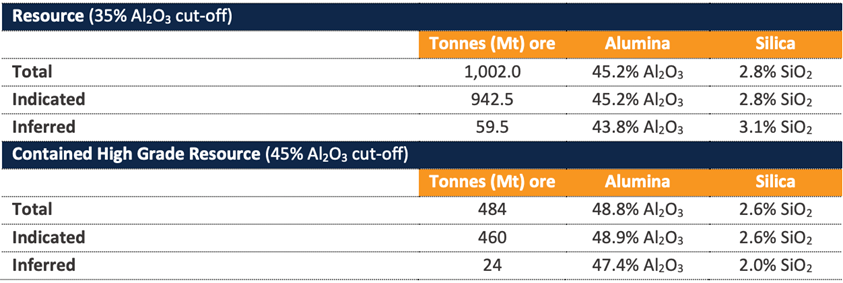
The JORC 2012 compliant 2020 Mineral Resource estimate for Canyon’s high-grade Minim Martap Project in Cameroon is presented as:
Canyon’s mining and geological consultants, Mining Plus and Mr Mark Gifford, were both involved in the completion of the update. Both parties have a strong and long term relationship with Canyon and the Project and are supporting Canyon in advancing the Feasibility Study.
The completion of the Physical Properties Programme, as announced on 25th August’20, which tested for rock strength, moisture levels and density, allowed for an update of the density assumptions of the Mineral Resource Estimate.
Over 500 samples were tested in total extracted from several recently constructed and historical pits on the priority plateaux, ranging in depth from 4.75 to 11m. Based on accessibility, 7 pits across the 3 priority plateaux were selected for the physical properties programme (2 on Beatrice, 2 on Danielle and 3 on Raymonde). The pits were sampled using a hand-held jackhammer, miner’s bars, chisels, and hammers. For surface samples, sampling was undertaken from predetermined locations on the plateau surfaces with 30 samples collected on each plateau. All samples were logged and coded onsite by a geologist before transportation to base camp for testing.

The 2019 Mineral Resource estimate was based on the results from previous tests on 167 density samples completed on diamond drill core collected in 2009. The dry density value assumption for the 2019 Mineral Estimate used a conservative figure based on the averages of the results from this diamond drilling test work. It was proposed in the 2019 Mineral Resource estimate to conduct further work on density and this was included in the Physical Testing Programme.
Lindian Resources reveals Mineral Resource Estimate of its newly-bought Lelouma Bauxite Project in Guinea
Next articleLindian Resources: Non-Executive Director Mathew Bull resigns
Grow with
AL Circle