With an ESG vision of serving the market with low-cost bauxite and delivering long-term benefits to stakeholders, Queensland-based Metro Mining has set its sights higher for its 2025 bauxite shipment target. The confidence to aim higher stems naturally from the company’s strong performance in 2024. Although it narrowly missed its annual shipment target by a few percentage points, the final figure still marked a record-breaking achievement.
Financial performance analysis ’24
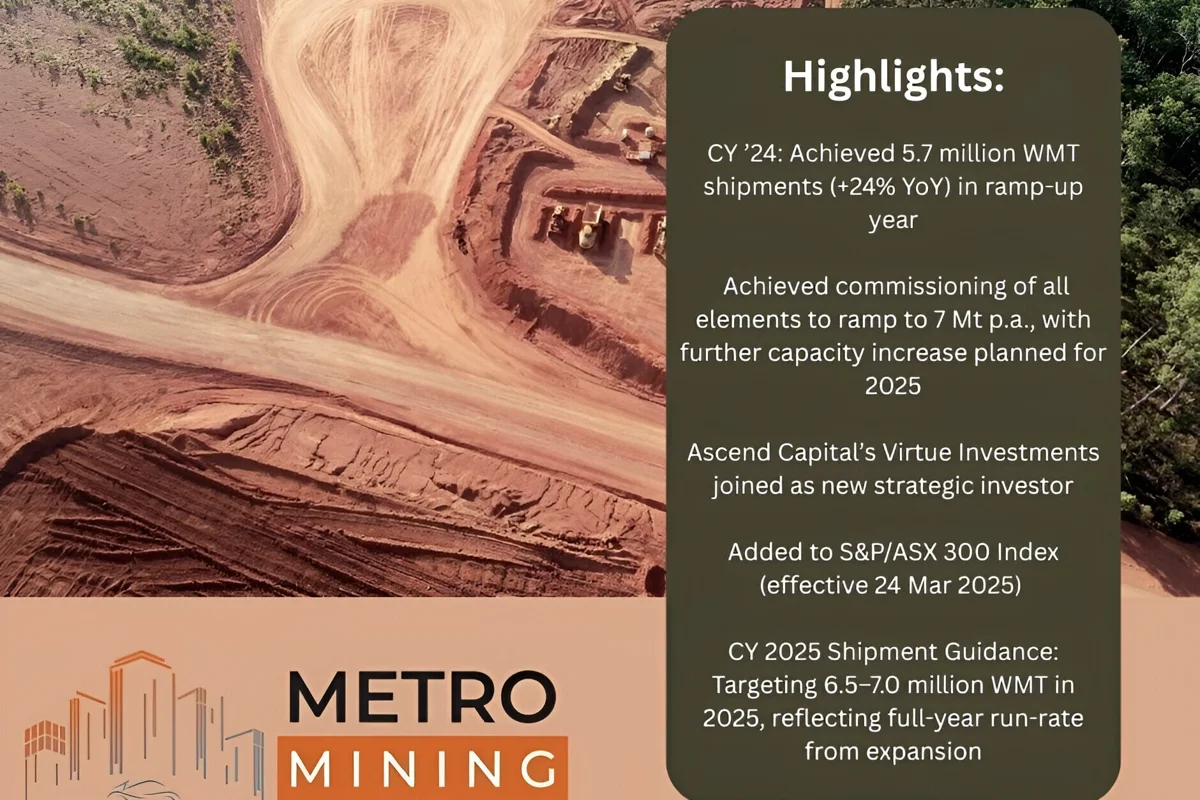
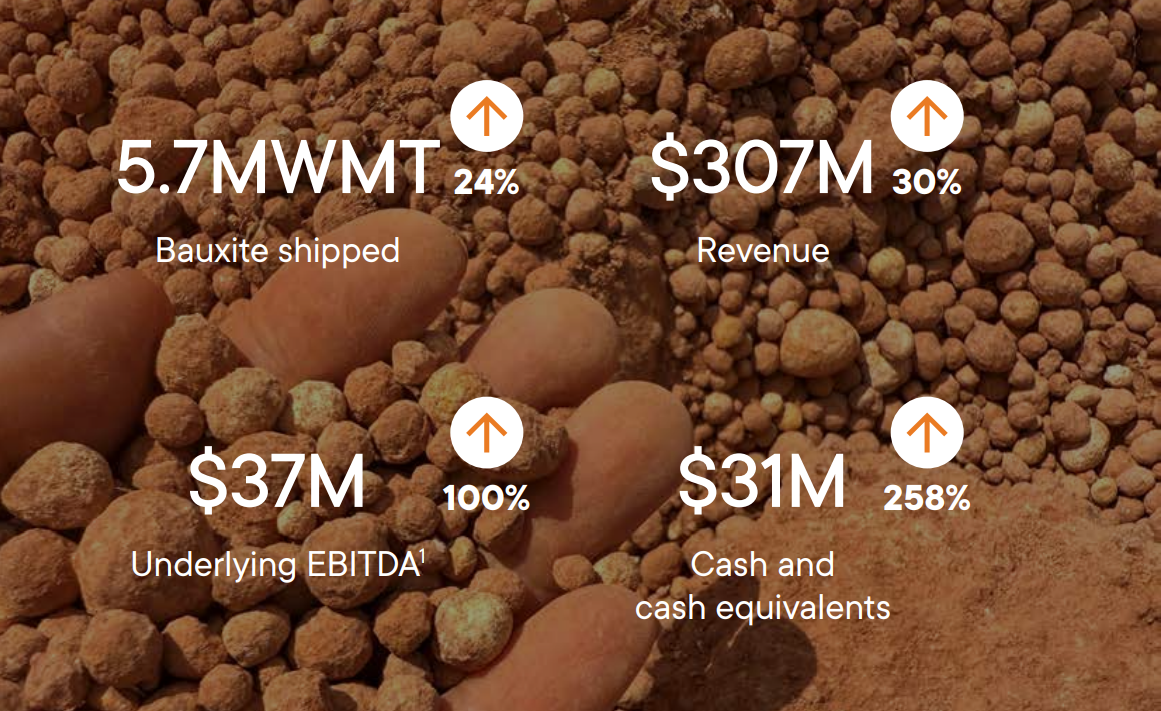
Despite a prolonged wet season that delayed the start of operations and adverse weather in December that forced the cancellation of the final vessel in the shipping schedule, Metro successfully delivered a record 5.7 million WMT from the Bauxite Hills Mine in 2024.
The company continued to benefit from a tight global bauxite market, with average delivered prices in FY24 up 32 per cent year-on-year. During the year, Metro commissioned key expansionary infrastructure, increasing the mine’s capacity to 7 million WMT. These assets include the Ikamba Offshore Floating Terminal (OFT), two 90m barges, two additional tugs to support transhipment operations, and a newly commissioned wobbler screening circuit designed to boost material throughput and improve wet-weather resilience.
Metro also focused on strengthening its balance sheet. In the first half of FY24, it secured a USD 20 million funding package and completed a USD 45 million equity raise involving institutional and retail investors. These funds supported operations during the extended wet season, enabled commissioning of expansion assets, and facilitated principal debt repayments on shareholder loans.
In November 2024, Metro refinanced its senior debt and private royalty held by Nebari Natural Resources Credit Fund I, LP and II, LP. The refinancing achieved a lower interest rate, increased borrowing capacity, and deferred capital repayments to July 2025.
There was no income tax expense for the period. The Group recorded tax losses of USD 22 million and capital losses carried forward of USD 2.26 million.
The USD 45 million equity raise was executed through a private placement and Share Purchase Plan (SPP). Capital raised supported accelerated debt repayments, working capital, and transaction costs. As part of the equity raising, USD 5 million of shareholder loans from Ingatatus and Lambhill were converted into equity, with the remainder of the proceeds received in cash.
Sustainability report ’24
Metro’s Scope 1 emissions rose from 25,201 tonnes CO₂-e in FY2023 to 26,388 tonnes CO₂-e in FY2024—a 4.7 per cent increase, compared to a 26 per cent increase in annual shipped bauxite. Scope 2 emissions fell from 19 tonnes CO₂-e in 2023 to 12 tonnes in 2024. On a per-tonne basis, Scope 2 emissions declined from 0.000004 t CO₂-e in 2023 to 0.000002 t CO₂-e in 2024, representing a 50 per cent reduction.
Metro’s operations remain under the 100,000 t CO₂-e threshold for inclusion in the Australian Government’s Safeguard Mechanism.
Groundwater used for potable purposes equated to 6.3 litres per tonne of bauxite shipped in 2024, up from 5.01 litres in 2023. This 1.29 L increase is attributed to a larger workforce and continuous December operations in 2024, in contrast to reduced activity in December 2023 due to Cyclone Jasper.
No groundwater was extracted for non-potable operational purposes in 2024. Potable water usage at the accommodation camp rose by 0.98 L per tonne shipped, while port and remote area usage increased by 0.59 L per tonne shipped year-on-year.
A total of 290.4 million litres (ML) of raw rainwater was used for dust suppression during mining and haulage in 2024, up 92 per cent (150.9 ML) from the previous year. On a per-tonne basis, this equates to 50.4 L in 2024 versus 30 L in 2023—a 68 per cent increase.
Shipment report recap ’24
Metro Mining achieved a new annual high of 5.7 million tonnes of wet bauxite shipments. Consistent growth from August 2024 onward led to a 24 per cent year-on-year increase, though the company narrowly missed its 6-million-tonne shipment target.
In August 2024, shipments reached 720,000 tonnes—up 13 per cent month-on-month. September saw volumes rise to 780,000 tonnes, bringing Q3’s total to 2.13 million tonnes.
October shipments rose further to 793,420 tonnes, meeting 69.5 per cent of the annual target and pushing the year-to-date total to 4.45 million tonnes. In the final two months (November and December), Metro shipped another 1.25 million tonnes.
Operational performance was supported by a real-time monitoring system and improved loading rates, stabilising at 1,800 tph by September and peaking at 2,500 tph during free-dig operations using the Ikamba conveyor. Q3 2024 marked the first full quarter of expanded operations, with Ikamba reaching nameplate capacity.
Although the shipment target for 2024 was set between 6 and 6.4 million tonnes, the company ultimately achieved 90–95 per cent of that goal. A 50 per cent year-on-year increase in Q3 shipments significantly propelled Metro towards its 2025 goal of 6.5–7 million tonnes.
2025: Three-Month Performance Overview
In Q1 2025, Metro shipped 184,000 WMT, generating USD 9 million in FOB revenue. Contracts for 2025 and 2026 secure offtake volumes of 6.9 million tonnes and 6.1 million tonnes respectively, with key partners including Xinfa Aluminium Group and China Aluminium International Trading Group.
15 months’ achievement record (January ’24 to March’ 25)
Throughout 2024, Metro maintained compliance with air quality standards under the Bauxite Hills Mine Air Quality Monitoring Plan.
Non-mineral waste was managed in line with site-specific waste procedures, with most being recycled or disposed of responsibly. The company partnered with GreenPowerTek and Chip Tyre Pty Ltd to recycle 384 end-of-life tyres in 2024—up 131 per cent from 2023.
Metro also prepared 182 hectares of disturbed land for seeding in 2024, surpassing its 180 ha target and marking a 227 per cent increase over the previous year. Since 2018, the company has rehabilitated 522 ha of disturbed land—approximately 59 per cent of its total disturbance footprint (excluding infrastructure to be returned to Native Title holders).
In FY24, the company fully repaid the remaining working capital and junior debt to Ingatatus AG Pty Ltd and Lambhill Pty Ltd, totalling USD 39 million in principal repayments.
Upcoming 21 months’ outlook
Metro’s ESG Strategy and roadmap for 2025–26 outlines several key initiatives across three pillars:
1. Sustainable Mine and Supply Chain
– Analyse water monitoring data to improve recycling and water-use efficiency
– Continue pursuing emissions reductions per tonne shipped via renewable energy at Bauxite Hills
2. Regional Alignment and Positive Impact
– Set short- and long-term gender balance targets at board and management levels in line with industry benchmarks
– Develop and implement a sexual harassment prevention plan to safeguard health and safety
– Implement a gap analysis for Australian Sustainability Reporting Standards
– Execute action plans from the Climate Change Risk Assessment
Metro’s bauxite remains attractive for its direct shipping quality, requiring minimal processing and delivering strong yields for smelters. The company continues to benefit from low strip ratios, minimal overburden, and a streamlined marine logistics chain. As of December 2023, Bauxite Hills had resources of 118.7 million tonnes and reserves of 83.2 million tonnes, supported by tenements spanning 1,900 sq km and proximity to deep-water export channels. The commissioning of the Ikamba OFT and upgraded port infrastructure has improved resilience against weather-related transhipment delays, although high seas during summer months can still cause occasional disruptions.












_md.webp)