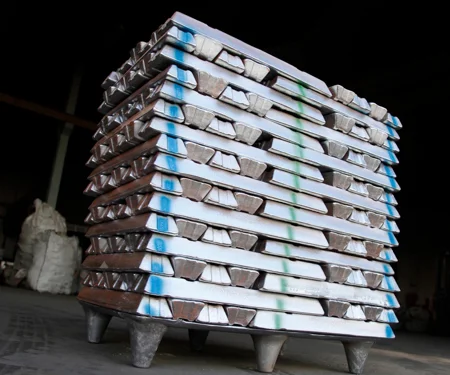
The European market for aluminium alloy ingot has experienced a significant devaluation, with both Germany and Turkey playing a pivotal role. Their substantial price reductions, amidst economic challenges and struggles in the automotive sector, have contributed to a pronounced downward trend in the week ending November 15th.
Image source: https://www.sav-al.com/
According to chemanalyst.news, Germany's aluminium alloy ingot prices dropped by 2 per cent as the country struggles with financial challenges. Its economy is in recession for two years in a row. In H1 (first half) of the ongoing year (2024), it contracted by 0.2 per cent compared to the same duration in 2023.
The nation's financial growth course has witnessed multiple speed breakers affected by insufficient public investment and bureaucratic hindrances, coupled with increased operational costs, leading to economic depression, leaving Germany lagging behind its European and global competitors (like China).
The German automotive sector, a major buyer of aluminium alloy ingot, is especially staggering and facing severe challenges. When Volkswagen's Works Council recently disclosed that company executives are contemplating shutting down three manufacturing units in Germany, it sent ripples through the industrial market as automotive producers steer a paramount demand for the metal alloy. Additionally, The Schaeffler Group, another prominent industrial and automotive components manufacturer, has announced plans to eliminate 4,700 positions across Europe, with alone Germany losing the lion's share of these cuts at 2,800 positions. The decision reflects the intense downturn in market prerequisites and has further enfeebled demand for the aluminium alloy ingot.
"The [German] metal market has entered a quieter phase owing to the summer recess at many plants. Remarkably, the official price for 226 ingots has decreased for the first time in a very long period. Expectations of any surprising demand shifts over the summer remain low. Despite this slowdown, availability of recycled raw materials remains significantly limited," Bureau of International Recycling (BIR) board member Murat Bayram said in the industry body's monthly report earlier this year.
Similarly, Turkey's aluminium alloy ingot market registered a 2 per cent price deflation during the same period, primarily owing to the frail automotive export figures. According to data from the Automotive Manufacturers Association (OSD), Turkey's automotive production declined by 10.4 per cent Y-o-Y in October, with total output reaching only 122,000 units. Passenger car production, in particular, saw a 7 per cent markdown Y-o-Y, falling to 85,115 units. The European market of the metal's alloy ingot faces additional structural challenges beyond these regional encumbrances. Chinese automotive manufacturers are ever-increasingly competitive in the global market, while European electric vehicle demand needs to catch up to expectations. Likewise, the necessity for substantial high-tech investments calls for momentous hurdles for European automobile manufacturers, adding pressure to the already strained aluminium alloy ingot market.
What’s with the heightened production?
On the contrary, the 2023 data provides a comprehensive view of the aluminium alloy production in various European countries, with France leading at 565.86 million kilograms, closely followed by Italy at 484.22 million kilograms. Noteworthy annual variations include substantial increases in Finland (235.38 per cent), Serbia (11.81 per cent), and the Czech Republic (10.05 per cent). Conversely, Spain experienced a significant decline (-100 per cent). The Compound Annual Growth Rate (CAGR) over the last five years varies across countries and indicates diverse growth patterns. As evident from the past, when demand decreases and supply swells, the price of the commodity is naturally the first thing affected in the scenario.
"In Europe, it is less optimistic currently. The economic metrics this year have been far from upbeat. While the European Central Bank is broadly forecast to lower interest rates, consumers are likely to remain cautious, particularly on big-ticket items, as the ill effects of the cost-of-living crisis continue," Fastmarkets analyst James Moore said.
Going ahead, the industry pricing is anticipated to remain under strain from a series of disrupting factors. Issues in corporate governance, a weakening car industry in Germany, and export dynamics in Turkey contribute to a downward market scenario. The near-term outlook for the market is contingent on the progress of these local difficulties and their overall effect on international supply networks and consumer demand. ChemAnalyst forecasts a decline in the near future, expecting a further price decrease in the forthcoming weeks.