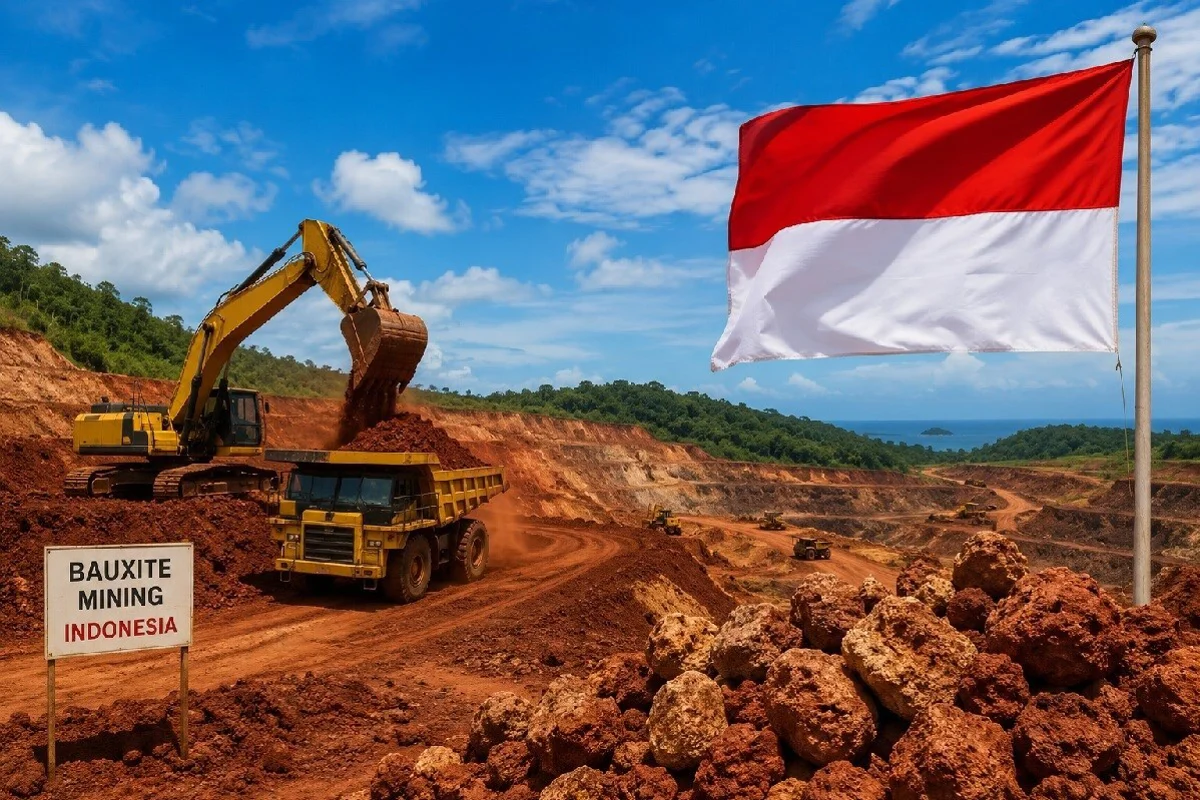
Indonesia’s aluminium value chain is expanding rapidly, but a critical imbalance is beginning to emerge beneath the country’s downstream ambitions. While alumina refineries and aluminium smelters are being developed at a fast pace, bauxite mine production has not increased with the same momentum, raising questions over whether Indonesia can secure enough raw material to sustain its long-term aluminium strategy.
The country is trying to build a fully integrated aluminium industry - from bauxite mining and alumina refining to aluminium smelting and downstream processing. Backed by export restrictions, foreign investment and large industrial projects, Indonesia is steadily shifting from being a raw mineral exporter to a producer of higher-value aluminium products.
However, the success of that strategy may ultimately depend on one basic factor: how quickly Indonesia can expand its bauxite production.
Indonesia has the reserves, but can production keep up?
Indonesia holds around 3 billion tonnes of bauxite reserves as of 2025, but mine production remains relatively limited compared with the scale of refining projects now under development.
The country produced around 32 million tonnes of bauxite in 2022 before output dropped sharply to 20 million tonnes in 2023. Production declined further to around 17 million tonnes in 2024 and recovered only slightly to nearly 18 million tonnes in 2025.
Demand, however, is rising much faster. According to Shanghai Metals Market, Indonesia’s bauxite demand is projected to reach around 25 million tonnes in 2026, driven mainly by the country’s rapidly expanding alumina refining sector.
That widening gap between refinery demand and mine output is now becoming one of the biggest pressure points in Indonesia’s aluminium expansion story.
Refineries are rising faster across Indonesia
Indonesia’s alumina production increased from around 3.9 million tonnes in 2024 to nearly 5.9 million tonnes in 2025 after two major refineries - PT BAI - Borneo Alumina Indonesia and PT Borneo Alumindo Prima (BAP) - began operations during the year. Together, the projects added roughly 2.7 million tonnes of new production capacity.
Indonesia’s alumina output is expected to rise further in 2026, with production projected to exceed 8 million tonnes as more refining facilities enter operation.
PT BAI - Borneo Alumina Indonesia in Mempawah, West Kalimantan, backed by Inalum, currently produces around 1 million tonnes of alumina annually, while future expansion plans could lift capacity to 2 million tonnes.
Another major addition is PT Borneo Alumindo Prima (BAP), part of the Jinjiang Group, operating in Ketapang, West Kalimantan. The refinery currently produces around 1.75 million tonnes of alumina per year and plans to eventually expand capacity to as much as 6 million tonnes.
A much bigger refinery wave is already coming
Indonesia’s alumina expansion is far from over. A large number of refinery projects are in pipeline. Much of the investment is being driven by Chinese and Malaysian companies looking to secure long-term exposure to Indonesia’s bauxite and alumina sector.
Among the largest proposed developments is PT Tianshan Alumina Indonesia, backed by China’s Tianshan Aluminium Group Co., Ltd., with planned refining capacity of 2 million tonnes per annum (MTPA).
Malaysia’s Press Metal Aluminium Holdings Berhad is associated with two Indonesian refinery developments. PT Kalimantan Alumina Refinery is planned with capacity of 2 MTPA, while PT Kalimantan Alumina Nusantara is expected to add another 1.0-1.2 MTPA.
PT Supreme Alumina Indonesia, linked to PT Laman Mining, is projected to have refining capacity of 2 MTPA.
China’s Sichuan Tianfu Xinchuang Group is backing PT Progressive Indonesia Alumina, expected to produce 1 MTPA of alumina.
Meanwhile, PT Green Indonesia Alumina is planned with combined capacity of 2.4 MTPA through two production lines of 1.2 MTPA each, supported by ALBA.
Another major proposal is PT Westerfield Alumina Indonesia, linked to China’s East Hope Group, with plans ranging from 1 MTPA to as much as 6 MTPA.
PT Borneo Alumina Indonesia is also preparing additional expansion of more than 1 MTPA backed by Inalum and PT Antam.
Overall, Indonesia currently has around 13 million tonnes of planned alumina capacity additions in the pipeline, highlighting the scale of the country’s downstream processing ambitions. Indonesia’s rapid refinery buildout also reflects broader structural shifts analysed in AL Circle’s Global Bauxite & Alumina Market Forecast to 2036: Supply–Demand, Trade Flows & Price Outlook report, which examines future supply-demand dynamics and global trade realignments.
So how much bauxite will all this require?
Using the widely accepted bauxite-to-alumina conversion ratio of 2.5:1, Indonesia’s expected alumina production of 8-8.7 million tonnes in 2026 would require around 20-21.75 million tonnes of bauxite.
At current levels, domestic bauxite supply would still be sufficient to support refining demand in 2026.
The longer-term outlook, however, presents a much larger challenge.
Indonesia’s alumina output is projected to rise to around 17.2 million tonnes by 2036. At the same conversion ratio, the country would require around 43 million tonnes of bauxite. Read Global Bauxite & Alumina Market Forecast to 2036: Supply–Demand, Trade Flows & Price Outlook report for an indepth analysis.
That means Indonesia would need to more than double bauxite production from the 18 million tonnes recorded in 2025 if it wants to fully support its future refining ambitions.
Export bans and pricing reforms remain central to Indonesia’s strategy
Indonesia’s bauxite export ban continues to form the foundation of the country’s downstream mineral policy. The ban, which took effect in June 2023, applies to raw and washed bauxite, requiring ore to be processed domestically before export.
The broader objective is to encourage local refining and smelting activities instead of raw ore exports while increasing national earnings from mineral resources and creating more employment opportunities. Indonesia currently operates 78 bauxite mines, with production reaching around 16.8 million tonnes in 2024.
More than 80 per cent of these mines are located in West Kalimantan province. The export restriction has also accelerated Chinese investment in overseas alumina refining projects.
Also, one of the government’s flagship downstream developments is the integrated mining and processing complex in Mempawah, operated by PT Borneo Alumina Indonesia (BAI) and developed under the MIND ID Group through PT Aneka Tambang Tbk and PT Indonesia Asahan Aluminium.
Indonesia has also revised its bauxite pricing framework under KepmenThe updated pricing system shifts benchmark calculations from a dry-tonne basis to a wet-tonne basis and introduces adjustments related to moisture content and reactive silica penalties.
The government said the changes are intended to better reflect ore quality and actual moisture levels. Under the revised formula, benchmark prices for around 15 per cent of comparable bauxite grades are estimated to decline. For a standard Indonesian bauxite grade containing 48 per cent alumina, 3 per cent reactive silica and 12 per cent moisture, the benchmark price falls to around USD 44 per tonne compared with roughly USD 52 per tonne under the earlier system.
Despite the reduction, official benchmark prices still remain above prevailing market levels. Indonesian bauxite ore is currently assessed at around USD 30-35 per tonne, leaving a gap of roughly USD 9-14 per tonne between benchmark values and actual transaction prices.
Indonesia is now attempting to increase output from existing mines, but the larger question remains whether mining expansion can move quickly enough to support the country’s rapidly growing refining industry.
Aluminium smelting is becoming the next expansion stage
Indonesia’s industrial plans are now extending beyond alumina refining into aluminium smelting.
As of 2024, the country had only two operating aluminium smelters - PT INALUM and PT Hua Chin - with combined production capacity of around 780,000 tonnes.
Among the two, INALUM remains the only producer supplying primary aluminium to Indonesia’s domestic market, while PT Hua Chin exports its output to China.
Indonesia’s aluminium sector expanded is expected to expan further in 2025 with the commissioning of PT Kalimantan Aluminium Industry and PT Bintan Electrolytic Aluminium. Together, the two projects are projected to add around 750,000 tonnes of new capacity, increasing total aluminium smelting capacity to around 1.53 million tonnes.
Production capacity is expected to continue increasing through 2030.
INALUM plans to raise annual production capacity to more than 1.2 million tonnes, while PT Kalimantan Aluminium Industry and PT Bintan Electrolytic Aluminium are each expected to add another 750,000 tonnes annually.
By 2030, Indonesia’s aluminium production capacity is projected to reach around 3.98 million tonnes per year. Beyond 2034, Indonesia’s aluminium capacity is projected to rise by more than 7.1 million tonnes.
Indonesia’s aluminium industry is expanding across the entire upstream value chain, but the deeper the country moves into refining and smelting, the greater its dependence on stable bauxite supply becomes.
If aluminium production capacity rises beyond 7 million tonnes, Indonesia would require more than 14 million tonnes of alumina. Using the standard bauxite-to-alumina conversion ratio of 2.5:1, that level of output would require roughly 35 million tonnes of bauxite.
At the same time, Indonesia’s alumina production alone is projected to reach around 17.2 million tonnes by 2036, pushing total bauxite demand closer to 43 million tonnes.
Indonesia has already secured refinery investment, smelter expansion plans and downstream industrial momentum. The next phase of its aluminium transformation may now depend on whether the country’s mining sector can expand quickly enough to supply the raw materials needed to keep the entire value chain moving.
To look for buying or selling leads of "raw materials" , visit our B2B marketplace.













_md.webp)
_md.webp)
_md.webp)







