Since the end of 2024, market analysts in India consistently signalled strong growth prospects in the electric vehicle (EV) sector, urging the manufacturing industry to gear up for a major transformation. A central narrative in this shift was the soaring demand for aluminium, a vital material used extensively in engine parts, chassis, body panels, and wheels.
Even ex-Vedanta CEO John Slaven had highlighted last year that the growing impact of electric vehicles, particularly four-wheelers, on the aluminium industry. He had explicitly said, “I think (electric) four-wheelers is where we expect to see the largest growth. There’s more (aluminium) content per vehicle than in a two-wheeler. And then also, as the four-wheelers become electrified, there’s more aluminium per EV than there is per IC (internal combustion) engine.”
After touching the 2 million mark of EV sales, with a total of 2,022,873 units in 2024, India continued to record a growth in EV sales, reaching 1,67,629 units in April 2025, up 44.62 per cent Y-o-Y. While Western markets like the US and Europe are facing headwinds from tariffs and policy uncertainty, India’s EV sector continues on an upward trajectory. In the first quarter of the year, the sales figure stood at 5,14,198 units, compared to 4,99,930 units sold in the same period of 2024.
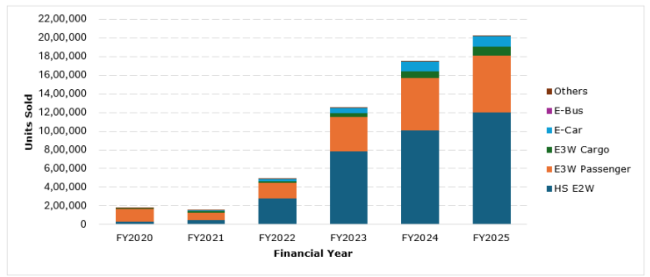
Graph source: Vahan Dashboard, Telangana State RTO, JMK Research
According to the Ministry of Road Transport and Highways, EV sales in India up until Q1 2025 accounted for 8 per cent of overall automobile sales, which totalled 6,371,476 units. This surge is also stimulating demand in adjacent markets, notably EV batteries. According to IBEF, a trust established by the Department of Commerce, Ministry of Commerce and Industry, Government of India, the Indian EV battery market is projected to surge from USD 16.77 billion in 2023 to a remarkable USD 27.7 billion by 2028.
On the infrastructure front, the pace of EV charging station deployment is intensifying. A recent report from the Confederation of Indian Industry (CII) report emphasised the necessity of establishing at least 1.32 million charging stations in India by 2030 to facilitate the rapid growth of electric vehicles, requiring over 4,00,000 installations annually.
EV sales across the globe exceeded 17 million units in 2024. China continues to dominate the landscape, registering 11.2 million units of battery electric vehicles (BEVs) and plug-in hybrids (PHEVs). India, now the world’s third-largest automotive market, also recorded a significant milestone with 2,022,873 EV units sold in the same year.
Growth is EV sales prompts aluminium demand
Given aluminium’s pivotal role in EV manufacturing, being lightweight, 100 per cent recyclable, and essential for improving energy efficiency, its demand is poised to escalate. CRU forecasts global EV-related demand for aluminium extrusions and sheet metal to approach 10 million tonnes by 2030, with extrusion demand alone pegged at around 2 million tonnes. In India, estimates suggest that every 1 million EVs sold will require approximately 250,000 tonnes of aluminium, or about 250 kg per vehicle.
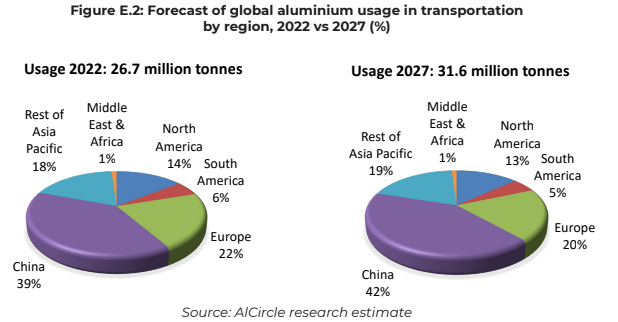
Worldwide, aluminium consumption in the transportation sector is projected to reach 31.6 million tonnes by 2027, with China and the rest of the Asia-Pacific region together accounting for 61 per cent of that demand, showed AL Circle’s special report. The accelerating adoption of EVs, driven by sustainability imperatives, is the primary catalyst behind this surge in aluminium usage.
Now, it is to see in this evolving landscape, aluminium producers are eyeing opportunities aggressively, and Hindalco is leading the charge. About a month ago, it delivered 10,000 aluminium battery enclosures to Mahindra for its BE 6 and XEV 9e electric SUVs and commissioned a dedicated EV component manufacturing facility in Chakan, Pune, spanning over 5 acres of national industrial park.
Hindalco's low-carbon aluminium battery enclosures are able to reduce up to 40 per cent weight, improve vehicle driving range by 8 to 10 per cent, enhance crash safety, and better thermal management for battery cooling.
Moreover, Hindalco has earmarked 10 per cent of its ambitious INR 45,000 crore (USD 5.22 million) capital expenditure plan. With the allotted amount of INR 4,500 crore, Hindalco will establish a battery foil unit worth INR 850 crore, build a flat-rolled products plant in Odisha, and set up an extrusion facility in Silvassa.
Earlier this month, the company announced that local production of aluminium battery foils would commence by October 2025, a move aimed at reducing import dependency and strengthening the domestic battery component supply chain. With aluminium, copper, and specialty alumina all playing integral roles in lithium-ion battery production, Hindalco’s multi-metal strategy positions it well to benefit from the electrification wave sweeping India’s automotive sector.













_md.webp)