India’s bauxite industry is entering a new phase of expansion as domestic production and imports rise simultaneously. The country produced around 25 million tonnes of bauxite in 2025, slightly higher than the 24 million tonnes recorded in 2024. However, despite increasing domestic mining activity, imports also surged sharply to nearly 4.9 million tonnes from 4.1 million tonnes a year earlier, marking year-on-year growth of around 20 per cent.
The trend points to a larger structural shift unfolding in India’s aluminium sector. As refinery capacities continue expanding, aluminium producers are increasingly prioritising stable and high-grade bauxite supplies for long-term operations, making imported ore important alongside domestic production.
India currently produces around 9.5 million tonnes of alumina annually. At the standard industry conversion ratio of 2.5:1, this translates into annual bauxite demand of roughly 24 million tonnes. On paper, India’s domestic production of around 25 million tonnes in 2025, appears sufficient to support current refinery operations while still leaving a surplus of nearly 1 million tonnes.
Yet imports remain elevated at nearly 4.9 million tonnes annually in 2025, while India also continues exporting close to 0.47 million tonnes of bauxite.
Why India imports bauxite despite large reserves and sufficient roduction
The answer lies in ore quality, refinery suitability, legal bottlenecks and logistics.
India continues to import large volumes of bauxite because domestic mining projects often face lengthy legal and regulatory delays. Most reserves are located in forested and tribal areas, requiring multiple environmental and forest clearances, Gram Sabha consultations and compliance with tribal protection laws. Court and tribunal interventions, along with land acquisition and rehabilitation disputes, further slow mine development, forcing refineries to rely on imports for stable supply.
At the policy level, frequent changes in mining rules, auction procedures and compliance requirements have added uncertainty to project execution, while stricter ESG, biodiversity and water-use norms have extended approval timelines.
At the same time, government-compiled Indian Minerals Yearbook (IBM) data show that although India has large bauxite reserves and annual production of around 24–25 million tonnes, not all of the ore is suitable for cost-efficient Bayer-process alumina refining.
A portion of domestic production is diverted to cement, refractories and abrasive industries, while several deposits contain higher reactive silica or are commercially viable only for lower-value applications.
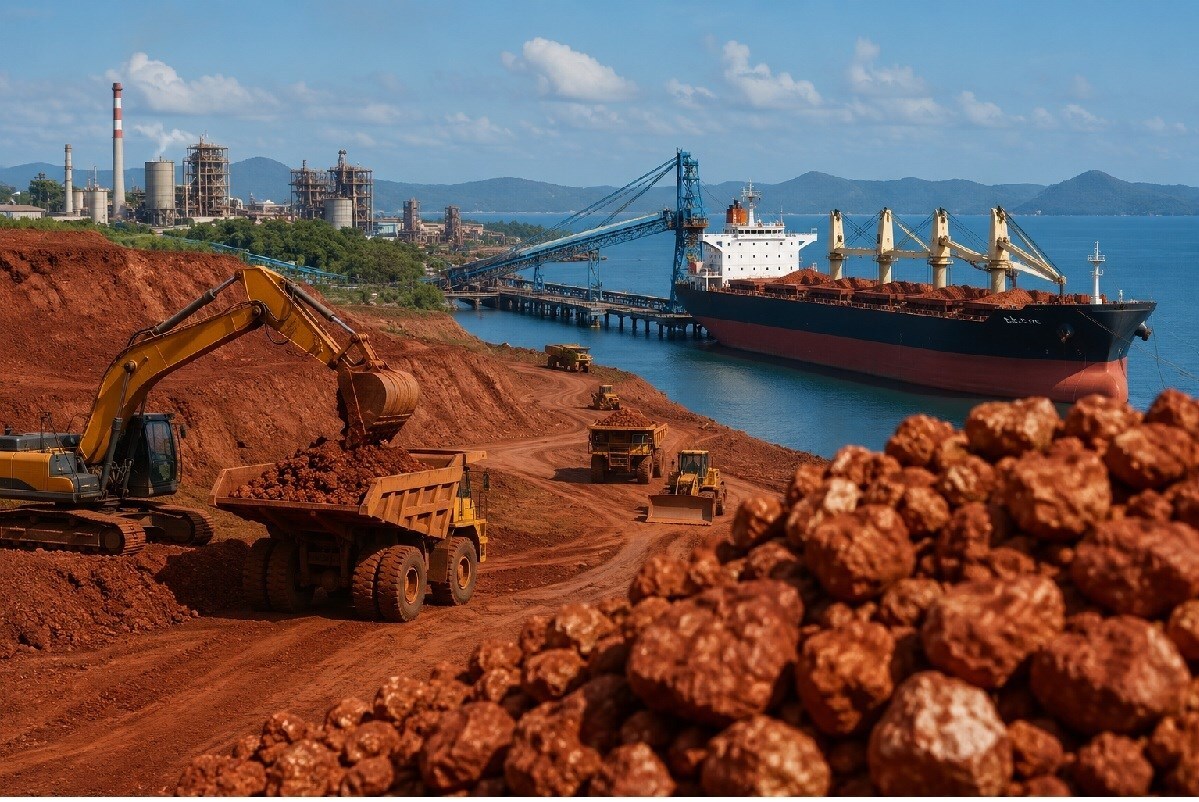
Logistics have also become a major driver of imports. Coastal refineries, particularly those operated by Vedanta Limited, can import large cargoes from Guinea, Sierra Leone and Brazil at competitive freight rates. In several cases, importing ore by sea has become cheaper than transporting domestic bauxite across India through rail networks.
India’s bauxite import graph is moving up rapidly
India’s bauxite import trajectory has changed sharply over the last few years. Imports stood at around 3.1 million tonnes in 2021 before rising to 3.8 million tonnes in 2022, reflecting growth of nearly 22.58 per cent. Volumes remained relatively high at around 3.7 million tonnes in 2023 before climbing further to 4.1 million tonnes in 2024 and nearly 4.9 million tonnes in 2025.
A closer look at the quarterly trend between 2024 and 2025 shows just how volatile and rapidly shifting the market became.
In Q1 2025, India’s bauxite imports dropped sharply to around 311,518 tonnes from nearly 1.28 million tonnes in Q1 2024, mainly due to lower shipments from Guinea. Q2 remained relatively stable, with imports standing at around 1.27 million tonnes in 2024 compared with nearly 1.26 million tonnes in 2025. Read India’s bauxite export story in H1 2025: Surging demand meets domestic roadblocks for an indepth analysis.
The real turnaround came during the second half of 2025. Q3 imports surged from around 714,595 tonnes in 2024 to nearly 1.43 million tonnes in 2025, driven by stronger shipments from Guinea and the entry of Sierra Leone into India’s import basket.
Q4 witnessed an even sharper jump. Imports climbed to nearly 1.93 million tonnes in 2025 compared with around 839,981 tonnes during the same quarter of 2024. Guinea remained the dominant supplier, while Brazil and Sierra Leone also increased shipments to India.
How different regions are supporting India’s bauxite supply
India’s rising bauxite imports are increasingly being driven by African suppliers, particularly Guinea, which has emerged as the country’s largest source of refinery-grade ore. Guinea’s high-grade bauxite, lower impurity levels and stable long-term supply agreements have made it increasingly attractive for Indian refiners as aluminium and alumina capacities continue expanding.
Shipments from Guinea rose sharply to 4.4 million tonnes in 2025 from 3.7 million tonnes in 2024, reflecting year-on-year growth of around 19.47 per cent.
At the same time, India’s import basket also began widening during 2025. Sierra Leone emerged as a new supplier, exporting 95,570 tonnes after recording no shipments in the previous year. Brazil witnessed one of the steepest increases, with exports rising to 93,920 tonnes from only 13.7 tonnes in 2024.
Meanwhile, Ghana’s exports to India declined sharply to 119,373 tonnes in 2025 from 222,187 tonnes a year earlier, while China’s shipments remained relatively stable at 108,951 tonnes compared with 111,667 tonnes in 2024. Read Global Bauxite & Alumina Market Forecast to 2036: Supply–Demand, Trade Flows & Price Outlook report for an indepth analysis.
India’s dependence on Guinea could become a risk
India’s growing reliance on Guinea is now becoming a major strategic concern for the aluminium industry. Guinea currently accounts for a dominant share of India’s imported refinery-grade bauxite, making the country increasingly critical to India’s future aluminium expansion plans.
However, Guinea is reportedly planning to cap its total bauxite exports at around 150 million tonnes annually. India currently receives around 2.4 per cent of Guinea’s total bauxite exports. If the export cap is implemented and India continues receiving a similar share, shipments from Guinea to India could potentially decline to around 3.6 million tonnes, creating an estimated supply gap of nearly 1.8 million tonnes.
That possibility may already be influencing India’s sourcing strategy. The emergence of Sierra Leone and the rapid increase in Brazilian shipments suggest Indian refiners are actively diversifying their supplier network beyond Guinea in an effort to secure long-term raw material stability.
New bauxite projects are becoming critical for future supply
Indian aluminium producers are now moving aggressively to secure future bauxite supplies as competition for refinery-grade ore intensifies.
Vedanta Limited is leading one of the country’s biggest mining-led growth plans. The company has secured the Sijimali bauxite mine, which holds around 300 million tonnes of reserves and has mining capacity of 12 MTPA. The project is expected to meet nearly 67 per cent of Vedanta’s future bauxite requirement for refinery expansion projects, while the remaining demand will come from Odisha Mining Corporation (OMC), other domestic miners and imports.
The mine forms a key part of Vedanta’s broader downstream plans. The company aims to raise alumina refinery capacity at Lanjigarh to 5 MTPA by FY26 and 6 MTPA by FY28. It is also planning a 6 MTPA refinery in Rayagada and a 3 MTPA aluminium smelter in Odisha’s Dhenkanal district. Overall investment commitments linked to these projects stand at nearly INR 2.27 lakh crore, or around USD 27 billion.
NALCO is strengthening its upstream position through the Pottangi bauxite mine, which contains reserves of around 111 million tonnes and has production capacity of 3.5 MTPA. The mine will support feedstock supply for NALCO’s additional 1 MTPA alumina refinery expansion, taking total alumina capacity to 3.1 million tonnes by the first half of 2027.
Hindalco Industries Limited is securing long-term ore supply for its upcoming 850 KTPA refinery expansion at Aditya in Odisha, expected to be commissioned in FY2027-28, through an MoU with OMC.
Pioneer Aluminium Industries Limited, operated by Anrak, continues maintaining refinery capacity of 1.5 MTPA, while United Company RUSAL is acquiring up to a 50 per cent stake in the company to strengthen its alumina and raw material supply chain.
Future ore demand could rise even further after AM Green and Mitsui & Co., Ltd. signed an MoU to jointly develop a 2 million tonne alumina refinery project.
Can India unlock its full bauxite potential?
If the current expansion plans move ahead as expected, India could add nearly 18.5 million tonnes of additional bauxite mining capacity through the Sijimali mine, OMC’s Kodingamali expansion and NALCO’s Pottangi project alone. Together, these projects could lift domestic bauxite production to around 45–50 million tonnes annually over the coming years.
India also has enough geological strength to support that growth. The country holds around 646 million tonnes of bauxite reserves, giving the aluminium sector significant long-term mining potential.
But demand is rising just as quickly. India’s smelter-grade alumina production is expected to increase sharply to around 21.8–23.8 million tonnes by 2036 as refinery capacities continue expanding. At the standard industry conversion ratio, that would require nearly 54.5–59.5 million tonnes of bauxite every year to support future alumina production.
This means that even if domestic mining expands to around 45–50 million tonnes annually, India may still need to import close to 9 million tonnes of bauxite to bridge the supply gap.
According to this, the import dependence ratio may remain largely unchanged. In 2025, India imported nearly 19.6 per cent of its total bauxite requirement. Even with higher domestic mining output in the future, import dependence could still remain close to 20 per cent. Read Global Bauxite & Alumina Market Forecast to 2036: Supply–Demand, Trade Flows & Price Outlook report for an indepth analysis.
The bigger challenge now is not reserves, but how quickly India can unlock them. Forest and environmental clearances, land acquisition disputes, tribal consent requirements and legal challenges continue to slow or delay several mining projects across the country.













_md.webp)
_md.webp)
_md.webp)







