The Indian aluminium industry has been encountering challenges in recent times, principally due to the surge in competitively priced imports from countries like China. The industry has been advocating for higher import duties to level the playing field and protect domestic producers.
But is it at all necessary? And, if so, why?
The current state of affairs
India's aluminium production has steadily increased over the years, with the country producing around 4.1 million tonnes of aluminium in FY2022-23. However, despite this growth, the industry has been struggling to compete with cheap imports. In FY2022-23, India imported around 1.4 million tonnes of aluminium, with China being the largest supplier, accounting for over 40 per cent of the total imports.
"The current import duty of 7.5 per cent is not sufficient to protect the domestic industry. We need a higher duty to make domestic production more competitive and reduce our dependence on imports," stated Aluminium Association of India Secretary General, Manoj Kumar
The impact of cheap imports
The influx of cheap imports has had a devastating impact on the domestic industry. Many aluminium smelters in India have been forced to operate at lower capacities, resulting in significant losses. According to a report by the Aluminium Association of India, the industry has been operating at around 50-60 per cent of its total capacity, resulting in a loss of around INR 10,000 crores (approximately US$1.3 billion) in revenue.
- India's aluminium production: 4.1 million tonnes (FY2022-23)
- India's aluminium imports: 1.4 million tonnes (FY2022-23)
The role of import duties
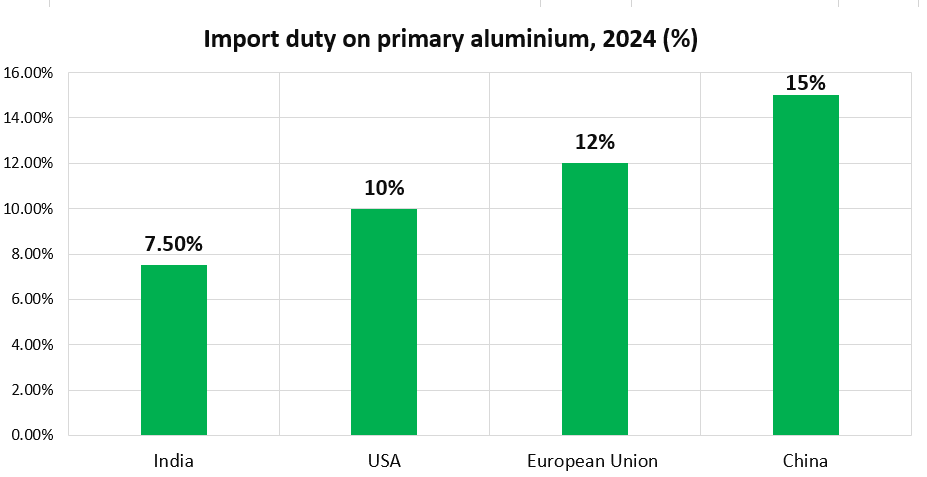
Import duties play a crucial role in protecting domestic industries from cheap imports. Currently, the import duty on aluminium in India is around 7.5 per cent. However, the industry has been demanding a higher duty of around 15-20 per cent to make domestic production more competitive.
A comparative analysis of import duties on aluminium in other countries reveals that India's duty is one of the lowest. For instance, the US has an import duty of around 10 per cent, while the EU has a duty of around 12 per cent. Even China, which is the largest supplier of aluminium to India, has an import duty of around 15 per cent.
"The Indian aluminium industry has the potential to become a major player in the global market, but it needs government support to compete with cheap imports. We hope the government will take decisive action to protect the industry," commented Satish Pai, Managing Director of Hindalco Industries, on this note.
The need for higher import duties
Given the current state of the industry, there is a strong case for higher import duties on aluminium. A higher duty would help to reduce dependence on imports by making imports more expensive. It would encourage domestic production and reduce India's dependence on imports. The increased duty would help to protect the domestic industry from cheap imports and prevent the closure of smelters. It would result in increased revenue for the government, which could be used to support the industry.
And the environmental impact of primary aluminium production also deepens the concern. While aluminium is advocated for its recyclability, the production process of primary aluminium is highly energy-intensive. A substantial share of China’s aluminium production requires coal-powered electricity, raising questions about the environmental expense of importing frugal aluminium. Thus, with the global push for sustainability attaining impetus, transnational governments might introduce carbon tariffs on aluminium imports, further knotting affairs for India.
The Indian aluminium industry is facing significant challenges due to the surge in cheap imports. A higher import duty is necessary to protect the domestic industry and make it more competitive. The government should consider increasing the import duty on aluminium to around 15-20% to support the industry and reduce India's dependence on imports.













_md.webp)