您想继续阅读英文文章还
是切换到中文?
是切换到中文?

THINK ALUMINIUM THINK AL CIRCLE

Implementing suitable technologies and processes and ensuring thorough emissions monitoring throughout the supply chain is imperative to achieving decarbonisation across any sector. This monitoring enables producers to pinpoint areas of concern and empowers buyers and investors to advocate for low-emission products.
Nicole Labutong, a Principal of Climate Intelligence at RMI, and Wenjuan Liu, a Senior Associate of Climate Intelligence at RMI, have scrutinised the monitoring practices within the aluminium sector. To meet global targets, emissions must be reduced by 77 per cent by 2050. Transitioning from coal-fired to clean energy sources stands out as a crucial step.
Founded in 1982 as Rocky Mountain Institute, RMI is an independent, non-partisan nonprofit transforming global energy systems through market-driven solutions to align with a 1.5°C future and secure a clean, prosperous, zero-carbon future for all. It works in the world’s most critical geographies and engages with businesses, policymakers, communities, and nongovernmental organisations to identify and scale energy system interventions that will cut greenhouse gas emissions by at least 50 per cent by 2030.
_0_0.png)
The near-infinite recyclability of aluminium presents a unique opportunity to reduce emissions compared to other industries. Thus, meticulous tracking of all inputs becomes paramount. Recycling rates need a significant boost; even in affluent regions like Europe, roughly 28 per cent of beverage cans still end up in landfills or incinerators. RMI has released guidance on accurately reporting the origins of emissions within the supply chain. The authors emphasise that without robust and transparent monitoring, targets hold little significance and are unlikely to be achieved.
Aluminium commits to 77 per cent emission cut by 2050
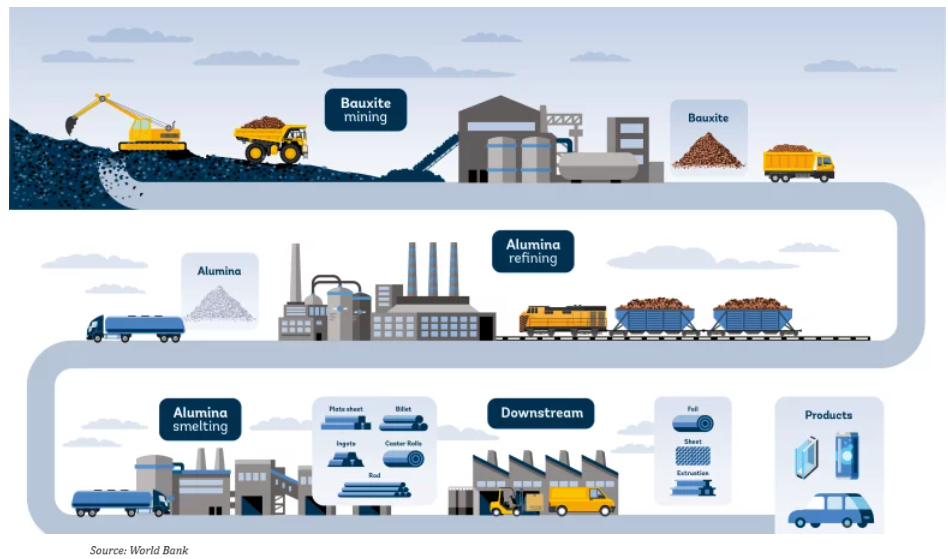
The indispensable use of aluminium across various industries, including automotive, aerospace, and renewable energy sectors, is primarily due to its lightweight and robust properties. However, this versatility comes with environmental costs. Approximately 2 per cent of global greenhouse gas emissions stem from the aluminium industry, largely attributed to the production process involving bauxite ore and coal-fired electricity.
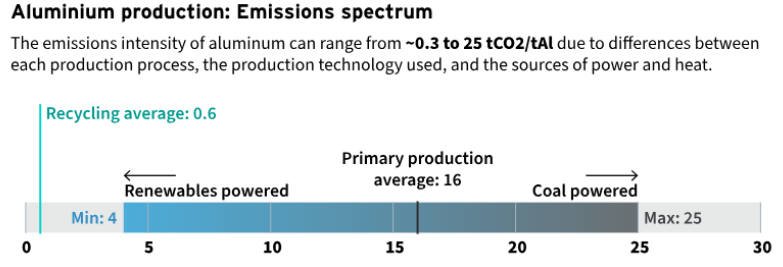
Source: RMI/Energy Post
As the world's leading aluminium producer, accounting for around 59 per cent of global output, China is particularly emissions-intensive. Given aluminium's heavy reliance on electricity, there is an opportunity to reconsider its production methods and transition towards a future powered by renewable energy sources.
There's no better time than now. The energy transition is set to significantly boost aluminium consumption by 50 to 80 per cent by 2050. However, to align with a 1.5°C pathway, emissions from aluminium production must decrease by 77 per cent.
Aluminium is infinitely recyclable
Obviously, the most climate-friendly aluminium is made from the least energy, and that's where the metal excels. However, relying solely on recycling will not decarbonize the industry, as it cannot meet the escalating demand for aluminium.
Two critical shifts are imperative for the aluminium sector to thrive in a net-zero world: transitioning aluminium production from primary raw materials to renewable sources and significantly boosting recycling rates.
RMI is actively addressing both challenges by collaborating with aluminium producers to enhance transparency in their operations and engaging financial institutions. This collective effort aims to secure the necessary financing, estimated at nearly $1 trillion, to facilitate the sector's transition to renewable energy and achieve net-zero emissions by 2050.
Diving into the details of recycling
Distinguishing between post-consumer and pre-consumer aluminium is crucial for decarbonising the aluminium sector. Post-consumer aluminium refers to used products like soda cans, while pre-consumer aluminium refers to manufacturing waste, such as the ends of aluminium sheeting on factory floors. Both are classified as scraps within the industry.
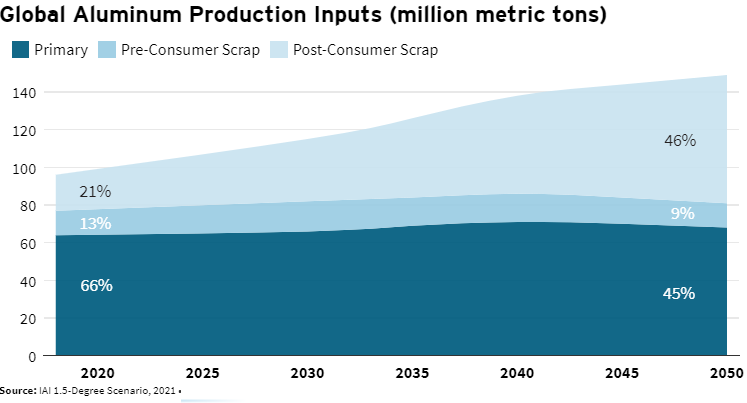
To achieve net zero emissions, the manufacturing sector must enhance efficiency, thereby reducing the unnecessary production of aluminium. Despite eventual recycling, the aim is to decrease pre-consumer scrap from 13 per cent to 9 per cent of production by 2050.
Addressing the post-consumer side presents further opportunities. A European study revealed that approximately 28 per cent of beverage cans are in landfills or incinerators. Globally, the utilisation of post-consumer scrap in aluminium production must rise from 21 per cent to 46 per cent by 2050 to align with net-zero objectives.
To promote the utilisation of more post-consumer scrap, it's essential to ascertain the percentage of end-of-life scrap in aluminium products' inputs. Currently, many producers only report the overall recycled content, rendering it challenging to discern the extent of post-consumer scrap usage. To address this, aluminium product buyers increasingly demand detailed information regarding the share of post-consumer scrap in their purchases.
Responses