H1 2026 sees more renewable energy than ever: Here’s a region-by-region guide to renewable energy supply in the recent past
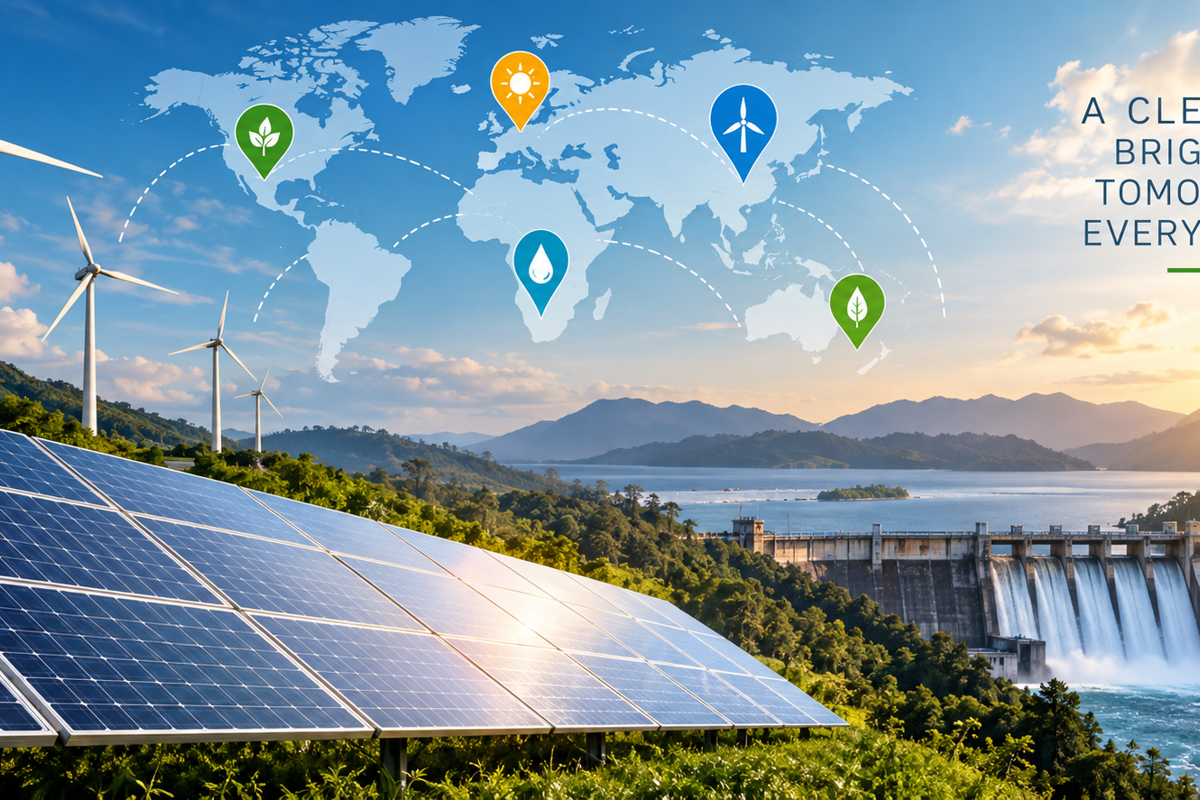
The image used in this article is generated with an AI tool and does not depict any real-time moment
In the first half of 2025, humanity generated more electricity from renewables than from coal for the first time ever. What led to it? It was possible only because of two decades of falling solar panel prices, taller wind turbines, and governments finally treating clean power like an economic opportunity instead of a favour to the planet.
But the renewable energy scenario cannot be portrayed as a single global story. To get the full picture, one has to connect dozens of regional stories moving at wildly different speeds. Some countries are already powered almost entirely by sun, wind and water. Others are still warming up. Here is a tour of how renewable energy supply looks across the world’s regions right now, and who is actually leading the charge.
The global scorecard: Renewable energy supply by the numbers
Let’s start with the big picture. Globally, renewables supplied roughly 34 per cent of the world’s electricity in 2025, generating close to 10,715 terawatt-hours. Hydropower remains the single largest contributor, followed closely by wind and solar, which are now running neck and neck and growing far faster than any other power source.
On the capacity side (meaning the actual power plants, turbines and panels installed and connected to grids) global renewable capacity reached roughly 5,149 gigawatts (GW) in 2025, a jump of 15.5 per cent in just one year. Solar power alone accounts for nearly half of that total, at about 2,392 GW, after surging more than 27 per cent year-on-year. Renewables now make up close to 92 per cent of all new power capacity added worldwide each year, which tells you where the money and the momentum are going.
Speaking of money, global investment in renewable power and fuels hit USD 623 billion in 2023 alone, spread across a record 536 GW of new capacity. And here's a fact worth repeating at dinner parties — more than 9 out of 10 new renewable power projects built today are already cheaper than building new fossil fuel plants.
To learn about the market potential of aluminium dross, explore "ALuminium Dross Processing: Generation, Recovery & Strategic Roadmap"
- Europe
Europe is where the renewable energy transition looks least like a transition and most like an accomplished fact. Several European nations are essentially running their electricity grids on sun and wind already:
-Denmark sources about 88 per cent of its electricity from renewables, with wind power alone providing 58 per cent — the payoff from more than 50 years of community-owned wind projects. Denmark is racing toward 100 per cent renewable electricity by 2030.
-Portugal is powered by more than 75 per cent renewables and has been coal-free since 2021. Its solar generation grew by an eye-watering 440 per cent between 2017 and 2024.
-Lithuania has more than doubled its renewable generation since 2018, ending its reliance on imported Russian fossil fuels in 2022 and now sitting above 60 per cent renewable.
-Germany, Europe's industrial powerhouse, generates around 45 per cent of its power from renewables and is installing more than 100,000 solar panels every single day, on its way to an 80 per cent renewable target by 2030.
-Spain gets 43 per cent of its electricity from wind and solar combined, with coal down to just 1 per cent of the mix in 2024.
-Ireland became the sixth European country to go completely coal-free in June 2025, powered increasingly by a wind sector that has grown from 117 megawatts in 2000 to more than 5 gigawatts today.
-Greece and the Netherlands are close behind, each drawing 40-50 per cent of their power from renewables, with the Netherlands aiming to quadruple its offshore wind capacity by 2032.
Regionally, Europe added roughly 77 GW of new renewable capacity in 2025 alone, with Germany contributing more than 20 GW of that growth. Europe also captured around 21 per cent of global renewable energy investment in 2023, second only to China.
- Asia-Pacific
No region moves the global renewable energy needle like Asia, and no country moves Asia like China. In 2025, China alone added more than 440 GW of new renewable capacity, which is more than the entire installed renewable capacity of most countries combined. China now generates about 3,913 terawatt-hours of renewable electricity annually, representing roughly a third of all renewable electricity produced on Earth, and it controls close to half of the world's total installed solar and wind capacity.
Yet here’s the twist. Despite that colossal output, renewables still make up only about 37 per cent of China’s own domestic electricity mix, because its total demand is so enormous. That is very different from countries where renewables dominate a smaller grid.
Elsewhere in the region:
-India produced around 501 terawatt-hours of renewable electricity in 2025, about 24 per cent of its domestic power mix, and continues to scale up solar rapidly.
-Vietnam has quietly become a renewable energy story worth watching, sourcing roughly 45 per cent of its electricity from renewable sources.
-Australia now draws 36 per cent of its main grid's power from wind and solar plus another 6 per cent from hydro. Rooftop solar is where Australia truly stands out — one in three households has panels on the roof, the highest rate anywhere in the world.
-Across Oceania as a whole, the renewable share of electricity climbed from 23 per cent a decade ago to 43 per cent today, driven largely by Australia's rapid wind and solar rollout.
3. The Americas
Latin America and the Caribbean hold the title of the world's most renewable-powered region, generating around 62 per cent of their electricity from renewables, up from 52 per cent just a decade ago. Hydropower does the heavy lifting here, supplying over 43 per cent of the region's total electricity and nearly 70 per cent of its renewable output.
-Brazil generates close to 650 terawatt-hours of renewable electricity annually, with renewables making up an impressive 86.6 per cent of its domestic power mix.
-Paraguay runs almost entirely (essentially 100 per cent) on hydropower.
-Costa Rica regularly operates on 100 per cent renewable electricity for extended stretches, thanks to a mix of hydro, geothermal and wind.
Up north, Canada generates about 417 terawatt-hours of renewable electricity, representing nearly 64 per cent of its domestic supply, largely from hydropower. The United States, despite being the world's second-largest renewable electricity producer in absolute terms (around 1,159 terawatt-hours, or 11 per cent of global renewable output), still only draws about 26 per cent of its own electricity from renewable sources — a reminder that scale and share are two very different metrics.
Unlock key insights from leading companies and experts across the aluminium ecosystem with our e-Magazine - Mine to Market: Aluminium Producers & Manufacturers 2026
- Africa and the Middle East
Africa and the Middle East together attracted only about 3.6 per cent of global renewable energy investment in 2023, evidently the clearest sign of where the world's clean energy investment gap remains widest. But growth rates here are now turning heads.
-Djibouti rocketed from near-zero renewable generation to 67 per cent in just five years, opening its first wind farm in 2023 and targeting 100 per cent renewable power by 2035.
-Mauritania has gone from less than 1 per cent renewable before 2008 to more than 50 per cent renewable today, targeting 70 per cent by 2030.
-Ethiopia already sources all of its electricity essentially from renewables, overwhelmingly hydropower.
-Africa posted its largest capacity growth on record in 2025, adding roughly 11.3 GW of new renewable capacity (up almost 16 per cent year-on-year), led by Ethiopia, South Africa and Egypt.
The 100% club: Countries already fully renewable
A small group of countries have already crossed the finish line, or come extremely close, including Iceland, Norway, Costa Rica, Nepal, Albania, Ethiopia, Bhutan, Paraguay, the Democratic Republic of Congo, Lesotho and the Central African Republic. Most rely on abundant hydropower or geothermal resources rather than wind and solar.
Iceland is the poster child: powered since the 1970s by a combination of hydropower and geothermal energy drawn from its volcanic landscape, Icelanders now pay next to nothing for electricity. Denmark and Estonia, by contrast, are chasing 100 per cent renewable status the hard way (through wind and solar) and both are targeting the milestone by 2030.
Why this matters for your power bill
Renewable energy supply is not just a climate story; it is increasingly a cost-of-living story. In Ireland, wind and solar power are estimated to have saved consumers EUR 840 million since 2000. In the United Kingdom, wind power alone saved households and businesses an estimated £104.3 billion between 2010 and 2023. In Spain, wholesale electricity prices fell by roughly 20 per cent between 2021 and 2024 as renewable generation grew by a similar margin. The pattern repeats across nearly every region: more renewable supply tends to mean downward pressure on power prices over time.
The road to 2030
At the 2023 UN Climate Change Conference, governments agreed to triple global renewable power capacity to 11,000 GW by 2030. At current rates of growth, the world is on track to reach closer to 8,000 GW, i.e., real, historic progress, but short of the target. Closing that gap will require faster grid upgrades, more energy storage (global battery storage capacity jumped 65 per cent in a single recent year), and, crucially, far more investment reaching regions like Africa, which today receive the smallest slice of renewable energy investment despite having some of the richest solar and wind resources on the planet.
Note: This is exclusive coverage by AL Circle and may not be reproduced, republished or shared without prior permission.
Adani-IHC expand Odisha investment plans to $25bn across 14 projects
Next articleScatec’s Thakadu solar project gets a $16m risk buffer by Lyra Energy, Norway
Grow with
AL Circle