For years, aluminium strength was measured in smelters and megawatts. Primary metal sat at the heart of industrial growth, and power determined who could scale and who could not. That formula is starting to lose its hold. In both China and the United States - the world’s two largest aluminium markets, the focus is shifting away from energy-intensive primary production and toward a material once treated as secondary material in literal sense: aluminium scrap.
The US has already taken a decisive step in that direction. China has been found to be increasing its secondary aluminium consumption and hence its imports to a great extent – but the question remains whether the country is shifting its focus from primary aluminium to secondary metal.
China’s aluminium consumption profile provides the first clue. The country’s primary aluminium consumption stands at around 44 million tonnes, and the secondary aluminium consumption though small but, is steadily gaining ground. China’s secondary aluminium consumption rose from 12.70 million tonnes in 2024 to 13.35 million tonnes in 2025, marking a 5.1 per cent year-on-year increase. This surge in secondary consumption has been accompanied by a marked rise in scrap usage and increase in imports.To know more about the global primary aluminium industry 2026 outlook, book the report “Global ALuminium Industry Outlook 2026."
China’s aluminium strategy has always been tightly bound to carbon limits and now it got a production caps of 45MT. Over the past few years, this pressure has led Beijing to lower barriers to scrap imports, relax quality standards, and expand recycling capacity. Under the 14th Five-Year Plan for the Circular Economy, China set an explicit target to use more than 15 million tonnes of recycled aluminium by 2027.
The build-out is already underway. A Harbor Aluminum report prepared for European Aluminium shows that China has commissioned, or is in the process of commissioning, around 22 million tonnes of secondary aluminium capacity between 2022 and 2026.
While total scrap recycling capacity is estimated at around 16.6 million tonnes, domestic scrap generation reached only about 11.77 million tonnes by 2025, up 13.8 per cent from 2020 levels, according to BIR. As a result, the gap between what the market needs and what domestic supply can provide has increasingly been filled by imports.
It is also important to note that scrap cannot be reused entirely. Coatings, oils, and alloying elements must be removed, although recovery rates still reach 95–98 per cent for clean prompt scrap and 85–92 per cent for mixed scrap, with 5–15 per cent lost as dross and residues.
How much scrap China imports - and from where?
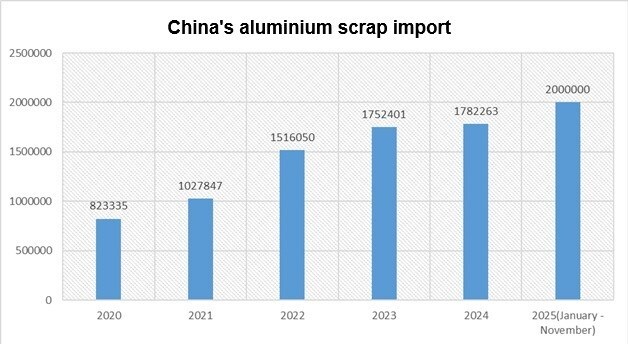
China’s import story shows a rising trend. China was bringing in 823 thousand tonnes of aluminium waste and scrap in 2020. A year later, that figure moved higher, reaching 1027 thousand tonnes. The acceleration came in 2022, when imports jumped sharply to 1516 thousand tonnes, a 47.5 per cent leap that marked a clear change in pace. Volumes continued to build in 2023, rising 15.6 per cent to 1752 thousand tonnes. In 2024, imports edged up a little by 1.7 per cent to 1782 thousand tonnes. Even so, demand did not disappear. Between January and November 2025, inflows still reached 2 million tonnes, reflecting the need to keep material moving as producers balanced output growth against emissions limits and capacity caps.
Imports remain a cornerstone of China’s scrap market. Mysteel Global noted that tight domestic availability, combined with steady demand from secondary aluminium producers, continues to support inflows.
In 2024, Thailand ranked as China’s largest supplier, shipping 298 thousand tonnes, followed by Malaysia with 210 thousand tonnes, Japan with 195 thousand tonnes, and South Korea with 35,456.24 tonnes.
The picture almost remained same in 2025. Thailand retained its leading position, lifting shipments to 437 thousand tonnes. Then comes United Kingdom, that exported 221 thousand tonnes, Japan supplied 210 thousand tonnes, the United States contributed 118 thousand tonnes, and Australia added 105 thousand tonnes over the period, underlining how China’s scrap supply chain is becoming both deeper and more diversified.
Is China beginning to mirror the US story?
In the United States, the move away from primary aluminium is no longer theoretical. It is clearly visible in consumption trends. Scrap demand stood at 3.174 million tonnes in 2024 and edged up to 3.183 million tonnes in 2025, according to AL Circle.
By mid-2025, aluminium scrap had firmly moved out of the margins. In the first half of the year alone, 1.8 million tonnes of aluminium were recovered from scrap, compared with 1.76 million tonnes over the same period a year earlier, marking a 2.3 per cent increase. Secondary metal now dominates US output, with around 85 per cent of aluminium produced using recycled scrap as the main feedstock.
The rationale is straightforward. Recycling aluminium requires only about 5 per cent of the energy needed for primary production. Analysts estimate that retaining and recycling more of the scrap currently exported could offset up to half of the U.S. aluminium supply gap. The potential savings are substantial—around 31 billion kilowatt-hours each year, roughly equal to the annual electricity consumption of three million homes. With more than 500,000 jobs already supported by the recycling industry, scrap has evolved beyond a sustainability measure into a key pillar of energy security and industrial competitiveness.
China is not yet in the same position as the United States, but it is clearly moving in the direction of greater scrap use. For now, the gap remains wide. China’s primary aluminium consumption is around 44 million tonnes, while scrap consumption stands at roughly 13.5 million tonnes, which is about 33 per cent of its primary aluminium consumption. By contrast, aluminium consumption in the United States fell by about 4.4 per cent year on year in the first half of 2025, with scrap increasingly stepping in to replace primary metal.
Matching the US model remains a long way off for China. Even so, mounting production caps and tightening environmental policies suggest the country is gradually shifting its focus toward secondary aluminium, rather than relying exclusively on primary metal.
Don’t miss out- Buyers are looking for your products on our B2B platform















_md.webp)
_md.webp)







