Over the past few years, the aluminium foil market has been moving in one direction — up—and it’s been doing very quietly, without any dramatic spikes. Back in 2018, global use of foil was around 5.3 million tonnes. By 2023, it moved up to 6.1 million tonnes. And if current projections hold, the world will be using close to 7.2 million tonnes by 2028.
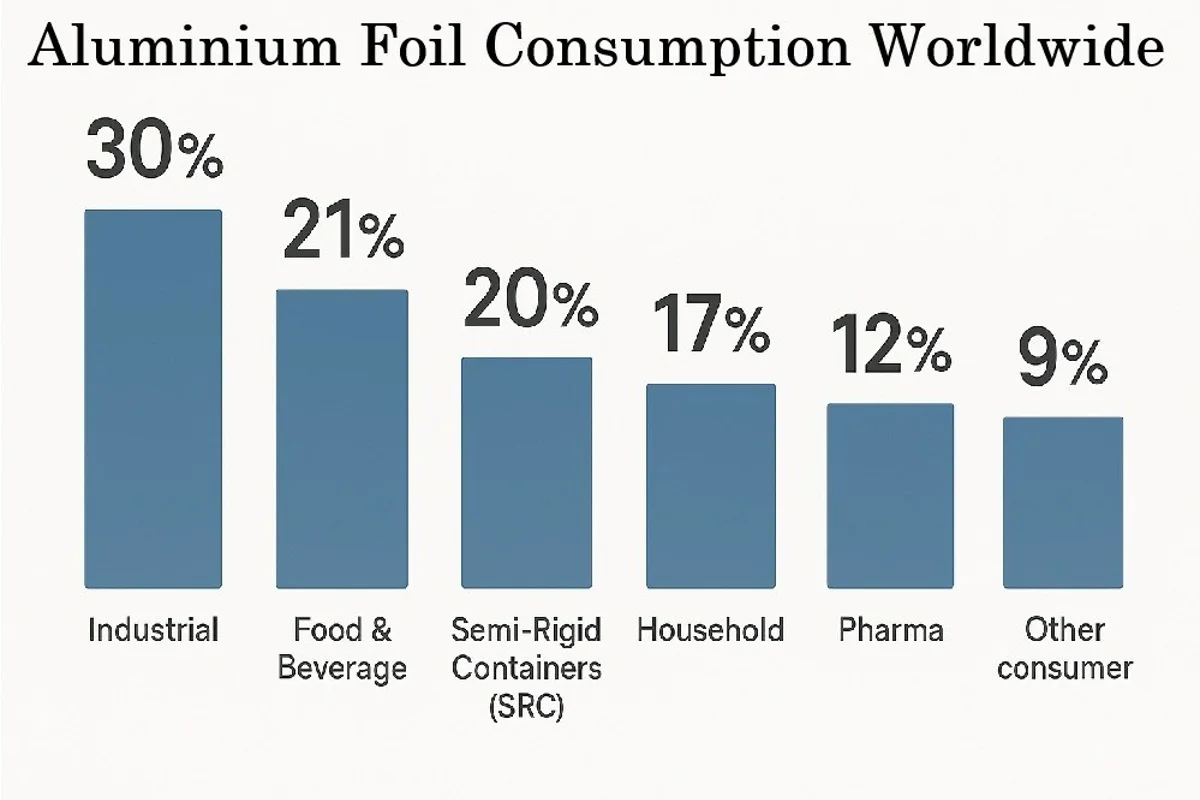
What’s curious is how familiar the consumption pattern still looks. In 2023, the industrial sector took 30 per cent of total usage, food and beverage packaging held 21 per cent, semi-rigid containers (SRC) formats accounted for 17 per cent, household foil for 13 per cent, other consumer uses for 9 per cent, and pharmaceuticals for 10 per cent.
Even by 2028, the distribution barely changes: industrial demand edges to 32 per cent, food and beverage slips to 20 per cent, SRC stays fixed at 17 per cent, pharmaceuticals hold at 10 per cent, household foil moves to 12 per cent, and the remaining consumer uses stay at 9 per cent. Aluminium foil’s long-standing appeal—its ability to shield products, its recyclability, its reliability in both harsh and everyday environments is helping to keep the proportions in place.
Industrial and consumer applications behind the numbers
The industrial side of the market, which absorbed 1.8 million tonnes in 2023, is expected to push toward 2.3 million tonnes by 2028, roughly a 4.9 per cent CAGR. Much of this material goes into heat-exchanger fins inside vehicles or HVAC systems in homes, office buildings and large industrial sites.
On the consumer side, demand reached 4.3 million tonnes in 2023, and this is projected to rise to 4.93 million tonnes by 2028, or about 2.7 per cent growth each year. Inside that, food and beverage packaging alone used 1.29 million tonnes in 2023, with growth around 2.1 per cent expected through the period. Pharmaceutical packaging consumed 626,000 tonnes, projected to rise at 3.2 per cent. SRC applications were near one million tonnes, expected to grow at about 3.1 per cent, while household foil—763,000 tonnes in 2023—is expected to increase at around 2.9 per cent. To access the exact details download: Aluminium Foil and its End Uses Current Trends and Forecast till 2028.
Every one of these segments depends on foil’s ability to preserve and protect, and it’s telling how even the fastest-growing categories still reflect the same underlying need: durability, hygiene, and longer shelf life.
In 2023, North America used around 625,000 tonnes of aluminium foil, which comes out to roughly 10 per cent of the global total. The region is expected to use about 667,000 tonnes by 2028, which implies a modest 1.3 per cent annual growth rate.
The region has a large demand, as foil is an important part of automotive sector, battery foils and electronic components. US produced around 9.7 million vehicles in 2022, while Canada added around 1.2 million. The US also had 65 GWh of installed lithium-ion battery cell capacity in 2022, with capacity still expanding. Canada has been evaluating whether to establish its own cell-production base. This graph is on a rising trajectory, so use of foil will also be on the same path.
Packaging, however, remains the largest user category in North America. Ready-to-eat meals, single-use packaging, increasing reliance on flexible packs and the growth of online grocery all play a part. The food and beverage sector alone accounted for about 25 per cent of the region’s foil usage in 2023.
Although North America has around 500,000 tonnes of annual aluminium-foil manufacturing capacity, the region remains tied to imports. The US imported 268,700 tonnes in 2023, followed by 271,700 tonnes in 2024, and by July 2025, imports had already reached around 170,000 tonnes—a pace that would push the year’s total even higher if it continued.
Combining imported material with domestic production yields close to 769,000 tonnes of supply available in 2023. Since consumption was 625,000 tonnes, the region carried a surplus of roughly 144,000 tonnes, giving producers, converters and distributors room to store, redistribute or redirect material as needed.
South America: A market outgrowing its local production
South America consumed approximately 355,000 tonnes of aluminium foil in 2023, and demand is on track to reach around 400,000 tonnes by 2028, growing at about 2.3 per cent a year. But this is a region where consumption routinely outpaces local capacity. Total production capability stands at only 230,000 tonnes, leaving a structural deficit of around 125,000 tonnes, a gap that must be covered through imports.
The region’s foil usage is concentrated in two major markets. Mexico accounted for 51 per cent of South American consumption in 2023, and Brazil contributed 31 per cent, giving the pair 82 per cent of the regional total. Food and beverage packaging is the single largest application at 33 per cent, driven by rapid urbanisation, shifting consumer habits and growing reliance on frozen, ready-meal and shelf-stable formats.
Industrial uses took up 32 per cent of South American consumption—86,000 tonnes in 2023—spread across fin stock, thermal insulation, capacitor foil, pharmaceutical packaging and electronics production.













_md.webp)








