Alumina production in Asia (including China) and Africa continued to rise in the first half of 2025, but fresh data from the International Aluminium Institute (IAI) indicates signs of cooling by mid-year. With China still dominating global output, new projects in Indonesia, India, and Africa are reshaping the supply landscape, as governments in bauxite-rich regions tighten rules to encourage local refining.
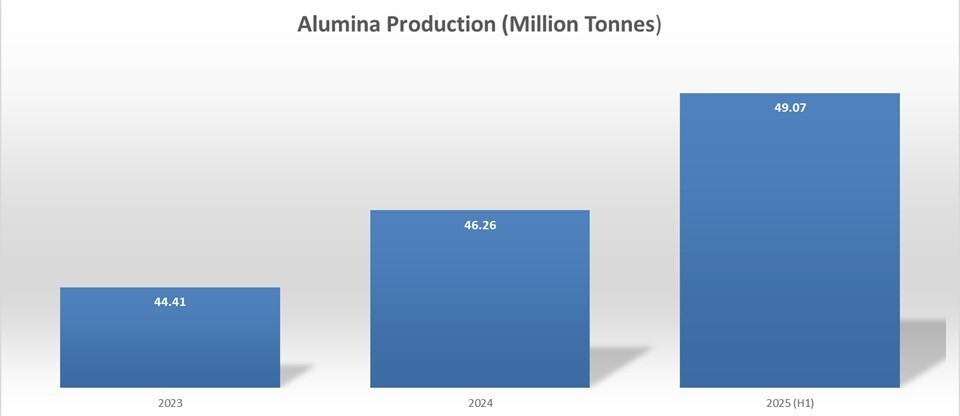
In the first half of 2025, alumina production across Asia and Africa reached 49.07 million tonnes, a 6.1 per cent increase from 46.26 million tonnes in the same period of 2024 and a 10.5 per cent rise from 44.41 million tonnes in 2023. The year began on a strong note, with output including China at 8.58 million tonnes in January, but volumes slipped to 8.03 million tonnes by June, reflecting a 6.3 per cent decline.
China accounted for most of this slowdown. Its production fell from 7.34 million tonnes in January to 6.84 million tonnes in June, a drop of 6.8 per cent. By contrast, Asia (excluding China) and Africa remained broadly stable, edging down only slightly from 1,238 thousand tonnes in January to 1.19 million tonnes in June.
In 2023, Asia (excluding China) and Africa each failed to surpass 1.2 million tonnes in any month. China, however, maintained a much higher monthly average of around 6.5 million tonnes, driving total annual output to 91,173 thousand tonnes.
Total alumina production in 2024 reached 95.382 million tonnes. In the first half of 2025, output stood at 49.070 million tonnes. Based on the average monthly production in H1 2025, full-year output is projected at around 98.140 million tonnes—up 2.89 per cent from 2024.
In the first half of 2025, alumina production showed monthly variations with notable comparisons to the respective months of 2024. January 2025 recorded production of 8.58 million tonnes, reflecting a strong increase of approximately 12.92 per cent compared to January 2024. February saw 7.76 million tonnes produced, about 7.02 per cent higher than the same month in 2024. March’s production increased by 7.09 per cent to 8.4 million tonnes, followed by April, which rose by 5.47 per cent with 8.04 million tonnes. May continued the positive trend with a 3.96 per cent increase, producing 8.24 million tonnes, while June had the smallest growth at 0.46 per cent, with 8.03 million tonnes.
Indonesia emerges as a refining hub
Indonesia is rapidly positioning itself as a key alumina refining hub in Southeast Asia, anchored by large-scale projects in West Kalimantan. PT Kalimantan Alumina Nusantara, majority-owned by Malaysia’s Press Metal Aluminium Holdings, is developing a refinery with a planned capacity of 1.2 million tonnes annually by 2027.
PT Borneo International Aluminium already produces around 1 million tonnes per year and is targeting an expansion to 2 million tonnes.
Other major developments include the Jinjiang Group’s PT Borneo Alumindo Prima, which plans to scale up to 4.5 million tonnes a year, with Phase I of 1 million tonnes already commissioned and ramping up. State-owned MIND ID is also expanding its Smelter Grade Alumina Refinery, with Phase I producing 1 million tonnes per year and Phase II expected to double capacity to 2 million tonnes by 2025–26, supported by a bauxite processing capacity of 3.3 million tonnes.
Altogether, Indonesia has around 11 alumina projects either planned or under construction, representing a combined capacity of 25.5 million tonnes, more than 60 percent of which is concentrated in West Kalimantan. This positions the country as one of the fastest-growing refining centers in Asia.
China and India drive regional output
China remains the world’s largest alumina producer. By February 2025, its metallurgical-grade alumina refining capacity had reached 105 million tonnes per year, operating at about 86 per cent utilisation. This supported a strong start to the year, though production softened by mid-2025. The country’s strategy continues to prioritise capacity expansion, efficiency improvements, and import substitution to meet surging domestic aluminium demand.
India is also playing an increasingly important role in regional supply. Alumina production in FY 2024–25 reached a record 2.42 million tonnes, up 2.1 per cent year-on-year. Though slower than previous years, the growth was supported by stable bauxite supply of about 25 million tonnes annually, along with capacity expansions from Vedanta and NALCO.
Vedanta is in the process of commissioning an additional 1.01 million tonnes per year of refining capacity, which is expected to be fully operational by early 2026. Rising aluminium demand in infrastructure and automotive, expanding at 9 to 10 per cent annually, continues to support India’s alumina growth, while government measures to encourage exports and reduce import dependence further strengthen its market position.
Africa pushes for value addition
Africa is also advancing efforts to capture more value from its abundant bauxite resources. Guinea, which hosts some of the world’s largest reserves, operates one of the continent’s biggest alumina refineries through the Guinea Alumina Corporation, with a capacity of over 3 million tonnes annually. In 2025, the Guinean government revoked Emirates Global Aluminium’s mining license after the company failed to build a promised refinery, signaling its push for stronger local value addition. Several other mining licenses were also cancelled that year for non-compliance.
Ghana is pursuing a similar path. The Ghana Integrated Aluminium Development Corporation is pushing forward with plans for multiple refineries with a combined capacity of 4 to 6 million tonnes per year, aimed at processing more of its domestic bauxite. Supporting infrastructure upgrades, including modernised mining equipment and improved rail links to Takoradi Port, are underway to back this ambition.
Currently, Africa accounts for just 4–5 per cent of global aluminium output, but with Guinea’s planned 2 million tonne refinery scheduled for 2026 and Ghana’s upcoming projects, the continent’s share could potentially double to 10–12 percent within a decade.
While signs of a slowdown emerged by mid-2025, Asia and Africa remain firmly on a growth path. Indonesia is consolidating its position as a refining hub, India is steadily expanding its capacity, and China continues to dominate the global alumina landscape. Meanwhile, Africa’s new policy direction, centered on tighter regulations and domestic refining, signals a shift toward greater participation in the global supply chain.













_md.webp)








