The first half of 2024 witnessed significant developments in the Chinese aluminium industry, reflecting a blend of challenges, strategic shifts and growth. As a result, China's economic condition also witnessed significant changes during the H1 2024, owing to reasons like the demand production gap, which in turn resulted in higher aluminium prices.
Apart from this, other specific reasons, like the ease of electricity shortage in the Yunnan province, also resulted in significant changes in the economic conditions. Another reason that brought about changes in the Chinese aluminium industry can be attributed to Rio Tinto's declaration of force majeure on alumina shipments from its Queensland refineries due to gas shortages, which in turn affected their operations, leading to supply risks which temporarily drove aluminium prices higher.
As per the International Aluminium Institute (IAI), China's aluminium production during the first half of 2024 (H1 2024) came in at 21.259 million tonnes, reflecting a Y-o-Y surge of 1.042 million tonnes from 20.217 million tonnes recorded on H1 2023.
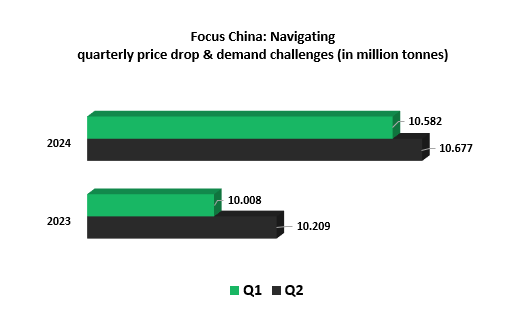
During the first quarter (Q1) of 2024, China's aluminium production stood at 10.582 million tonnes, which, when compared with Q1 2023, reflected a significant expansion of 5.74 million tonnes from 10.008 million tonnes. Similarly, the production for Q2 2024 closed at 10.677 million tonnes, showing a rise of 4.68 million tonnes from 10.209 million tonnes recorded on Q2 2023.
China's A00 aluminium ingot price settled at RMB 18,970 per tonne after dropping by RMB 40 per tonne. On M-o-M comparison, a fall of RMB 600 per tonne, or 3.06 per cent, was recorded from RMB 19,570 per tonne on December 29, 2023.
On February 2024, China's A00 aluminium ingot price hiked by RMB 70 per tonne to close at RMB 18,860 per tonne. The price showed M-o-M contraction of RMB 110 per tonne or 0.57 per cent from RMB 18,970 per tonne recorded in January.
As per the SMM analysis, the price on March 29 2024, stood at RMB 19,470 per tonne, which, compared to M-o-M, hiked by RMB 610 per tonne or 3.23 per cent. The SMM aluminium ingot price on March 29 gained RMB 140 per tonne.
Based on the SMM price graph, during April, a significant surge of RMB 1060 per tonne or 5.44 per cent was recorded M-o-M from RMB 19,470 per tonne. The price as of April 30 closed at RMB 20,530 per tonne.
On May 31 the SMM A00 aluminium ingot price had arrived at RMB 21,240 per tonne, which when compared M-o-M reflected an ascend of RMB 710 per tonne or 3.45 per cent, followed by a M-o-M decline of RMB 1090 per tonne or 5.13 per cent on June 28. The price as of June 28 stood at RMB 20,150 per tonne.
The significant surge in May
During May, the price of A00 aluminium ingot had reached its highest since the beginning of this year. As of May 30, the price had arrived at RMB 21, 710 per tonne, recording a surge of RMB 640 per tonne. One of the main reasons for the price surge can be attributed to the gas shortage-led force majeure declared by Rio Tinto on alumina shipments from its operations in Queensland, Australia. This has raised concerns about supply from the world's second-largest producer. Additionally, uncertain weather conditions in China's Yunnan province threatened the availability of hydroelectric power for aluminium producers, further exacerbating supply worries. Significant changes in aluminium stocks compounded this situation.
Overall bearish trend recorded in June-July
China has experienced a persistent decline in A00 aluminium ingot prices, driven by weak demand from downstream consumers due to the traditional off-season and a surge in production following the resumption of smelters in Yunnan province. This imbalance has created a chronic demand-supply gap, leading to an inventory increase to nearly 800,000 tonnes (July 15 to July 19)—a new high for H2 2024 and up by 243,000 tonnes year-on-year.
Since early July, the drop in aluminium ingot prices and the rise in inventory have progressed simultaneously, and this trend is anticipated to continue through the end of July, with inventory levels fluctuating between 750,000 and 850,000 tonnes.
In June, China's aluminium production saw a significant surge of 5.56 per cent Y-o-Y, reaching 3.553 million tonnes. This increase was primarily driven by the resumption of full production capacity in Yunnan, a key province in China's aluminium industry, and the partial resumption of capacity in Huayun Phase III in Inner Mongolia.
Given SMM's forecast of a rise in domestic aluminium production, the price of A00 aluminium ingot will likely remain subdued until demand aligns with the increased output. Additionally, tariffs imposed on China's aluminium are dampening global consumption, preventing prices from seeing substantial growth.
From January to June 2024, China imported a total of 1.219 million tonnes of primary aluminium, a notable increase of 151.1 per cent year-over-year. The net import volume was 1.191 million tonnes, with exports totalling 28,300 tonnes, a decrease of 50.91 per cent year-over-year.
China's import volume of primary aluminium continued to decline in June 2024 since mid-to-late April due to a closed import window over the preceding three months. Consequently, the volume of primary aluminium in transit has diminished, and port arrivals of aluminium ingots are now primarily from long-term domestic suppliers.
The alleviation of Yunnan Province's electricity shortages and high aluminium prices prompted a second round of production resumption at local smelters. As of May 9, Yunnan's annual operating capacity was about 5.15 million tonnes, having recovered by approximately 660,000 tonnes since early March and increasing by 480,000 tonnes from early April. Additionally, smelters in Xinjiang and Guangxi resumed operations after shutdowns for maintenance.
According to data from the National Bureau of Statistics (NBS), during the first half (H1 2024), the total production reached 21.55 million tonnes in China, marking a 6.9 per cent increase compared to the same period last year. This growth was driven by higher profit margins in the industry, spurred by a rise in aluminium prices. Investor optimism about the demand for light metals and increased investment in the base metals sector contributed to this price surge.
According to research firm Antaike, the combination of rising prices and reduced electricity costs enabled the industry to achieve an average profit margin of RMB 2,818 per tonne in the first half of this year, more than double the RMB 1,211 per tonne recorded a year ago. However, the increased output has led to an accumulation of inventory in China, where a prolonged property crisis and rising prices have dampened demand.
In July, the domestic social inventory of aluminium ingots showed sluggish destocking, with total inventory levels quickly surpassing 800,000 tonnes —300,000 tonnes higher year-over-year. As of August 1, 2024, SMM statistics indicated that the total social inventory of aluminium ingots stood at 814,000 tonnes, with 688,000 tonnes available for sale. This represents an increase of 24,000 tonnes week-over-week and 13,000 tonnes since July 29, marking a 289,000 tonnes year-over-year rise. Notably, major domestic consumption areas have experienced substantial inventory accumulation, leading to a temporarily pessimistic outlook for early August.
As of August 1, the domestic social inventory of aluminium billets was 129,200 tonnes, down 2,000 tonnes from the previous week and 3,300 tonnes from July 29. An SMM survey revealed that some shipments from Guangxi have been redirected to Nanchang, exerting significant pressure on the inventory and conversion margins of aluminium billets in Nanchang. The domestic aluminium billet inventory remains at a three-year high for this period, 50,300 tonnes higher year-over-year.
The domestic aluminium billet inventory is expected to remain stable in early August. With weak demand during the off-season but limited supply pressure, overall inventory will likely stay within the range of 120,000 to 150,000 tonnes throughout the month.













_md.webp)
_md.webp)
_md.webp)