Just like the US, Europe appears to be reshaping its aluminium strategy - and scrap is steadily gaining the upper hand. With recycling crossing the 50 per cent mark in 2025, the balance of the industry is shifting away from primary aluminium and moving toward secondary metal. That trend is also visible in the production numbers. Primary aluminium production across Europe, including Russia reached 6.4 million tonnes between January and November 2025. That’s only slightly higher than the 6.38 million tonnes recorded in 2024 and 6.1 million tonnes in 2023, in the same period, working out to growth of about 0.9 per cent in 2025 after a stronger 3.8 per cent growth the year before.
During 2025, output moved up in stages - 1.72 million tonnes in the first quarter, 1.74 million tonnes in the second and 1. 78 million tonnes in the third. October added 606 thousand tonnes and November 584 thousand tonnes, taking the fourth-quarter running total to 1,190 thousand tonnes.
The year before followed a similar pattern. Production rose from 1.69 million tonnes in the first quarter of 2024 to 1.71 million tonnes in the second and 1.77 million tonnes in the third, while October and November contributed a further 609 thousand tonnes and 590 thousand tonnes - bringing the partial fourth-quarter figure to 1.19 million tonnes.
In 2023, the increases were more modest, with output at 1.6 million tonnes in the first quarter, 1.67 million tonnes in the second and 1.68 million tonnes in the third, followed by 574 thousand tonnes in October and 556 thousand tonnes in November.
To know about 2026 aluminium industry trend, visit: Global Aluminium Industry Outlook 2026.
Gas prices ease - but scars from the energy shock remain
From 2023 to 2025, Europe’s aluminium industry largely moved to the rhythm of natural gas prices at the TTF hub - in stark contrast to Russia, where domestic pricing stayed far lower.
Early in 2023, TTF averaged EUR 40–50/MWh, briefly shot above EUR 100/MWh when supply tightened, and later slipped toward EUR 30 - 40/MWh as LNG cargoes arrived. Russian domestic prices remained closer to EUR 5 -10/MWh equivalent. Through 2024, TTF mostly sat between EUR 30 and EUR 45/MWh and touched EUR 46/MWh in November, while Russia held below EUR 7/MWh.
By December 2025, prices hovered around EUR 27 - 30/MWh, roughly 45 per cent lower year on year - although March briefly spiked to EUR 40/MWh. Russia stayed near EUR 6 - 8/MWh, helping keep its aluminium and alumina production steadier.
Even with the pullback, the earlier price shock had already done damage. Refinery shutdowns and smelter curtailments swept across Europe, with some facilities permanently closing or running at sharply reduced capacity between 2023 and 2025.
Closures redraw Europe’s production map
The list of disruptions is long. Speira’s Rheinwerk smelter in Germany closed down smelting in the second half of 2023 after earlier halving output, pivoting toward recycling with a EUR 30 million investment and affecting about 300 jobs.
Alcoa’s San Ciprián plant in Spain (228,000 tpy) continued with closure plans through 2023. Romania’s ALRO Slatina (283,000 tpy) had already gone offline in January 2022, followed by the Alum Tulcea alumina refinery (600,000 tpy) later that August. Slovalco in Slovakia (175,000 tpy) shut completely by September 2022.
All of this traces back to the fallout from Russia’s geo political tension with Ukraine. EU imports of Russian gas collapsed by more than 80 per cent, Nord Stream pipelines were damaged in the September 2022 explosions, and electricity prices soared. Roughly 1 million tonnes of EU primary capacity was idled - a 52 per cent loss from 2020 levels, according to European Aluminium.
Sanctions reshape trade - and scrap steps up
Sanctions then rewired trade flows. EU restrictions gradually expanded to cover a wider range of Russian aluminium products, culminating in a full primary ban in February 2025 under the 16th sanctions package. Russian metal, which accounted for 19 per cent of EU supply in 2018, slipped to 6 per cent by 2024, with roughly 1 million tonnes rerouted to Asia. Europe filled the gap by importing 6.5 million tonnes of raw aluminium in 2024, lifting imports to about half of consumption.
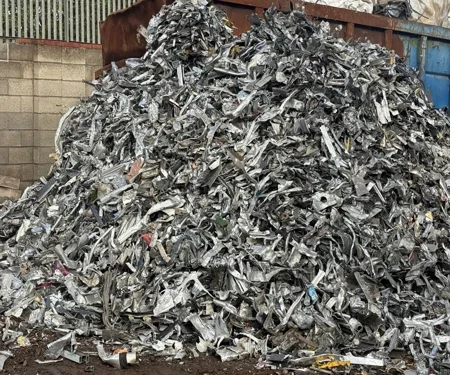
Recycling became increasingly central. By 2025, recycled aluminium accounted for 51 per cent of Europe’s total production. Switzerland and the United Kingdom remained major suppliers of scrap, shipping USD 201 million (119.487 thousand tonnes) and USD 173 million (83.833 thousand tonnes), respectively.
Policy is reinforcing this direction. Under the EU Green Deal, recycling is expected to meet at least one-quarter of critical minerals demand by 2030, supported by more than EUR 11 billion (USD 12.7 billion) invested in collection systems, sorting and circular product design. Fears of “scrap leakage” led to new export surveillance in mid-2025 and proposals for a 30 per cent export tariff by spring 2026.
Also, scrap is excluded from the Carbon Border Adjustment Mechanism (CBAM), which applies carbon costs to primary and semi-finished imports while assigning zero emissions to recycled inputs - a meaningful advantage for secondary producers.
CBAM: another hurdle for primary smelters
For primary producers, CBAM adds complexity and cost. Aluminium’s reliance on electricity and the emissions make it more vulnerable to CBAM. Producers now have to collect detailed plant-level emissions data or risk default values that may be higher. Contracts are being rewritten to decide who pays the CBAM bill, and exporters risk losing ground to low-carbon or recycled material. As EU climate rules tighten, margins shrink and investment decisions tilt toward cleaner power — or exit.
Europe did manage to stabilise production, yet the 0.9 per cent rise in 2025 fell short of the previous year’s bounce. Lower gas prices helped, but they didn’t reopen smelters that had already closed. Instead, the region leaned more heavily on imports and, increasingly, scrap.
That shift looks like permanent. Recycling now supplies more than half of Europe’s aluminium, policy is accelerating circular-use systems, and sanctions and CBAM are nudging buyers toward lower-carbon metal. Primary production remains constrained by high power costs, permitting challenges and the legacy of shutdowns. Without large-scale investment in clean energy for smelting, Europe’s recovery is likely to remain modest on the primary side - with faster growth coming from secondary metal and markets that reward low-carbon content rather than raw volume.














_md.webp)