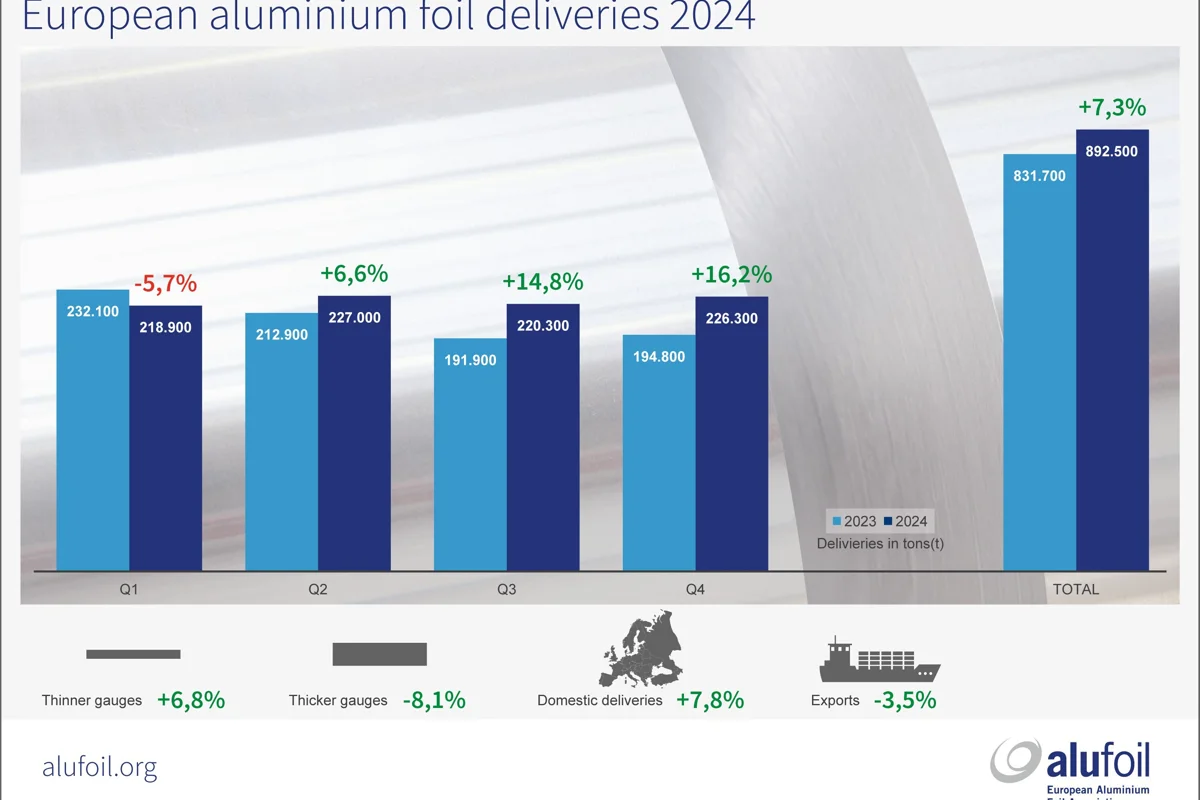
The European aluminium foil industry has staged an impressive recovery in 2024 after a tumultuous 2023, marked by weak demand and soaring inflation. According to the latest data from the European Aluminium Foil Association (EAFA), total deliveries surged to 892,500 tonnes, a robust 7.3 per cent increase from the previous year’s 831,700 tonnes. While the industry is far from the pre-pandemic heights, signs of resilience and stabilisation are evident, driven primarily by a resurgence in packaging demand.
Key factors for growth in 2024
The key driver of this resurgence has been a marked uptick in demand from the packaging sector, which helped balance the industry’s recovery. Deliveries within Europe rose by 7.8 per cent, while exports outside the EAFA region recorded a modest increase of 3.5 per cent. Notably, thicker aluminium foil (61-200µ), widely used in food containers and technical applications, experienced an impressive 9.5 per cent growth in domestic deliveries. Meanwhile, thinner foils (<60μ), primarily used for household foil and flexible packaging, rose by 6.9 per cent.
The packaging sector proved to be the catalyst for this revival, showcasing remarkable resilience amid high inflation and shifting consumer behaviour. The demand for aluminium foil used in food containers skyrocketed by 23.8 per cent, while household foil saw a more stable yet positive increase of 0.2 per cent. With consumers adapting their spending habits in response to inflation, aluminium foil has gained traction as a sustainable and cost-effective packaging solution.
Thin vs thick foil witnessed differing growth trajectories
Thin and thick aluminium foils both witnessed positive growth, albeit at different paces. Total production of thin foils increased by 6.8 per cent, largely fuelled by demand for packaging films for food and household applications. On the other hand, thicker films saw a more substantial rise of 8.1 per cent, driven by heightened demand for aluminium packaging in the food delivery industry, pet food sector, and coffee capsules market.
Despite this upward trajectory, not all sectors experienced the same recovery momentum. The market for technical applications, especially in the automotive and construction industries, remains sluggish. High construction costs and declining activity in the real estate sector have hampered the demand for thicker aluminium foils, while the automotive industry continues to grapple with subdued demand.
Industry leaders weigh in
Bruno Rea, Chairman of the EAFA Roller Group, expressed cautious optimism regarding the industry’s rebound, stating, “The significant recovery in 2024 is a positive signal for our industry. We can see that the market dynamics are improving, particularly in the packaging sector. However, the pre-crisis level has not yet been reached. We expect that it will take at least another year and continuous growth rates to return to pre-pandemic levels.”
Guido Aufdemkamp, Executive Director of EAFA, echoed similar sentiments earlier, highlighting the disparities between market segments. “While demand for packaging applications and household foil remained strong, demand for technical applications is still weak due to sluggish activity in the automotive and construction sectors. The current upward trend shows that the industry is steadily stabilising and recovering. Despite subdued economic growth in Europe and ongoing geopolitical uncertainties, we are cautiously optimistic about the final quarter and the next year.”
Quarterly trends and market uncertainty
A closer look at quarterly trends reveals a mixed picture. In Q3 2024, aluminium foil deliveries within Europe rose sharply by 15 per cent year-on-year, reaching 220,300 tonnes compared to 191,900 tonnes in the previous year. This contributed to a year-to-date total of 666,200 tonnes, up from 636,200 tonnes in 2023. However, a quarter-on-quarter analysis suggests a slight dip of 3 per cent, following a growth of 4.2 per cent in Q2. While the recovery trajectory is encouraging, intermittent slowdowns underscore the continued uncertainty within the broader economic landscape.
Challenges on the horizon
Despite the positive trends, significant challenges remain. The ongoing struggles in the automotive and construction industries continue to weigh on technical applications. High material costs, supply chain disruptions, and geopolitical factors add to the complexity of the situation. Additionally, increasing international tariff barriers pose a threat to export growth, raising concerns about whether domestic demand can sufficiently compensate for potential trade obstacles.
The industry also faces the looming question of sustainability. With regulatory pressure mounting for greener alternatives, aluminium foil manufacturers must accelerate efforts towards circularity, improved recycling rates, and energy-efficient production. The growing focus on environmental responsibility could present both challenges and opportunities for aluminium foil producers in the coming years.
Steady but cautious optimism
The European aluminium foil industry’s recovery in 2024 marks a crucial turning point, yet the journey to pre-pandemic levels is far from over. While the packaging sector continues to drive growth, weaker demand from industrial applications and external economic pressures mean that stability is not yet guaranteed.
As we move forward, much will depend on the overall economic climate, technological advancements in foil applications, and the industry’s ability to adapt to evolving consumer and regulatory demands. While 2024 has been a year of resurgence, sustained growth will require resilience, innovation, and a keen eye on global market shifts.
For a comprehensive analysis of aluminium foil usage, regional demand, and key industry segments, the industry-focused report "Aluminium Foil and Its End Uses: Current Trends and Forecast Until 2028" provides valuable insights. The report examines the evolving patterns of aluminium foil consumption worldwide and evaluates global demand, highlighting significant trends shaping the market.












_md.webp)
_md.webp)
_md.webp)