EU–India trade agreement opens a new regulatory perspective for Indian aluminium producers
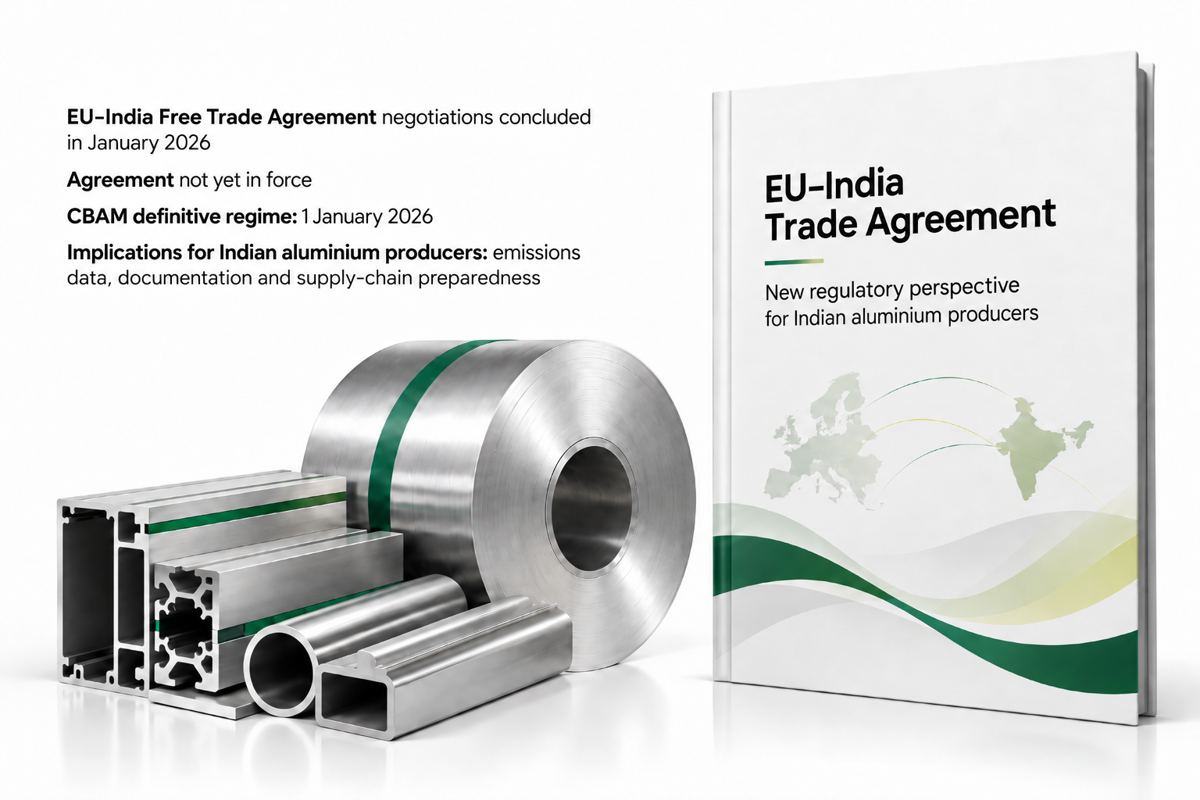
The image used in this article is generated with an AI tool and does not depict any real-time moment
The conclusion of negotiations on the EU–India Free Trade Agreement creates a new context for Indian manufacturers considering the European market, but future opportunities will increasingly depend on regulatory preparedness as well as commercial competitiveness.
Negotiations on the Free Trade Agreement were concluded in January 2026. Earlier this month, the European Commission submitted proposals to the EU Council for its signature and conclusion. The Agreement is not yet in force and remains subject to the required European and Indian procedures.
For the Indian aluminium industry, the development comes at a time when access to Europe is increasingly shaped by environmental, product and supply-chain regulation. One of the most immediate examples is the European Union’s Carbon Border Adjustment
Mechanism (CBAM), which entered its definitive regime on 1 January 2026 and covers aluminium among its principal sectors. In August, the European Commission issued updated guidance specifically addressing aluminium producers outside the EU.
According to Paolo Licandro, CEO of Brussels-based eEuropa: “For an Indian manufacturer, the question is no longer simply whether Europe offers a commercial opportunity. Companies increasingly need to ask what they should prepare today in their production processes, emissions data, documentation and supply chains in order to sell successfully in Europe tomorrow.”
Licandro spent several decades at the European Parliament, where he held senior management positions including Director and Deputy Secretary-General. eEuropa now monitors EU legislation and institutional developments for companies and organisations seeking to understand how European regulatory requirements are evolving.
The issue is particularly relevant during Aluminium Bharat 2026, organised by the Aluminium Extrusion Manufacturers Association of India (ALEMAI) in Gandhinagar from 26 to 29 September.
The event brings together the aluminium value chain, with its conference programme addressing issues including global competition, trade flows, CBAM and export opportunities.
“A trade agreement can improve the framework for market access,” Licandro added. “But companies must also be able to meet the rules that apply when their products arrive in Europe. Understanding those rules early can become part of export strategy itself.”
eEuropa believes there is scope for closer dialogue between Indian aluminium manufacturers and European regulatory specialists as companies assess the implications of the forthcoming EU–India trade framework.
Note: This article has been shared by eEuropa and has been published by AL Circle with its original information without any modifications or edits to the core subject/data.
NALCO pays record ₹11b dividend to government as Angul Aluminium Park draws investor interest
Next articleMacro headwinds combined with divergent domestic demand in China keep aluminium prices consolidating
Grow with
AL Circle