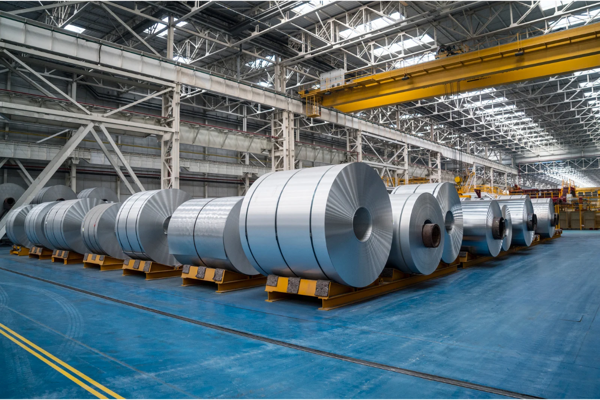
ABB has secured two orders from China’s Southwest Aluminum to supply integrated automation and digital technologies for two six-high aluminium cold rolling mills, supporting the manufacturer’s wide-strip production expansion and upgrade. The projects involve a 2,500 mm two-stand mill and a 3,000 mm single-stand mill, with both lines expected to be fully commissioned and operational by the end of 2027. Chongqing-based Southwest Aluminum is a subsidiary of the Aluminum Corporation of China (Chinalco). The orders build on the longstanding cooperation between ABB and the aluminium producer, with the latest projects focusing on process stability, control precision and production performance. Explore insights and forecasts for the aluminium flat rolled products (FRP) market from our...
India-based PG Foils Limited plans to establish a downstream aluminium manufacturing facility in Bahrain, focusing on electric vehicle (EV) battery foil and pharmaceutical foil production. The proposed investment is expected to expand the kingdom’s aluminium downstream capabilities and strengthen its manufacturing base. Bahrain’s Ministry of Industry and Commerce signed a letter of intent with PG Foils for the project. The agreement was signed by Industry and Commerce Minister Abdullah bin Adel Fakhro and PG Foils Joint Managing Director Sahil Shah during the fourth edition of the Gateway Gulf expo, which opened on November 1 in Manama. Explore: The most comprehensive and forward-looking industry-focused report – Aluminum Foil Market Report Forecast Till 2035 Hosted by the Bahrain...
Grow with
AL Circle

India, one of the major aluminium importers from the US, imported 168,000 tonnes of crude metal and alloys, aluminium semi-finished products and scrap from the US during January-October 2018, an increase of 102800 tonnes or 157.67% from 65,200 tonnes during January-October 2017. {newsStudioGallery} Total aluminium imports by India stood at 25,800 tonnes in October 2018, an increase of 16390 tonnes or 174% from 9,410 tonnes in October 2017, according to the latest Mineral Industry Survey report from US Geological Survey. On month on month comparison, total imports increased 5% from the September total of 24,600 tonnes. Semi-fabricated products (plates, sheets, bars, etc.) imports increased 264% year on year to 3,860 tonnes in the first ten months of 2018. India imported 313 tonnes of...

Braidy Industries have reported that they have spent US$15.7 million on the construction of its Braidy Atlas aluminium rolling mill in Greenup. It is working towards meeting its anticipated target of bringing the mill to full commercial operation in 2021. Braidy is banking on its proprietary Veloxint alloy, designed by Massachusetts Institute of Technology scientists for this project. These ultra-high strength metals alloys are suitable for extreme temperature uses in the automotive and aerospace industries and help in weight and cost savings. Braidy acquired Veloxint in the first quarter of 2018 and NanoAl, another leader in high strength aluminum alloys, in mid-2018. Braidy is in the process of raising US$500 million in equity capital and approximately $1.2 billion in debt capital for...

According to the latest Mineral Industry Survey report from US Geological Survey, aluminium imports by the USA for consumption stood at 5.29 million tonnes in January-October 2018, 8.79% less than 5.8 million tonnes in the same period in 2017. {newsStudioGallery} In October, the USA imported 485,000 tonnes of aluminium for consumption, from 473,000 tonnes in September 2018. Imports of crude metal and alloys and scrap dropped by 540,000 tonnes year on year and 3,000 tonnes year on year respectively during ten months period 2018. But imports of semi-fabricated products increased by 30,000 tonnes in comparison to the same period of 2017. Total crude metal and alloys and scrap imports stood at 3.53 million tonnes and 592,000 tonnes respectively during January-October 2018. Semi-fabricated...

Semi-finished aluminium export from China is creating concern among other south Asian countries as well. Vietnamese aluminium producers fear cheap aluminium products imported from China would make their domestic products un-competitive. Nguyen Hong Linh, owner of an aluminium manufacturing firm in Hanoi, said he has not been able to expand despite having the capital as he is not sure of the profitability. He said that, his company along with other aluminium manufacturers have been cutting production capacity since the beginning of 2018 as their products seem uncompetitive in front of Chinese imports. Some industry players, as shown by media reports are operating at only 30-40 per cent of capacity. Vu Van Phu, chairman of Hanoi company Fran Alumi, said that locally made aluminium has to go...
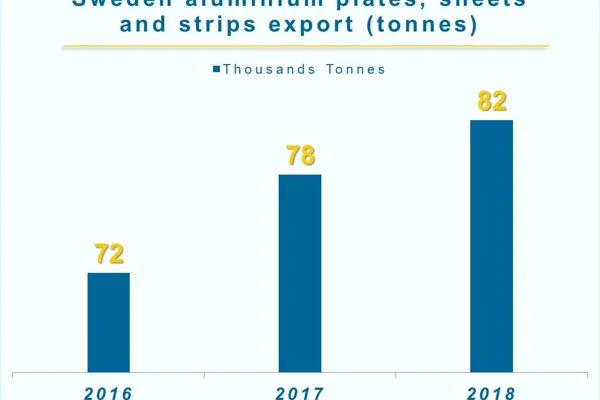
The applications of aluminium plates, sheets and strips widely range from transformers through plaster strips to silos and heavy good vehicles. Thus, the industries in need of these products include automotive, aerospace, defence and also packaging. Among many countries that ship aluminium plates, sheets and strips to the various parts of the world, Sweden is one European nation that has been logging a steady growth over a past couple of years. {newsStudioGallery} According to the international export-import data, Sweden’s estimated export volume of aluminium plates, sheets and strips were at 72,515 tonnes in 2016, which in the next year, grew to the estimated amount of 78,952 tonnes, up 9 per cent year-on-year. That’s not all, 2018 was also estimated to see a rise further in Sweden’s...

Despite the damage on business, President Donald Trump’s steel and aluminium tariffs did not have a widespread negative impact on the business in Northeast Ohio The manufacturing sector feared there would be immediate fallout of the tariffs in Northeast Ohio. They also were concerned about the impact of retaliatory tariffs from Canada, China, Mexico and the European Union on metals and other consumer goods. Business owners say tariffs have not drastically affected the bottom lines of the manufacturing or supply businesses. There have been no significant layoffs and manufacturing employment has increased by 10,600 jobs in Ohio, between November 2017 and November 2018. However, reopening of closed steel and aluminium facilities have been slower than expected. Many steel and aluminium...

The United Kingdom is a major aluminium product manufacturing hub in Europe. Automotive is the key end-user sector that generates maximum demand followed by the building and construction sector. The aerospace industry has also increased its operations in the UK, driving the requirements of aluminium extrusions and semi-finished products. {newsStudioGallery} The global trade data shows that the United Kingdom imports a significant amount of aluminium bar rods and profiles each year. However, the amount may slightly increase or decrease every year, like for instance, in 2017, the estimated import volume by the UK stood down compared to the previous year by 16 per cent. While in the year 2017, the UK’s estimated bar rods and profiles imports were at 125,948 tonnes, in 2016, they were at...

According to the China Association of Automobile Manufacturers (CAAM), in October 2018, China's export of aluminium alloy auto wheels grew 16.9 per cent from a year ago to 96,000 tonnes. On month on month comparison, the volume increased 7.5 per cent from the September volume of 89,300 tonnes. In the first eleven months of 2018, China exported 913,000 tonnes of aluminium alloy auto wheels, up 7.9 per cent from the same period last year. Concerns over tariffs across overseas buyers accounted for the rising exports from China. Shanghai Metals Market expects that the reading will continue to climb this month, and slow at the beginning of 2019.

Aluminium Secondary Manufacturers Association (ASMA) had a meeting today, on 28 December, with Suresh Prabhu, the Minister of Commerce and Industry in wake of his media statement that the ministry is in favour of hiking import duty on aluminium. The association has submitted a petition making a case against hiking import duty on aluminium. The association said that the duties will only favour the three major primary producers in India while disregarding the interest of the entire downstream sector. They insisted there has been no surge in the import of primary aluminium and hence, increasing duty on primary metal is irrelevant. The petition says that primary aluminium sector has already been given protection of 7.5% import duty and the primary metal is sold in the domestic market at a...

According to the latest Mineral Industry Survey report from US Geological Survey, domestic primary aluminium production in October 2018 was 84,000 tonnes. The average daily production in October was 2,710 tonnes, 6% more than that in September 2018, 34% more than that in October 2017. In October, exports of aluminium semi-finished products (plates, sheets, bars, etc.) by the U.S. stood at 86,600 in October 2018, down 3.2% or 2900 tonnes from October 2017 volume of 89,500. On a month on month comparison, the volume rose 13.6% from the September export volume of 76,200 tonnes. During January-October, the U.S. exports of aluminium semi-finished products stood at 883,000 tonnes, an increase of 7000 tonnes from 876,000 tonnes during January-October 2017. The U.S. exports to Canada increased...

Turkish authorities are expecting an abolition of additional tariffs on steel and aluminium imports, imposed by the U.S. in August 2018, Turkish Trade Minister Ruhsar Pekcan said this in a statement. Ankara, the capital of Turkey hopes for release from US sanctions against Iran for the import of Iranian oil for a period of 6 months, Bloomberg reported. “We expect an extension of Turkey’s exemption” from sanctions, Pekcan said in an interview with NTV in Ankara. On Friday, August 11, President Trump ordered doubling of U.S. tariffs on imported aluminium and steel from Turkey. The decision indicated the growing diplomatic spat with a NATO ally. The diplomatic row over the case of American pastor Andrew Brunson led to the doubling of tariffs by Trump. In his Tweet, Trump justified increasing...

According to the latest report from Aluminum Association, aluminium demand in the United States and Canada (measured in shipments by domestic producers plus imports) totalled an estimated 10.7 million tonnes in the period from January to October 2018, up 3.4 per cent over the same period of 2017. Demand for semi-finished or mill products totalled 7.7 million tonnes, up 3.3 per cent. Demand for semi-finished or mill products totalled an estimated 822,363 tonnes in October, up 7.8 per cent YoY. Apparent consumption from January to October (demand minus exports) in domestic markets stood an estimated 9.4 million tonnes, up 1.8 per cent from the same period of 2017. Apparent consumption in October was up 7.3 per cent YoY to 1 million tonnes. Total aluminium exports (ingot and mill products)...

Novelis says it has seen limited impact from the import tariffs on aluminium imported from other countries. Novelis, the world’s largest aluminium recycler and rolling product manufacturer, imports about one-third of its aluminium from Canada and it recovers the other two-thirds of aluminium from recycled scrap. "In the near term it wouldn't have a huge impact on the business. Unfortunately with a higher tariff that's going to mean higher prices to our customers and end consumers," said CEO Steven Fisher, during an MSNBC interview in March 2018. According to a statement made by Fiona Bell, Director, Communications & Government Affairs, North America, the company has applied for product exclusions from the Department of Commerce. "Novelis is experiencing strong demand for high-strength,...

Indian aluminium producers applaud the fact that the Indian commerce ministry is in favour of raising the import duty on aluminium to support domestic manufacturers. This could come as big support for domestic manufacturers of aluminium products as the aluminium demand India is currently very strong and a restriction on import will boost domestic aluminium consumption. Discussing the impact of import duty hike, TK Chand, CMD of National Aluminium Company (NALCO) said that primary aluminium producers are in favour of hiking the import duty. He said that the Aluminium Association needs import duty on downstream products that are being diverted from China to India after the U.S. has implemented 10 per cent import tariffs on aluminium. This increased flood of semi-finished aluminium export to...

According to Shanghai Metals Market, stocks of 6063 aluminium billet across five major consumption areas in China expanded 1,400 tonnes over the week ended on Thursday, December 27, to stand at 11,000 tonnes. Weaker demand accounted for increase in billet stocks. The below chart shows the current status of aluminium billet inventories across China: Aluminium alloys (ADC12) spot price showed restraint today since December 20 at RMB 15,000 per tonne. The price is expected to range between RMB 14,900 per tonne and RMB 15,100 per tonne. Aluminium alloy (A380) price remained unchanged at RMB 15,800 per tonne. The price of aluminium alloy (A356), on the other hand, stood at RMB 14,200 per tonne, down RMB 100 per tonne from RMB 14,300 per tonne on December 26 2018. The price is expected to range...
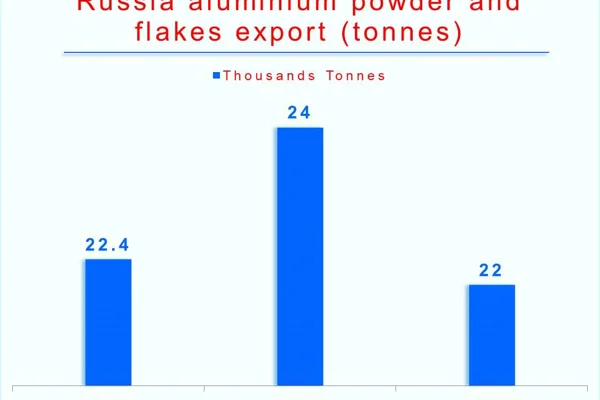
According to the global export-import data, Russia’s aluminium powder and flakes exports in 2018 is estimated to see a decline compared to the last two years. As per the data, the estimated aluminium powder and flakes exports by Russia in 2016 was at 22,413 tonnes, which in the next year (2017) grew 9 per cent to 24,413 tonnes. But after a year-on-year growth last year, Russia’s estimated aluminium powder and flakes exports this year are likely to drop to 22,026 tonnes, down 2 per cent from 2016 and 10 per cent from 2017. However, despite a fall in exports volume, the revenue out of it is likely to continue to remain steady this year. Last year in 2017, Russia’s estimated aluminium powder and flakes exports revenue were at US$ 27 million after growing from US$ 23 million in 2016. This...

According to Shanghai Metals Market, the week ended on December 20 recorded the biggest weekly decline in social aluminium billet inventories in last eight months. The inventories dropped 11,900 tonnes because of smaller arrivals and sellers destocking at the year-end. Deliveries from social warehouses, however, continued to pick up from December 24, SMM learned further. Production cuts at aluminium smelters lowered supplies of molten aluminium, which finally resulted in poor production of aluminium billet and thus, the lowered inventories. Moreover, slow deliveries of cargoes due to a shortage in transportation and logistics in Xinjiang, and high freight charges at the end of the year accounted for the limited arrivals of aluminium billet last week. This overall situation last week...

According to Shanghai Metals Market, stocks of 6063 aluminium billet across five major consumption areas in China shrank some 11,900 tonnes over the week ended on Thursday, December 20, to stand at 108,600 tonnes. The reason for this decline could be the smaller arrivals of billets to warehouses and sellers destocking at the year end. This followed after fewer purchases for building materials expanded inventories by 2,600 tonnes last week. The billet inventories in Foshan and Guangdong dropped 7,400 tonnes to stand at 61,000 tonnes while in Wuxi and Jiangsu, the inventories dipped 200 tonnes. But in Huzhou and Zhejiang, the inventory rose by 400 tonnes from 6,200 tonnes, as on December 13, to 6,600 tonnes on December 20. The below chart indicates the current status of aluminium billet...